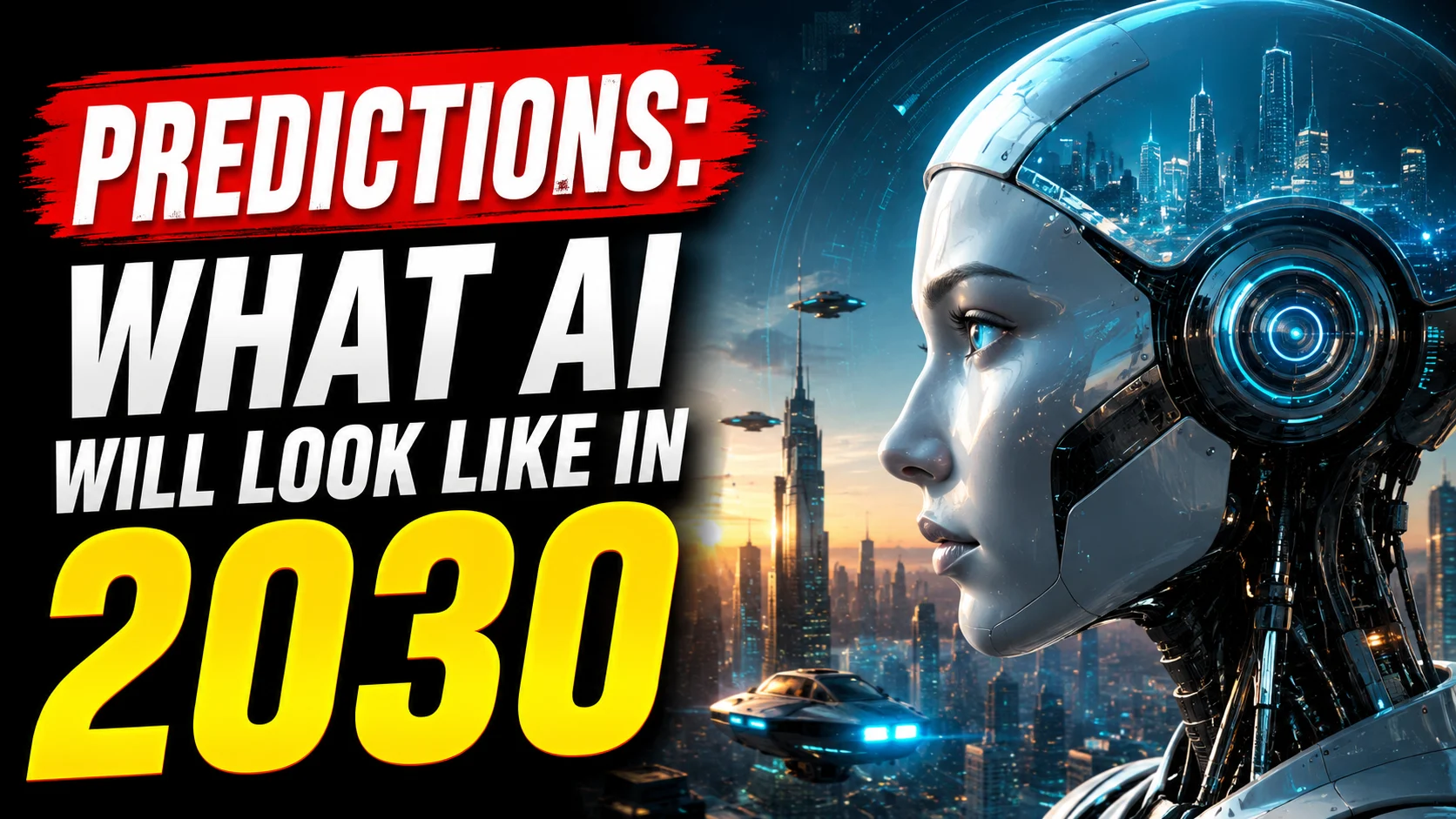
If you think the AI explosion of the mid-2020s was disruptive, buckle up. We are rapidly transitioning from an era of polite chatbots to a world powered by deeply integrated, highly autonomous digital intelligence. By 2030, the artificial intelligence landscape won’t just be a tech sector—it will be the very operating system of the global economy.
As we navigate through 2026, the hype cycle is settling into tangible, world-altering infrastructure. Drawing on current data from top-tier research firms, here are five bold artificial intelligence future predictions that will redefine how we live, work, and survive by the end of the decade.
1. The Era of Autonomous AI Agents: From Assistants to Colleagues
Right now, most of the world uses generative AI as a digital assistant—prompting it to write code, draft emails, or brainstorm ideas. By 2030, you won’t just be prompting an AI; you will be managing a digital workforce. The transition from reactive tools to proactive, autonomous AI agents is already underway.
According to a recent Gartner survey of tech executives, an estimated 25% of all enterprise IT work will be executed entirely by AI without human intervention by 2030. Furthermore, a UK Government foresight report highlights that human workers will transition into directing “teams” of autonomous agents that execute multi-step workflows. The implications are staggering: the future of work isn’t just about learning to use AI, but learning to manage synthetic employees.
2. A $1.3 Trillion Economic Engine
If the early 2020s were about venture capital speculation, 2030 will be about massive, grounded commercialization. The global AI market size—valued at roughly $224 billion in 2024—is projected to surge past the $1.33 trillion mark by the end of the decade.
What does this mean for the global economy?
- Unprecedented GDP Growth: AI is expected to contribute a net 21% increase to the US GDP alone by 2030.
- The Labor Pivot: While a McKinsey report warns that AI could displace up to 400 million workers globally, Gartner optimistically predicts that by 2028, AI will create more jobs than it destroys.
We are entering a new skills economy. Workers in highly AI-exposed roles who learn to leverage these tools will likely see significant productivity boosts, pushing real-wage growth to levels unseen in decades.
3. The Great Compute and Energy Crunch
Software may eat the world, but AI eats electricity. As we race toward 2030, the physical infrastructure supporting AI—what PwC refers to as the foundational “AI Stack”—will face unprecedented strain.
Research from Epoch AI suggests that the largest frontier models of 2030 will require 1,000 times the compute power of today’s flagship systems. The ripple effects of this computational hunger will be felt globally:
- Semiconductor Supremacy: The geopolitics of the late 2020s will be heavily dictated by who controls advanced AI chip manufacturing and supply chains.
- Energy Demand: Data centers will consume vast amounts of power, forcing tech giants to invest heavily in next-generation energy solutions—including nuclear micro-reactors and advanced renewables—simply to keep the servers running.
4. Healthcare’s Digital Biology Breakthrough
Nowhere will the impact of AI in healthcare be felt more intimately than in human longevity. By 2030, AI will have fundamentally transformed the early stages of medical research, precision medicine, and diagnostics.
We are already seeing deep learning algorithms outperforming human clinicians in specific diagnostic imaging, enabling early disease detection. Over the next few years, AI will routinely assist in mapping molecular biology and identifying novel drug candidates at a fraction of the traditional cost. However, there is a reality check: due to stringent clinical trial regulations, fully AI-discovered drugs may still struggle to reach pharmacy shelves by 2030. While the physical rollout will take time, the digital R&D pipeline is forever changed.
5. Approaching the AGI Threshold and Regulatory Reckoning
Will we achieve Artificial General Intelligence (AGI)—systems capable of performing any cognitive task a human can—by 2030? Industry insiders remain divided, but most agree we will firmly cross the “autonomous agent threshold” by 2028–2029.
As systems become more capable, they also become harder to align and evaluate. Government watchdogs warn that without strict intervention, highly capable AI could pose severe cybersecurity risks or operate outside human control. By 2030, expect to see a highly regulated global landscape. The AI market will likely be dominated by a concentrated group of tech behemoths, deeply intertwined with national security apparatuses in the US, China, and Europe.
The Takeaway
The year 2030 is no longer the distant future—it is just around the corner. The organizations and individuals who will thrive aren’t those who simply adopt AI, but those who rethink their entire operational playbook around it.
Stop treating AI as a novelty search tool. Start auditing your own “AI readiness” today. Whether you are a business leader planning your tech stack, or a professional looking to future-proof your career, the mandate is clear: learn to collaborate with autonomous agents now, or risk being outpaced by those who do. How are you adapting your skills for the AI economy?
Also Read What Is Context Window and Why Does It Matter to You?