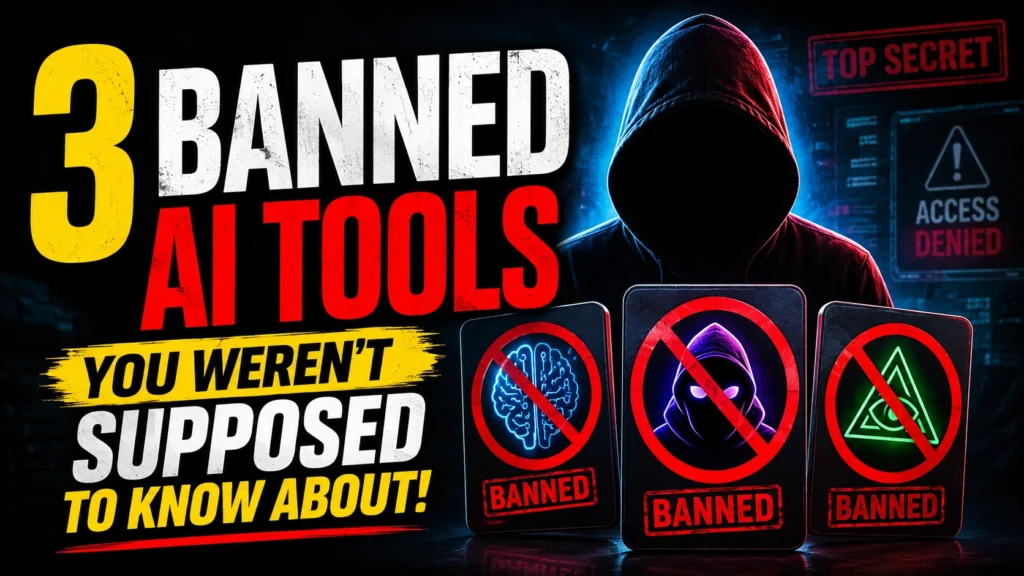
Banned AI Tools- Artificial intelligence isn’t just writing polite emails and generating colorful art—it has a dark, largely unregulated underbelly. While mainstream tools like ChatGPT and Midjourney operate under strict ethical guardrails, a shadow industry of rogue AI models has quietly thrived. These are the tools built without safety nets, designed to scrape our faces, steal our data, and violate our privacy.
Regulators, lawmakers, and tech giants have fought fiercely to scrub them from the open web, burying their existence to prevent mass misuse. Here is the factual, unvarnished look at three infamous, restricted, or outright banned AI tools you weren’t supposed to know about—and the terrifying digital realities they unleashed.
1. Clearview AI: The Death of Public Anonymity
Imagine taking a photo of a stranger on the street and instantly pulling up their name, address, family members, and social media profiles. That is exactly what Clearview AI promised.
Marketed as a revolutionary tool for law enforcement, Clearview AI scraped over 20 billion images from platforms like Facebook, Venmo, YouTube, and various public websites—all without user consent. The AI built a facial recognition database larger than anything previously known to exist.
However, the technology quickly crossed legal and ethical boundaries. In 2020, the American Civil Liberties Union (ACLU) sued Clearview for violating the Illinois Biometric Information Privacy Act (BIPA), widely considered one of the strictest data privacy laws in the United States.
After a two-year legal battle, the hammer fell.
- The Ban: Clearview AI was hit with a permanent, nationwide ban in the US, prohibiting the company from selling its facial recognition database to private businesses and individuals.
- Global Crackdown: Internationally, the tool faced massive backlash, leading to sweeping fines and bans from data protection authorities across the UK, France, Italy, and Australia.
The Verdict: “Clearview can no longer treat people’s unique biometric identifiers as an unrestricted source of profit,” noted Nathan Freed Wessler of the ACLU following the historic settlement. While law enforcement agencies in specific jurisdictions still use it in an after-the-fact capacity, its dream of commercializing total surveillance is officially dead.
2. WormGPT & FraudGPT: The Hacker’s Best Friends
If you ask ChatGPT to write a piece of malware or craft a convincing phishing email, it will outright refuse. Mainstream AI models are programmed with strict ethical guidelines. WormGPT, however, was built to bypass them entirely.
Launched in early 2023 on underground web forums, WormGPT was essentially ChatGPT’s “evil twin.” It was a maliciously fine-tuned Large Language Model (LLM) trained specifically on malware source code, exploit documentation, and social engineering scripts.
- The Threat: Historically, digital scams were easy to spot due to poor grammar and spelling. WormGPT eliminated that barrier, allowing non-native speakers to launch professional, flawless Business Email Compromise (BEC) attacks at scale. It could impersonate CEOs, generate fake invoices with company logos, and write custom Python-based malware,.
- The Ban: The tool became so notorious that it attracted immense media and law enforcement scrutiny. Consequently, even major cybercrime forums began banning the sales threads of WormGPT and its successor, FraudGPT, forcing their creators to retreat into highly encrypted, decentralized apps like Telegram.
The Verdict: While the original WormGPT project was abandoned by its creator to deflect legal liability, it proved a terrifying concept: AI-driven cybercrime is no longer a future threat—it is an accessible, plug-and-play subscription service.
3. DeepNude: The Synthetic Media Nightmare
Perhaps no AI tool has sparked as much immediate, visceral outrage as DeepNude. Launched in 2019, this desktop application used open-source machine learning to digitally—and realistically—strip the clothing off photos of women with a single click.
Unlike cybersecurity threats that target bank accounts, this was an assault on human dignity. It democratized non-consensual synthetic media, allowing anyone with a computer to weaponize AI against regular citizens.
- The Backlash: The public outcry was so intense that the app’s anonymous creator shut it down within hours, famously claiming that “the world is not yet ready.”
- The Ban: The damage, however, triggered a massive digital whack-a-mole war. Major web hosts, payment processors, and app stores instituted blanket bans on any “nudify” or synthetic media generators. Today, governments worldwide—including the US, UK, and India—are aggressively drafting and enforcing legislation to criminalize the creation and distribution of non-consensual deepfakes, effectively outlawing this category of AI.
The Verdict: DeepNude was the canary in the coal mine for digital consent, forcing society to realize that AI could be used for deeply personal harm.
The Takeaway: Innovation Outpacing Regulation
Artificial intelligence is a double-edged sword. While silicon valley giants race to build smarter, faster models, malicious actors will always lurk in the shadows, building tools stripped of morality. The bans on Clearview AI, WormGPT, and DeepNude prove that regulations and digital watchdogs can fight back—but they are almost always playing a game of catch-up.
What you can do: In an era where seeing is no longer believing, your best defense is strict digital hygiene.
- Lock down your social media profiles to prevent image scraping.
- Implement multi-factor authentication (MFA) to block AI-driven phishing attempts.
- Always verify urgent financial requests via a trusted secondary channel.
Have you ever checked what your digital footprint reveals about you? With AI scanning the web 24/7, now might be the perfect time to start.
Also Read 5 AI Resume Builders Guaranteed to Get You Past Tech Interview Filters