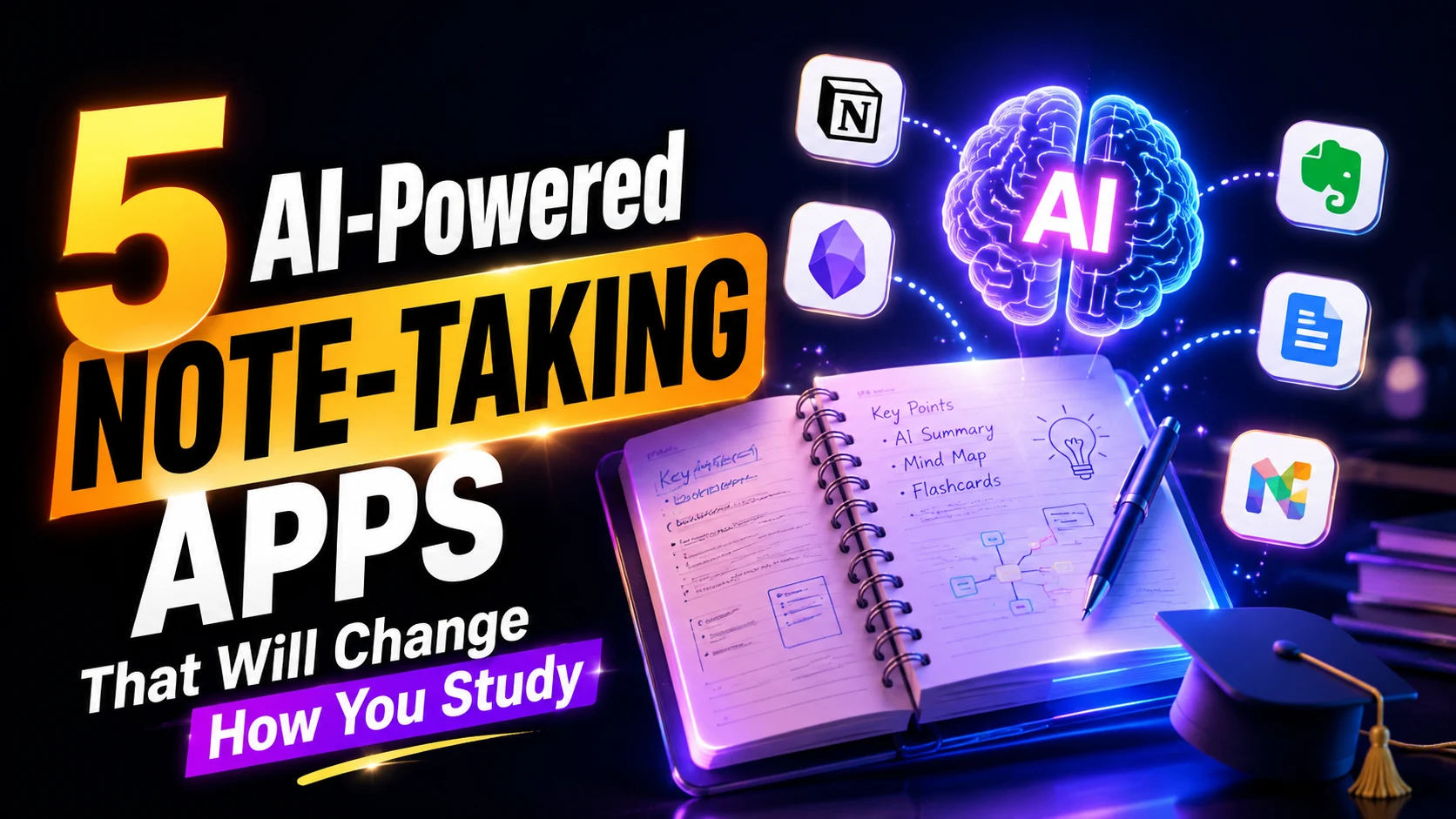
The days of frantically scribbling during lectures and losing track of scattered syllabus pages are officially over. Artificial intelligence has fundamentally re-engineered how students process information, turning passive note-taking into active, personalized learning. Whether you are synthesizing complex research papers or memorizing vocabulary for finals, these five AI-powered apps will streamline your workflow and save you hundreds of hours this semester.
According to educational productivity experts, students traditionally spend up to two hours organizing and formatting notes for every hour spent in a lecture. The latest generation of AI study tools flips this ratio entirely. By automating the busywork of transcription, formatting, and flashcard creation, these platforms allow you to dedicate your cognitive energy to what actually matters: understanding the material.
Here is a definitive look at the top five AI note-taking apps redefining academic success today.
1. Google NotebookLM: The Ultimate Research Assistant
If your coursework involves heavy reading and literature reviews, Google NotebookLM is an absolute game-changer. Unlike standard generative AI chatbots that are prone to hallucinating facts or pulling unverified data from the web, NotebookLM is a “grounded” AI. It only knows and references the exact sources you feed it.
- How it works: You upload your class materials—up to dozens of lecture PDFs, textbook chapters, or YouTube links—and the AI acts as a localized expert tutor for those specific documents.
- Standout feature:The revolutionary “Audio Overview” tool can instantly turn your dense uploaded readings into an engaging, podcast-like conversation between two AI hosts, making it perfect for auditory learners or commuting students.
- Best for: University students writing literature reviews, history majors, and anyone tackling dense academic texts.
Real-world application: Instead of re-reading a 50-page sociology PDF, you can ask NotebookLM, “What are the three main arguments the author makes against urban gentrification?” The app will provide a highly accurate answer, complete with in-text citations pointing directly to the pages in your document.
2. Notion AI: The All-in-One Semester Organizer
Notion has long been the gold standard for workspace customization, but its deeply integrated AI layer has transformed it into an indispensable academic command center. As tech reviewers often point out, Notion is much more than a note-taking tool; it functions as a task manager, a reference wiki, and a database simultaneously.
- How it works: It combines rich-text documents, task tracking, and relational databases on one fluid platform. The AI can instantly summarize long lecture notes, draft essay outlines, or reformat messy thoughts into clean, structured tables.
- Standout feature: Database-driven AI auto-fill. If you track your semester’s reading assignments in a Notion board, the AI can automatically populate a column with concise summaries of each text.
- Best for: Type-A students, project managers, and those who want their syllabus, calendar, and notes unified in a single digital ecosystem.
3. Otter.ai: The Live Lecture Transcriber
Taking detailed notes during a fast-paced lecture often means you miss out on actually processing what the professor is saying. Otter.ai acts as your personal stenographer, allowing you to maintain eye contact and focus on complex concepts.
- How it works: Otter runs on your phone or laptop to record the audio of your lecture, providing a highly accurate, real-time transcript.
- Standout feature: Post-lecture AI summaries. Once the class ends, Otter generates a structured breakdown highlighting key discussion topics, essential definitions, and any upcoming deadlines or action items mentioned by the instructor.
- Best for: Students with accessibility needs, non-native speakers, and those taking complex, fast-moving STEM classes.
4. Goodnotes: The Digital Canvas for Visual Learners
Not everyone wants to type their notes. For students who prefer the cognitive benefits and tactile sensation of handwriting, Goodnotes remains the premier choice—especially for iPad and Apple Pencil users.It offers a “write like paper, organize like digital” experience.
- How it works:It perfectly simulates the traditional notebook experience while integrating smart, under-the-hood AI tools to enhance your workflow.
- Standout feature: Handwriting refinement and AI math assistance. The app can spellcheck your handwritten text in your own handwriting style, complete complex equations, and help structure visual diagrams.
- Best for: Engineering students drawing circuit diagrams, medical students annotating anatomy slides, and spatial thinkers.
5. RemNote: The Flashcard and Retention Powerhouse
Educational psychology dictates that “spaced repetition” and “active recall” are the most effective strategies for long-term knowledge retention. RemNote is an AI note-taking platform built entirely around these scientifically backed principles.
- How it works: As you type your standard class notes, RemNote automatically parses the information and converts key concepts into digital flashcards.
- Standout feature: Its built-in spaced repetition algorithm schedules exactly when you should review specific flashcards based on how well you remember them, mathematically ensuring you never forget the material before exam day.
- Best for: Medical students, law students, language learners, and anyone facing high-stakes, memorization-heavy exams.
The Verdict: Which App Should You Choose?
Building the perfect tech stack is about matching the tool to your specific learning style and academic demands.
- Choose NotebookLM if you spend your days analyzing complex texts and need cited answers.
- Opt for Notion AI if you need a centralized dashboard to manage your entire semester.
- Download Otter.ai if you struggle to keep up with fast-talking professors.
- Invest in Goodnotes if you learn best by handwriting and sketching out concepts.
- Switch to RemNote if your degree requires brute-force memorization and daily flashcard reviews.
The Takeaway
The era of studying harder is giving way to the era of studying smarter. The most successful students today are leveraging artificial intelligence to eliminate the administrative burden of learning, freeing up their time for true comprehension and critical thinking.
Your next step: Identify your biggest academic bottleneck—whether it is keeping up with lectures, memorizing terms, or organizing research—and download the corresponding app from this list. Try it exclusively for one week, and watch how it transforms your academic performance. Embrace the technology, and give yourself the ultimate educational edge.
Also Read Free vs. Paid Tools—Which Actually Saves You Money in 2026?