Engineering school has never been for the faint of heart. But the days of pulling all-nighters to debug a single line of Python or brute-forcing a thermodynamics equation are rapidly fading. Artificial intelligence isn’t just automating busywork; it is fundamentally rewiring how future engineers learn, design, and build. If you are an engineering student relying solely on traditional search engines and energy drinks to survive, you are already falling behind.
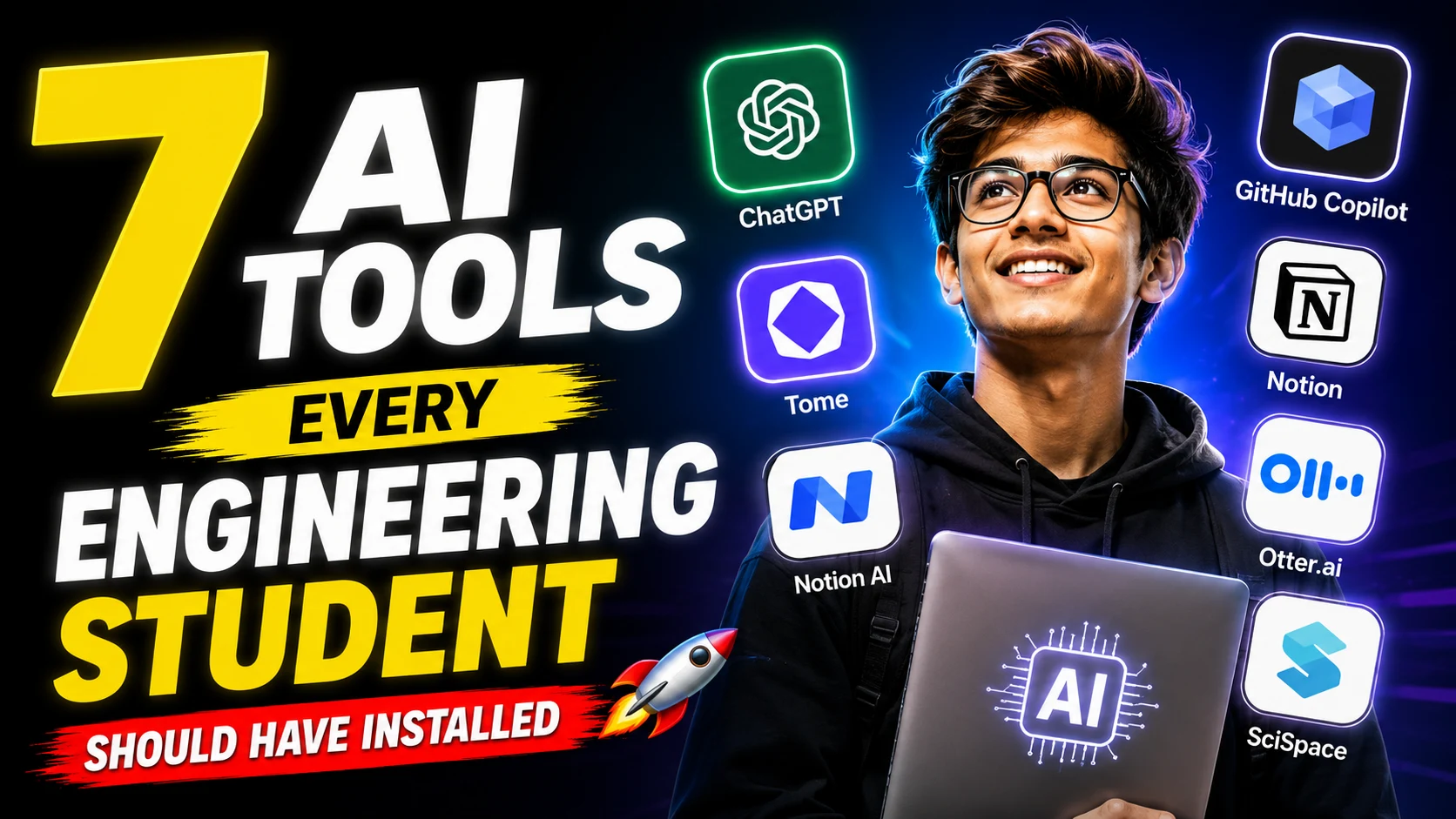
Today’s top-tier tech stack requires more than just a laptop and a scientific calculator. To stay competitive, master concepts faster, and reclaim your free time, here are seven essential AI tools every engineering student should have installed in 2026.
1. GitHub Copilot: The Coding Companion
Whether you are majoring in Computer Science or building embedded systems for a mechanical engineering project, coding is now a universal language. GitHub Copilot acts as an AI pair programmer, instantly suggesting code snippets, completing repetitive functions, and identifying syntax errors in real-time.
- Why you need it:It dramatically cuts down the time spent staring at a blinking cursor and works seamlessly with popular languages like Python, C++, Java, and SQL.
- Pro Tip:Copilot is entirely free for verified students through the GitHub Student Developer Pack.
2. Perplexity AI: The Research Heavyweight
When writing a literature review or researching advanced materials for a capstone project, standard AI chatbots can confidently hallucinate fake academic papers. Perplexity AI solves this by functioning as a conversational search engine that cites real, verifiable sources for every claim it makes.
- Why you need it: It reads the live web and footnotes its answers. You get instant summaries of complex topics with direct links to the original research, making fact-checking effortless.
- Best for:Conducting technical research, finding recent industry examples, and compiling accurate bibliographies.
3. Google NotebookLM: The Personalized AI Tutor
Imagine uploading an entire semester’s worth of dense PDFs, lecture slides, and personal notes into a private vault, and then having an AI instantly connect the dots. Google’s NotebookLM does exactly that.
- Why you need it:Unlike generic chatbots that pull from the open web, NotebookLM only generates answers based on the specific documents you upload.
- Standout feature: It can generate custom study guides, FAQs, and even turn your notes into an engaging two-person audio podcast, allowing you to “listen” to your coursework on your commute.
4. WolframAlpha: The Computational Powerhouse
While large language models often struggle with complex mathematics, WolframAlpha remains the undisputed king of computational knowledge. Enhanced with AI capabilities, it doesn’t just give you the final answer—it shows you the step-by-step logic required to get there.
- Why you need it:It handles calculus, differential equations, fluid dynamics, and statistical modeling with flawless accuracy.
- Real-world use: When you are stuck on a brutal physics problem set at 2 AM, WolframAlpha breaks down the exact methodology needed to reach the solution.
5. Autodesk Fusion AI: The Generative Design Pioneer
For mechanical, civil, and aerospace engineering students, AI is revolutionizing 3D modeling. Autodesk Fusion integrates generative design AI, allowing you to input strict constraints—like weight limits, materials, and manufacturing methods—while the software automatically generates dozens of optimized design alternatives.
- Why you need it: It teaches you to think beyond traditional geometry. The AI rapidly iterates structural solutions that are lighter and stronger than what a human might initially consider.
- Pro Tip: Autodesk offers free educational access to students, bringing enterprise-grade simulation right to your personal laptop.
6. Otter.ai: The Lecture Lifesaver
Engineering professors are notorious for flying through incredibly complex concepts at lightning speed. Otter.ai records and transcribes lectures in real-time, using AI to highlight key terms and automatically capture searchable notes.
- Why you need it: It frees you from frantically scribbling. You can actively listen and participate in class, knowing every technical term and explanation is being accurately documented for exam season.
7. Grammarly: The Technical Writing Polisher
Engineers are often stereotyped as poor writers, but communicating your ideas is just as important as building them. Whether you are drafting a 20-page lab report, a project proposal, or a crucial email to a recruiter, Grammarly’s AI ensures your technical writing is clear, concise, and highly professional.
- Why you need it: It goes far beyond basic spellcheck. It offers tone adjustments, rewrites clunky paragraphs, and helps make dense technical jargon readable for a general audience.
The Final Takeaway
The modern engineering industry doesn’t just reward hard work; it rewards efficiency. By integrating these AI tools into your daily workflow, you aren’t “cheating” the system—you are learning to manage and leverage the exact technologies that top-tier firms use today.
Ready to upgrade your workflow? Don’t wait until midterms to overhaul your study habits. Pick two tools from this list—like GitHub Copilot for your next coding assignment or NotebookLM for your lecture notes—and install them today.
Also Read Free vs. Paid Tools—Which Actually Saves You Money in 2026?