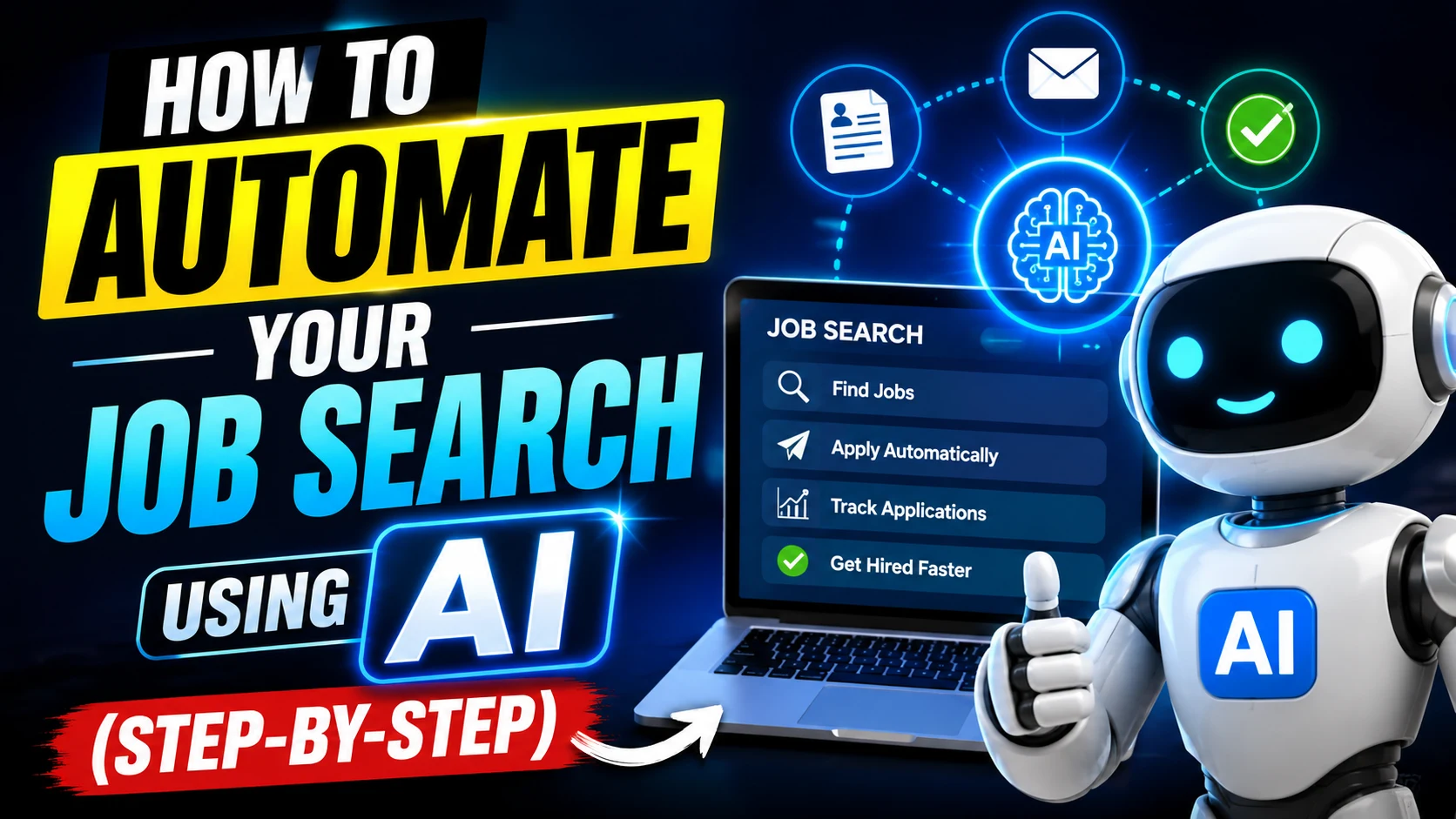
The modern job hunt is exhausting, with the average search now dragging on for up to six months—a full month longer than the peak hiring days of early 2023. But while you are manually tweaking your resume for the fiftieth time, your competition is letting algorithms do the heavy lifting. According to recent data from the Society for Human Resource Management (SHRM), a staggering 40% to 80% of job applicants are now using artificial intelligence to write resumes, draft cover letters, and prep for interviews.
If you are not automating your job search, you are operating at a massive disadvantage. The corporate world has already adapted; today, 69% of companies use AI somewhere in their talent acquisition pipeline, predominantly for screening resumes and candidate communication. To beat the bots, you have to use the bots.
Here is a step-by-step journalistic guide to leveraging AI tools to automate your job search safely, effectively, and intelligently.
Step 1: Let AI Find the Right Roles (Smart Discovery)
Gone are the days of spending hours scrolling through generic job boards. AI-powered matching tools now act as personalized career brokers, surfacing roles that actually fit your background.
Instead of mass-applying blindly, use platforms that understand context. LinkedIn’s recently updated AI matching algorithm now infers “skill adjacencies”—meaning if you list Python and Pandas on your profile, the platform will surface data science roles even if your past job titles do not perfectly match. For a more dedicated approach, platforms like JobRight AI analyze your profile to recommend roles with deep compatibility insights, allowing you to discover the right fit without the risk of spamming employers.
Step 2: Beat the ATS with AI-Optimized Resumes
When you hit “submit,” your resume is almost always fed into an Applicant Tracking System (ATS). These automated gatekeepers historically filter out roughly 75% of candidates before a human ever sees their application.
To survive the initial screening, your resume must speak the ATS’s language.
- Rezi: This AI-powered resume builder uses keyword targeting to align your document with specific job descriptions, ensuring you hit the critical formatting and keyword benchmarks required to pass ATS screenings.
- Teal: Teal’s Chrome extension offers an incredible “keyword gap analysis.” By saving a job description directly from a site, Teal compares your current resume against the specific role, flagging the exact keywords you are missing and suggesting where to incorporate them naturally.
Pro Tip: Create 1 to 3 core AI-written resumes tailored to your broad target roles, then prioritize application speed over chasing a 100% keyword match on every single submission.
Step 3: Draft Cover Letters That Actually Sound Human
Writing a cover letter from scratch for every application is a massive drain on your time. AI can generate a first draft in seconds, but the secret is in the prompting and the editing.
Tools like Final Round AI feature cover letter generators that craft compelling introductions meant to overcome writer’s block. However, recruiters can easily spot raw, unedited ChatGPT output. Use AI to handle the structural scaffolding—the opening hook, the alignment of three key qualifications, and the closing—but spend your saved time injecting specific, real-world examples and impact statistics that reflect your genuine voice. AI is your ghostwriter, not your replacement.
Step 4: Automate the Tracking and Application Process
Applying to dozens of jobs quickly leads to scattered spreadsheets, missed follow-ups, and duplicate applications. Automation brings order to the chaos.
Platforms like Teal HQ act as a centralized hub, replacing manual tracking with an intuitive dashboard that monitors all your applications in one place. Furthermore, if you want to scale your outreach, tools like Careerflow act as an “AI career autopilot.” Careerflow not only helps optimize your LinkedIn profile for up to 2.5x more visibility, but it also features an auto-apply tool that can fill out tedious job applications across various platforms automatically.
Step 5: Master the Interview with Predictive AI
Getting the interview is only half the battle. AI is now revolutionizing how candidates prepare for the actual conversation.
Rather than memorizing generic answers, use AI to anticipate the room. Crystal is a fascinating tool that uses behavioral analytics to predict an interviewer’s communication style. It provides pre-interview insights, allowing you to tailor your tone and responses to the person sitting across the table. Additionally, feeding a job description into a platform like Perplexity AI or ChatGPT and asking it to generate 10 role-specific behavioral questions gives you a targeted, hyper-relevant mock interview experience.
The Bottom Line: Be the Pilot, Not the Passenger
It is natural to feel hesitant about letting algorithms steer your career. In fact, only 26% of applicants say they trust AI to evaluate them fairly. But automating your job search is not about fabricating your experience; it is about scaling your genuine qualifications so you can compete in a saturated market.
Your Next Step: Pick just one bottleneck in your current job hunt—whether it is resume tailoring or interview prep—and test a tool like Teal or Perplexity AI this week. Let the automation handle the repetitive labor, so you can save your energy for what actually lands the job: human connection and relationship building.