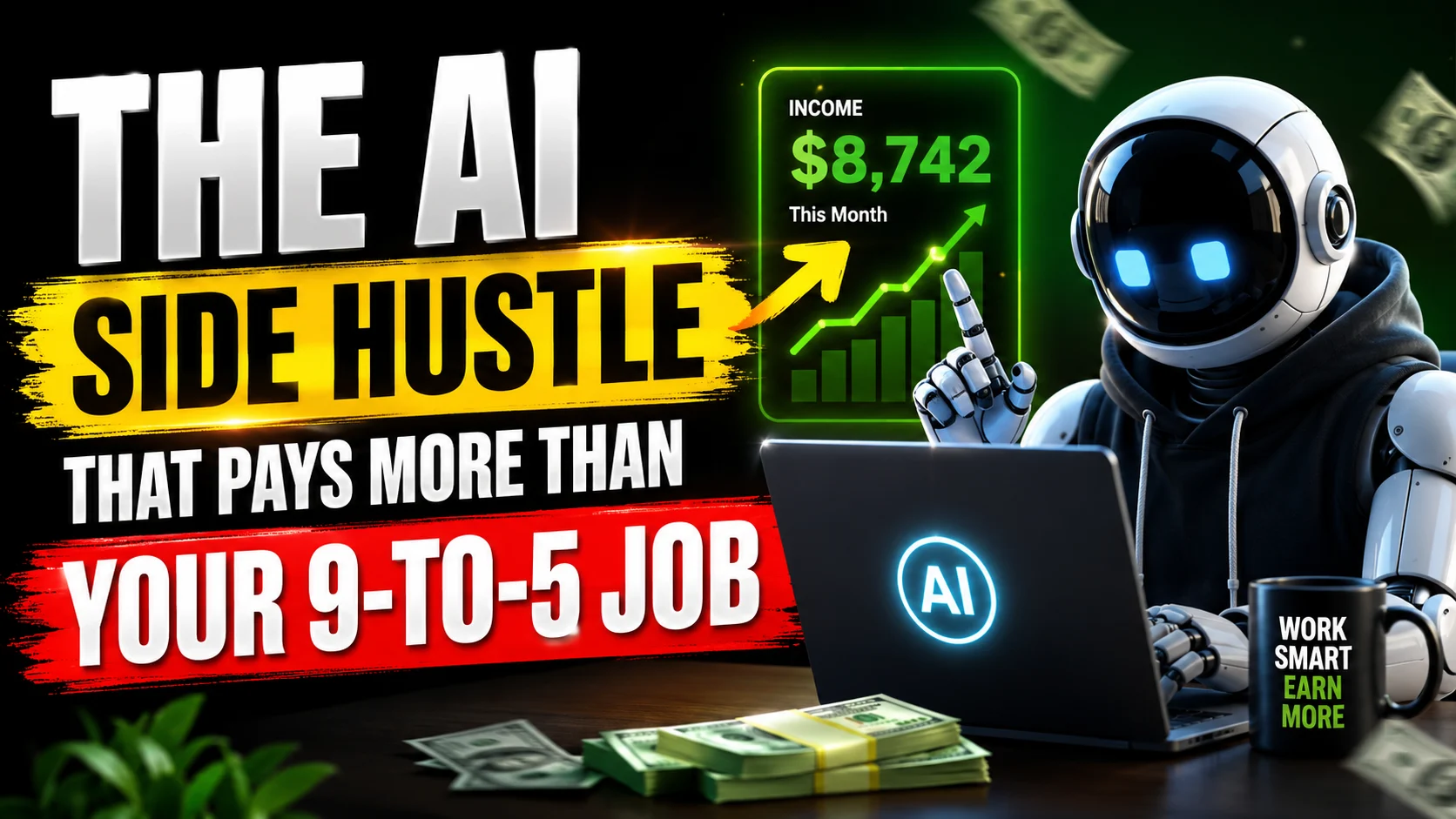
Artificial intelligence is creating a new kind of side hustle: using AI tools to deliver services that businesses already pay for, but doing the work faster, at greater scale or with capabilities that were previously expensive.
That does not mean anyone who opens an AI chatbot can suddenly replace a full-time salary. The more interesting opportunity is for people who combine AI with an existing skill — such as software development, marketing, video editing, research, data analysis or business operations — and sell the resulting service to clients.
Recent freelance-market data suggests that this distinction matters. Upwork’s 2026 research found that freelancers performing AI-related work earned 34% more per hour, on average, than freelancers who did not incorporate AI. But the same research found that lower-complexity AI execution work was becoming less lucrative as competition increased.
The emerging opportunity, therefore, is not simply “make money with AI.” It is use AI to solve a valuable business problem and charge for the outcome.
What is the AI side hustle?
The most viable AI side hustle is essentially an AI-assisted freelance service.
A person takes an existing professional skill, adds AI tools and automation, and packages the result for businesses.
Examples include:
- Building AI-powered customer-support workflows
- Creating and editing short-form video at scale
- Automating repetitive marketing tasks
- Developing AI agents for internal business processes
- Analysing large datasets and producing reports
- Building websites or software with AI-assisted development
- Fact-checking and improving AI-generated content
- Creating automated research or lead-generation systems
This is already visible on major freelance marketplaces.
Fiverr reported in June 2026 that searches for Claude Code specialists had increased 938% over the previous six months. Searches for n8n AI automation rose 125%, while searches related to AI voice agents increased 49%.
Those numbers do not mean every freelancer offering these services is making a high income. They show something more useful: businesses are looking for people who can turn AI capabilities into working systems.
Why businesses are paying freelancers for AI work
Companies do not necessarily need another employee every time they encounter a new technology problem.
A small business might need an automated lead-follow-up system but have no reason to hire a full-time automation engineer. A creator may need 30 short videos a month but cannot afford a large production team. A startup may need an AI-powered prototype without immediately building an entire engineering department.
Freelancers can fill those gaps.
Upwork’s 2026 research found that 77% of business leaders surveyed said AI was increasing their need for fractional talent with specialised skills.
The broader labour market is moving in the same direction. The World Economic Forum’s Future of Jobs Report 2025, based on more than 1,000 employers representing over 14 million workers, identified AI and big data as the fastest-growing skills through 2030. At the same time, it said creative thinking, analytical thinking, resilience and adaptability remain important.
That combination is important.
AI knowledge alone is becoming easier to obtain. AI plus useful domain expertise is harder to replace.
The highest-value opportunity is not generating content
One of the biggest misconceptions about AI side hustles is that the easiest AI output is necessarily the most profitable.
The latest Upwork data suggests the opposite.
In 2026, generative-AI and creative-production work on the platform saw a 90% year-over-year increase in contract starts, but earnings per contract fell 13%. Overall, AI-based execution tasks saw earnings decline 28% year over year.
In other words, more people are selling basic AI-generated outputs — text, images and videos — and that can push prices down.
Higher-value work is behaving differently.
Upwork reported that AI-augmented professional services grew 72% year over year, while earnings in that category increased 22%. Freelancers doing more complex work with AI saw earnings rise 45%.
That points toward a practical rule:
Do not sell “AI-generated content.” Sell the business result that AI helps you produce.
A social-media freelancer, for example, is competing in a crowded market if the offer is simply “I will generate 20 AI posts.”
A stronger proposition could be: “I will build and manage a monthly content system that researches topics, creates drafts, produces short videos, schedules posts and reports performance.”
The second service requires judgement, workflow design and accountability — not merely access to an AI model.
What can realistically earn more than a salary?
There is no reliable income figure that applies to everyone.
A freelancer earning a premium hourly rate is not automatically earning more than a full-time employee. Freelancers have unpaid sales time, inconsistent workloads, taxes, software costs and periods without clients.
So the claim that an AI side hustle will beat a 9-to-5 should be treated cautiously.
But the economics can work when the service is specialised and repeatable.
Consider the difference between these two models:
Low-value model:
Generate 100 social-media captions for a client.
Higher-value model:
Build an AI-assisted content operation that handles research, scripting, editing, publishing and reporting for a business every month.
The first is easily compared on price.
The second is closer to a business service.
That distinction is increasingly important as AI reduces the cost of producing basic digital work.
The AI freelancer is becoming an “orchestrator”
The emerging freelancer is less likely to be someone who simply knows how to write prompts and more likely to be someone who can coordinate several tools, verify their output and connect them to a client’s workflow.
Upwork’s 2026 research describes this emerging role as an “AI orchestrator”: someone combining AI fluency with domain expertise, judgement, workflow design and business impact.
For example, a marketing specialist could use AI for research and first drafts while personally handling positioning and quality control.
A developer could use AI coding tools to accelerate development while remaining responsible for architecture, testing and deployment.
A video editor could use AI for transcription, rough cuts and asset generation while making the creative decisions that determine whether the final video works.
The valuable skill is therefore not pressing the AI button. It is knowing what should happen before, during and after the AI does its part.
Why the opportunity comes with a catch
The same technology creating new freelance opportunities is also making some freelance work cheaper.
Fiverr’s second-quarter 2026 results described an accelerated shift in its marketplace, with AI absorbing some high-volume, low-value transactional tasks while increasing demand for longer projects where human expertise, workflow management and accountability matter.
This creates a difficult middle ground.
Someone whose only competitive advantage is “I can use ChatGPT” may have very little protection against thousands of other freelancers using the same tools.
Someone who understands a specific industry, knows how to solve its problems and uses AI to deliver faster has a stronger position.
The World Economic Forum similarly expects technological skills to grow rapidly while human capabilities such as analytical thinking, creative thinking, resilience and collaboration remain important.
How to build an AI side hustle without quitting your job
The safer approach is to start with a service rather than an abstract “AI business.”
First, identify a skill you already have or can realistically develop.
Then find a repetitive, expensive or time-consuming problem businesses have.
Next, use AI to reduce the amount of manual work required to solve it.
Finally, package the service around a measurable outcome.
For example:
Skill: Video editing
Problem: Businesses need frequent short-form videos
AI advantage: Faster transcription, clipping, scripting and asset preparation
Service: Monthly short-form video production
Value: More publishable content with less production time
The same framework can work for research, marketing, design, software, administration and data work.
The critical step is validating that somebody will actually pay for the finished service.
The bigger lesson for workers
The AI side hustle story is not really about finding a secret prompt or a magical income stream.
It is about the changing economics of skilled work.
AI is making certain forms of production dramatically cheaper. That creates opportunities for people who can combine the technology with judgement, specialised knowledge and responsibility for the final result.
It also means some previously valuable low-level tasks may become commodities.
The strongest position may therefore belong neither to people who reject AI nor to people who blindly automate everything, but to workers who can use AI to expand what they are capable of delivering.
That can produce a meaningful second income — and for some specialists, potentially more than a conventional salary. But the evidence does not support the idea that AI automatically turns a side hustle into a higher-paying replacement for a 9-to-5.
The money is increasingly in the problem-solving, not the prompt.
Frequently Asked Questions
Can an AI side hustle really replace a 9-to-5?
It can for some freelancers, but there is no evidence that it does so reliably for the average person. Income depends on expertise, client demand, pricing, workload and consistency. Marketplace data showing higher hourly AI rates should not be interpreted as a guarantee of higher annual income.
What is the best AI side hustle in 2026?
There is no single best option. Current marketplace data points to demand for AI automation, AI agents, AI-assisted software development, video production, digital marketing and other specialised services. The strongest opportunity is usually where AI overlaps with a skill you already understand.
Do I need to know coding?
No. Coding can create high-value opportunities, but AI is also being used in marketing, video, research, design, data work and business operations. Fiverr’s 2026 marketplace data, for example, showed strong growth in AI-related video and marketing services as well as technical automation.
Is prompt engineering still a good side hustle?
Prompting alone is a weaker proposition than it was when generative AI was new. Businesses increasingly want people who can integrate AI into actual workflows and deliver reliable results. Upwork reported strong growth in AI-related work, but its 2026 data also showed declining earnings for lower-complexity AI execution tasks.
What is the biggest mistake beginners make?
Selling the tool instead of the outcome. Clients generally do not need “someone who knows AI.” They need a problem solved — faster content production, automated processes, better analysis, software built or repetitive work removed. The closer your service is to a measurable business outcome, the harder it is to reduce it to a commodity.
ALSO READ
Free vs Paid AI Tools: Which Ones Actually Save You Money in 2026?