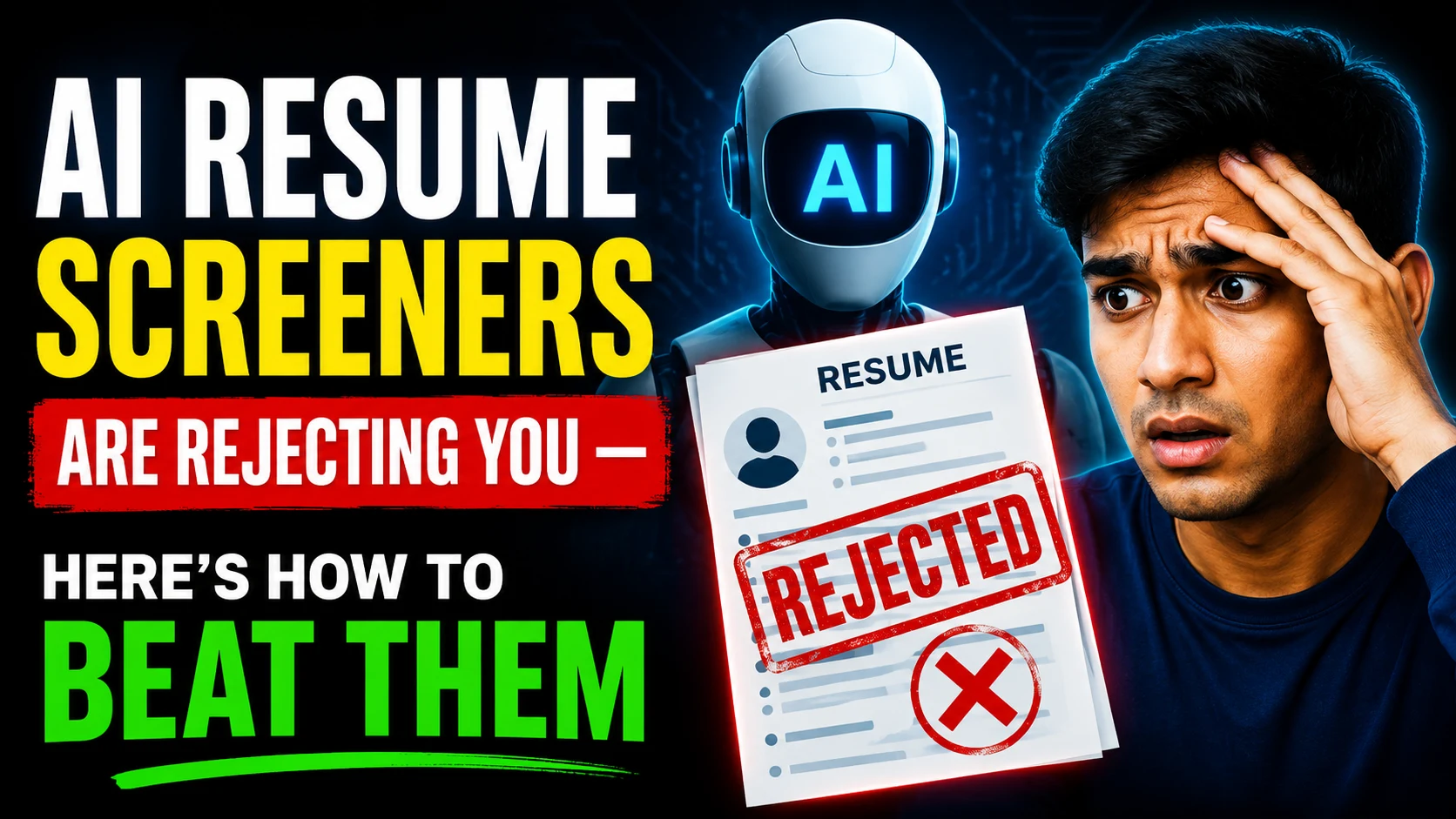
Imagine pouring hours into crafting the perfect resume, only for it to be rejected in exactly six seconds.
That’s the brutal reality of the 2026 job market.
A staggering 75% of resumes are tossed out by automated Applicant Tracking Systems (ATS) before a human recruiter even sees them. Worse, half of all job seekers who receive rejections get no feedback at all, leaving them in the dark about why they failed.
If you’re highly qualified but getting ghosted by employers, your problem isn’t a lack of experience. Your problem is that an algorithm can’t read your resume. Here’s why AI is rejecting you, and the data-backed strategies to finally get past the bots.
The Brutal Math of Modern Hiring
In 2026, getting a job isn’t just about proving you’re the best candidate; it’s about proving it to a machine first.
Almost all (99%) Fortune 500 companies use an ATS to manage the flood of applications. The volume of applications has spiked, but response rates have tanked. Out of 1,000 resumes submitted for a typical corporate role, only about 250 survive the initial automated screening.
When job seekers get rejected silently, 63.8% blame the algorithm. And they’re often right. These systems don’t evaluate your potential, your personality, or your cultural fit. They evaluate relevance based on cold, hard data extraction.
Why the Algorithm Hates Your Resume
AI screeners are designed to look for specific keywords and clear formatting. When they don’t find them, you get an automatic “no.” Here are the biggest culprits behind ATS rejection:
- The Formatting Trap: That beautifully designed, multi-column resume you paid for? It’s likely killing your chances. Complex graphics and multi-column layouts have a 43% higher failure rate than single-column designs. ATS parsers struggle to read tables, columns, and unconventional fonts.
- The Keyword Disconnect: AI models are literal. If a job description asks for “predictive analytics,” and you wrote “statistical modeling,” the system flags a mismatch. You might have the exact skills they need, but you didn’t speak their language.
- The “One-Size-Fits-All” Mistake: Sending the exact same resume to 50 different companies is a guaranteed recipe for failure. Recruiters say this is one of the biggest mistakes applicants make.
- Missing Hard Metrics: AI struggles to understand the nuance of your achievements. A bullet point saying “led a successful sales team” is weak compared to “increased Q3 sales by 30%.”
4 Data-Backed Strategies to Beat the Bots
You don’t need to outsmart the algorithm by hiding invisible keywords in white text (a tactic that will actually get you blacklisted). You just need to play by its rules. Here is how to optimize your application based on 2026 hiring data:
1. Embrace the Boring Layout
When it comes to ATS optimization, simple is always better.
Stick to a single-column layout. Avoid tables, text boxes, and graphics entirely. If you submit a clean, text-based PDF, you have an 87% chance of it parsing correctly, compared to just 64% for a complex design. Keep your fonts standard (think Arial or Calibri) and your section headers traditional (e.g., “Work Experience,” “Education,” “Skills”).
2. Mirror the Job Description
Read the job posting like a cheat sheet.
Identify the core skills, tools, and certifications listed, and weave those exact phrases naturally into your experience. If the posting asks for “Project Management,” don’t just say you “managed tasks.” Resumes that contain job-specific keywords are 4.5 times more likely to pass an ATS scan.
Tip: You can use free AI tools like ChatGPT to analyze a job description and suggest the most relevant keywords.
3. Quantify Everything
Numbers are the universal language of impact, and AI algorithms are programmed to value them.
Don’t just list your responsibilities; highlight your results. Replace vague claims with hard data. Did you save the company money? By what percentage? Did you manage a budget? How large?
4. Optimize the “Top Third”
If your resume survives the AI and reaches a human, you only have six seconds to impress them.
Recruiters spend 62% more time on resumes that include a strong professional summary. Put your most critical qualifications—your current title, your top skills, and a brief, impactful summary—at the very top of the page.
The Takeaway: Stop Applying Blindly
The era of “spray and pray” job applications is dead. In a market where 75% of applicants are rejected by an algorithm, quality matters significantly more than quantity.
Stop spending hours applying to hundreds of jobs with a generic resume. Instead, spend that time tailoring a clean, data-driven, keyword-optimized application for the roles you truly want.
The bots are acting as the gatekeepers. It’s time to give them exactly what they want so you can finally get in the room with a human.
Also Read How to Automate Your Job Search Using AI (Step-by-Step)