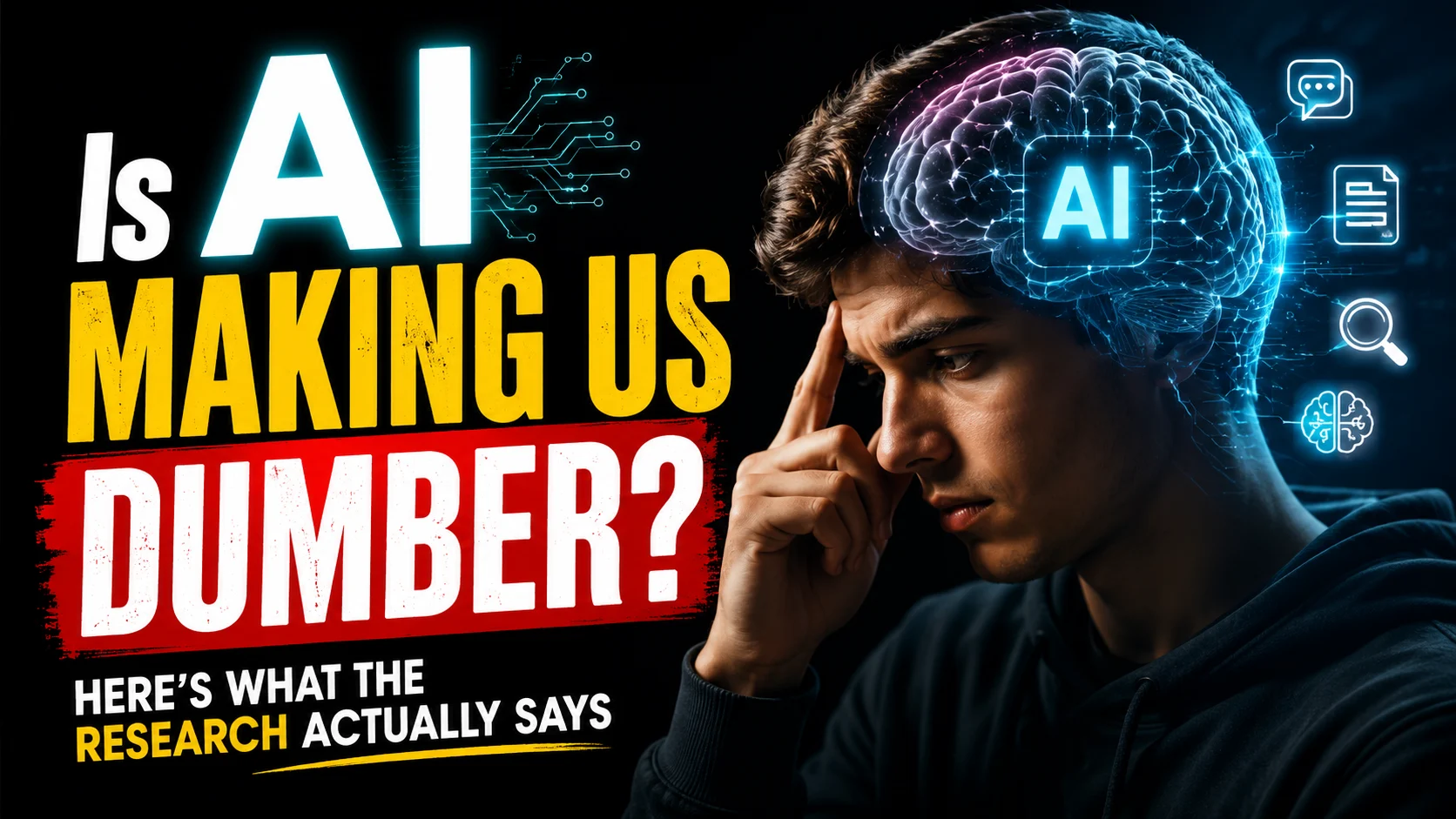
We have all been there: staring at a blank screen, only to ask ChatGPT to draft an email, write a code snippet, or summarize a dense report. But as we hand over our daily reasoning to algorithms, a disturbing question is quietly echoing through university labs: is artificial intelligence slowly eroding our own? The answer isn’t a simple yes or no—it is a complex psychological shift rooted in how our brains adapt to technology.
As generative AI becomes deeply embedded in our professional and personal lives, neuroscientists and educators are rushing to understand its impact on human intelligence. What they are finding is a phenomenon that could fundamentally rewire how we think, learn, and remember.
The Trap of “Cognitive Offloading”
Humans have always used tools to reduce mental burden—a practice psychologists call “cognitive offloading”. We write shopping lists instead of memorizing them, and we use GPS instead of reading physical maps. However, historically, these tools only stored information or performed rigid calculations. AI is entirely different: it processes, synthesizes, and reasons on our behalf.
This shift from tool-based assistance to cognitive delegation carries hidden risks. A 2025 study published in the journal MDPI, which surveyed 666 participants across various age groups, found a significant negative correlation between frequent AI tool usage and critical thinking abilities. The researchers noted that younger users, who exhibited the highest dependence on AI, scored noticeably lower on critical thinking assessments.
When we let algorithms do the heavy lifting, we bypass the cognitive struggle required to form deep neural pathways. The result? We might be getting faster at our jobs, but our underlying intellectual stamina is taking a hit.
Atrophy and the “AI-Trust Spiral”
Recent empirical data paints a concerning picture of how quickly our brains adapt to taking the easy way out. A recent study conducted in the U.S. and the U.K. found that when people spent just ten minutes using AI to help solve math or reading-comprehension problems, their unaided performance on similar problems immediately plummeted. More alarmingly, the participants who received AI assistance gave up on challenging problems much faster than those who worked without it.
Similarly, researchers at the Massachusetts Institute of Technology (MIT) found that individuals who used ChatGPT to write an essay consistently underperformed cognitively. Within minutes of completing the task, the AI-assisted writers struggled to remember what they had just written.
This phenomenon is tied to what experts are calling the “AI-trust spiral.” As people use AI more frequently, they begin to blindly trust its outputs, offloading increasingly complex work and becoming far less critical of the results. When students or professionals passively accept information without critical scrutiny, they risk cognitive deskilling—a gradual erosion of their foundational analytical abilities.
Are We Deskilling or Upskilling?
Despite the alarming data, many cognitive scientists insist that AI is not inherently making us stupid; rather, we are simply interacting with it stupidly.
“I’m skeptical we’re harming our abilities with artificial intelligence,” says Sam Gilbert, a senior research fellow at University College London. Gilbert argues that while we may disengage certain cognitive processes when using AI, we often re-engage them elsewhere, such as critically evaluating the AI’s output. He describes this shift as more of a “rebalancing than a net loss”.
Dr. Michael Gerlich of the Swiss Business School, whose research was featured in a July 2026 American Psychological Association report, supports this nuanced view. His studies suggest that while passive AI reliance reduces critical thinking, using the technology deliberately can actually enhance it. According to Gerlich, AI leads to upskilling just as often as deskilling, depending entirely on how people choose to use the extra time and mental space the technology frees up.
How to Protect Your Mind in the AI Era
To ensure generative AI remains a tool for growth rather than a crutch for cognitive atrophy, experts recommend adopting specific, brain-friendly habits:
- Try first, ask later: Research shows that engaging in a task—like brainstorming or pretesting—before using AI significantly improves memory retention and cognitive engagement.
- Fact-check relentlessly: Break the AI-trust spiral by actively verifying the claims generated by AI tools. Treat the algorithm as an eager intern, not an infallible expert.
- Use AI for friction, not finality: Offload tedious administrative tasks, but retain ownership over pattern recognition, ethical judgment, and complex problem-solving.
The Bottom Line
Artificial intelligence is not inherently destroying our ability to think, but it is forcing an evolutionary shift in how we think. As algorithms master routine reasoning, the humans who thrive will be those who pivot from being primary thinkers to “meta-thinkers”—individuals who excel at asking the right questions, framing complex problems, and scrutinizing digital outputs.
The future belongs to those who use AI to augment their minds, not replace them. Before you open a chatbot to handle your next task, ask yourself: are you saving time, or are you giving away your intellect?