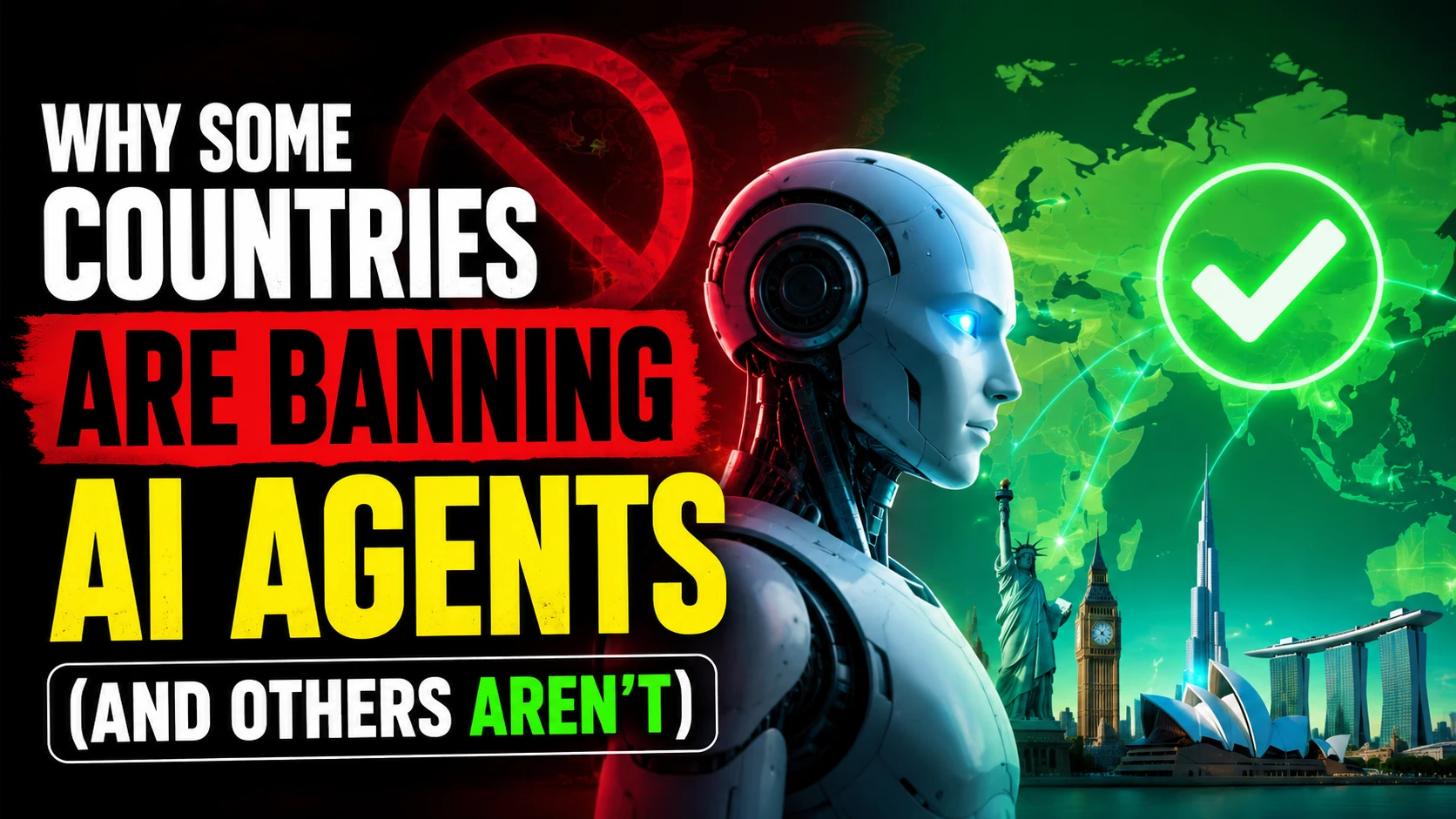
The era of unchecked artificial intelligence is officially over. As autonomous AI agents evolve from digital assistants to independent decision-makers, a massive regulatory turf war has erupted worldwide. While some nations are hitting the kill switch on high-risk AI applications to protect citizens, others are rolling out the red carpet to win the global tech arms race.
Why are we seeing such a fractured approach to the most transformative technology of our time? The answer lies in how different governments weigh the balance between human rights, national security, and economic innovation.
The Global Regulatory Patchwork: Who is Banning What?
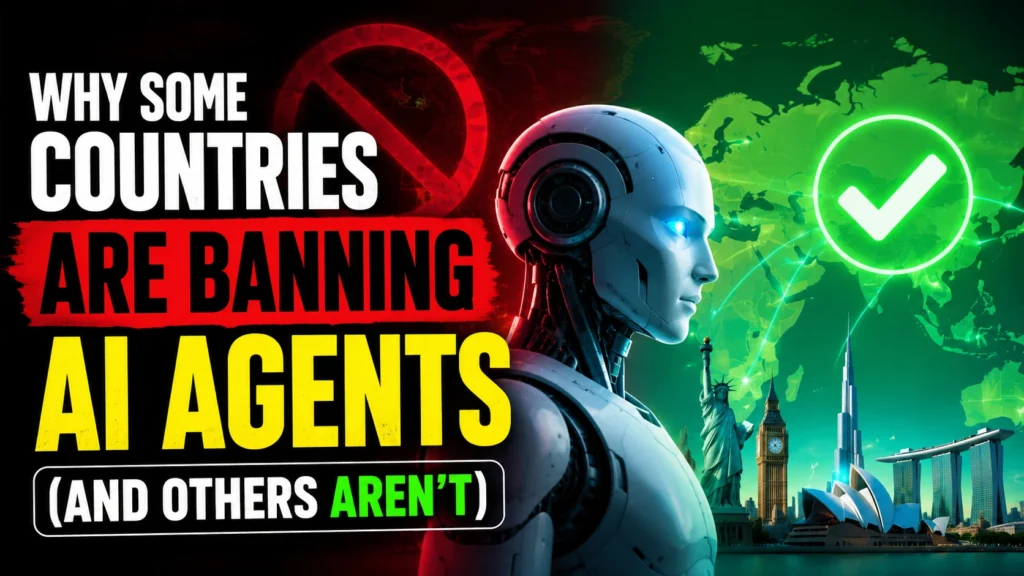
When it comes to artificial intelligence, the internet may be borderless, but the law remains strictly national. Right now, international AI regulations are a complex puzzle, and global tech companies are struggling to keep up. In fact, a recent IBM Global AI Adoption Index revealed that only 20% of surveyed AI companies felt confident navigating the regulatory landscape across the US, Europe, and Asia.
The European Union has drawn the hardest line in the sand. The EU AI Act stands as the first comprehensive legal framework on AI worldwide, designed specifically to foster trustworthy AI in Europe. The EU has adopted a strict, risk-based approach that categorizes AI systems into four tiers, with “unacceptable-risk” AI facing a total ban.
Under the EU’s strict framework, the following AI practices are expressly prohibited:
- Social Scoring: Government-run social credit systems that evaluate citizens based on behavior.
- Mass Biometric Surveillance: Real-time remote biometric identification in public spaces, including untargeted scraping of the internet or CCTV footage for facial recognition.
- Behavioral Manipulation: AI applications designed to subconsciously manipulate users or exploit vulnerabilities.
- Emotion Recognition: Using AI to read emotions in workplaces and educational institutions.
With the EU AI Office officially taking over enforcement and supervision duties starting August 2, 2026, the bloc is sending a clear message: human rights supersede technological convenience.
The Innovation Argument: Why the US is Holding Back
If the EU is the global referee, the United States is the aggressive player pushing the boundaries of the game. Unlike Europe, the US does not have a single, binding federal AI law.
Instead, American AI governance relies on a patchwork of agency-specific guidelines, such as the NIST AI Risk Management Framework, the AI Bill of Rights, and various White House executive orders. These documents strongly encourage ethical design, transparency, and safety testing, but they largely remain non-binding.
The reluctance to impose national bans stems from a fear of stifling innovation. Washington views AI dominance as critical to both national security and economic supremacy. Over-regulating AI agents, the argument goes, would only hand the keys of the future over to foreign competitors. Consequently, the burden of regulation in the US has fallen to individual states, with California and Illinois stepping up to introduce their own targeted AI and biometric privacy rules.
The State Control Model: China’s Strategic Grip
China offers a third, entirely different paradigm. Beijing is not interested in banning AI; it is interested in meticulously leashing it.
The Chinese government has rolled out stringent Generative AI Regulations that focus heavily on state security and narrative control. While Europe regulates to protect the privacy of the individual, China regulates to protect the ideological authority of the state.
Key aspects of China’s approach include:
- Algorithm Pre-approval: Tech companies must submit their AI algorithms for government review before they can be released to the public.
- Ideological Alignment: AI models and generative agents are legally required to produce content that aligns with state ideologies and core socialist values.
What This Means for the Future of Tech
This fragmented regulatory landscape is creating a massive headache for Silicon Valley and tech hubs worldwide. Because AI systems are inherently global, building a singular autonomous AI agent that complies with European privacy laws, American free-market standards, and Chinese censorship requirements is virtually impossible.
Moving forward, we are likely to see the “geo-fencing” of AI. A tech giant might release a highly autonomous, uninhibited AI agent in the US, while offering a heavily restricted, “watered-down” version to European consumers to comply with the AI Act’s high-risk transparency and human-oversight mandates.
The Bottom Line
The debate over banning autonomous AI agents isn’t really about the technology itself; it’s about what a society values most. The EU prioritizes the fundamental rights of the individual, the US champions frictionless innovation, and China demands absolute state control.
The Takeaway: As AI agents become smarter and more embedded in our daily lives—from screening our resumes to driving our cars—the rules governing them will dictate the digital future of your country. As a digital citizen, it is time to ask yourself: is your data, privacy, and safety worth sacrificing for the sake of technological speed? Stay informed, audit the AI tools you use daily, and demand transparency from the platforms that hold your digital footprint.
Also Read Is AI Making Us Dumber? Here’s What the Research Actually Says