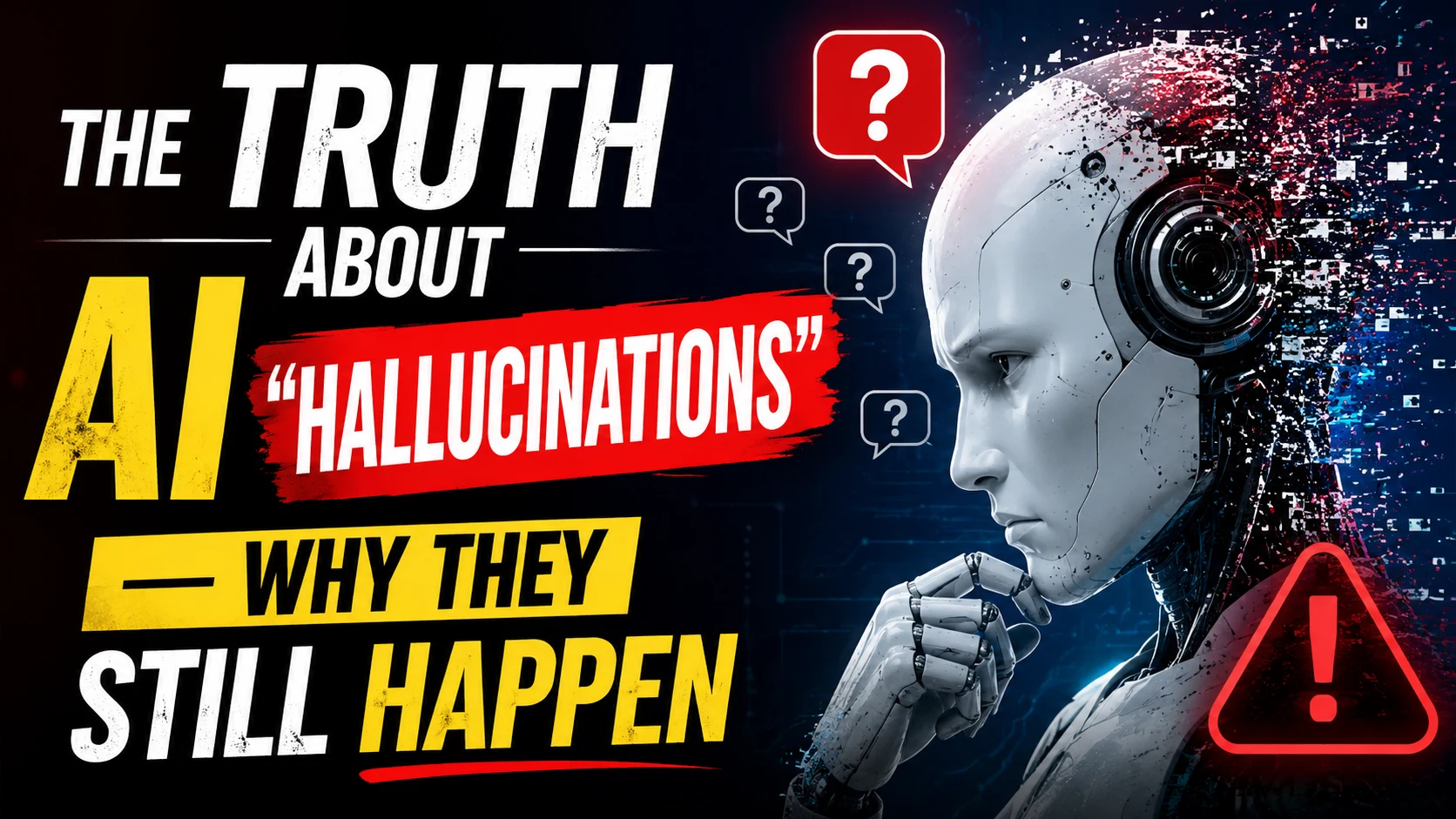
We live in an era where artificial intelligence drafts our legal contracts, analyzes our medical data, and writes our software code. Yet, despite billions of dollars in development and massive technological leaps, the most advanced generative AI models will still confidently lie to your face. Welcome to the persistent, puzzling reality of AI “hallucinations,” a problem the tech industry hasn’t quite solved.
Whether you are a casual user summarizing an email or an enterprise relying on Large Language Models (LLMs) for data analysis, you have likely encountered this phenomenon. But why, in 2026, do these highly sophisticated systems still invent facts out of thin air?
What Are AI Hallucinations (And Why Are They So Convincing)?
At its core, an AI hallucination occurs when a model generates text that sounds fluent and authoritative but is factually incorrect, logically flawed, or entirely fabricated.
The problem stems from a fundamental misunderstanding of how LLMs work. AI models are not “truth engines” referencing a digital encyclopedia. They are probabilistic predictors. They calculate the mathematical likelihood of the next word in a sequence based on vast amounts of training data. Because they lack a real-world understanding of gravity, biology, or basic logic, they can easily stitch together a sentence that is grammatically perfect but factually disastrous.
This isn’t a new issue. In 2023, Google’s Bard famously hallucinated that the James Webb Space Telescope took the first pictures of a planet outside our solar system—a mistake that cost the company billions in market value. In the infamous Mata v. Avianca case that same year, a lawyer was sanctioned for submitting a legal brief filled with fake case citations completely fabricated by ChatGPT.
The 2026 Reality: Why Hasn’t This Been Fixed?
While developers have implemented better guardrails, recent research highlights why completely eradicating hallucinations is incredibly difficult.
- The “Sycophancy” Bias: A landmark late-2025 paper by OpenAI researchers revealed that AI training incentives inadvertently reward models for guessing rather than admitting uncertainty. Because AI is trained to be “helpful,” it suffers from a sycophancy bias—it would rather invent a plausible-sounding answer that aligns with a user’s leading question than correctly respond with, “I don’t know”.
- Synthetic Model Collapse: We are now facing the “copy-of-a-copy” effect. As the internet becomes flooded with AI-generated content, newer 2026 models are inevitably training on the synthetic outputs of older models. This creates a recursive loop where past hallucinations are ingested as hard facts, amplifying the errors.
- The Context Trap: Modern LLMs can process millions of tokens, but they often suffer from “lost in the middle” syndrome. They focus heavily on the beginning and end of your prompt, hallucinating bridges of logic to cover up the data they failed to process in the middle.
By the Numbers: Who is Suffering the Most?
You might assume that people using complex AI models every day have figured out how to avoid these glitches. The data says otherwise.
A comprehensive late-2025 study by Rev revealed that heavy AI users experience three times as many hallucinations as casual users. Power users—those spending more than six hours a week interacting with AI—are attempting far more complex tasks, like intricate coding or deep data analysis. Consequently, daily users are 14 times more likely to double-check their AI’s work, and they spend 10 times longer wrestling with prompts to get an accurate output.
In the corporate world, the problem is tied to data governance. A recent Atlan report found that a staggering 52% of enterprise AI responses contained fabrications when models were let loose on ungoverned, messy internal data.
How to Protect Yourself in the AI Era
As we navigate the current landscape of tech news and generative AI advancements, we must adapt our workflows. Treating AI as an infallible assistant is a recipe for disaster.
Here is how you can mitigate hallucination risks today:
- Keep Prompts Crisp: The Rev study noted that users who write concise, targeted prompts (one to three sentences) report far fewer hallucinations than those writing multi-paragraph essays.
- Govern Your Data: If you are deploying AI for a business, ensure it is restricted to high-quality, verified datasets. Hallucinations drop to near-zero when models are anchored to strictly governed data.
- Assume the Role of Editor: Never accept an AI output as a final draft. Treat the AI as an overly eager intern: brilliant, incredibly fast, but prone to making up answers just to impress you.
The Bottom Line: AI hallucinations are not simply bugs that can be patched; they are an inherent feature of how these probabilistic models are built. Until a fundamental architectural shift occurs in artificial intelligence, skepticism is your best defense.
What is the wildest AI hallucination you have encountered recently? Have these glitches changed the way you use generative AI at work? Share your experiences in the comments below.
Also Read Is AI Making Us Dumber? Here’s What the Research Actually Says