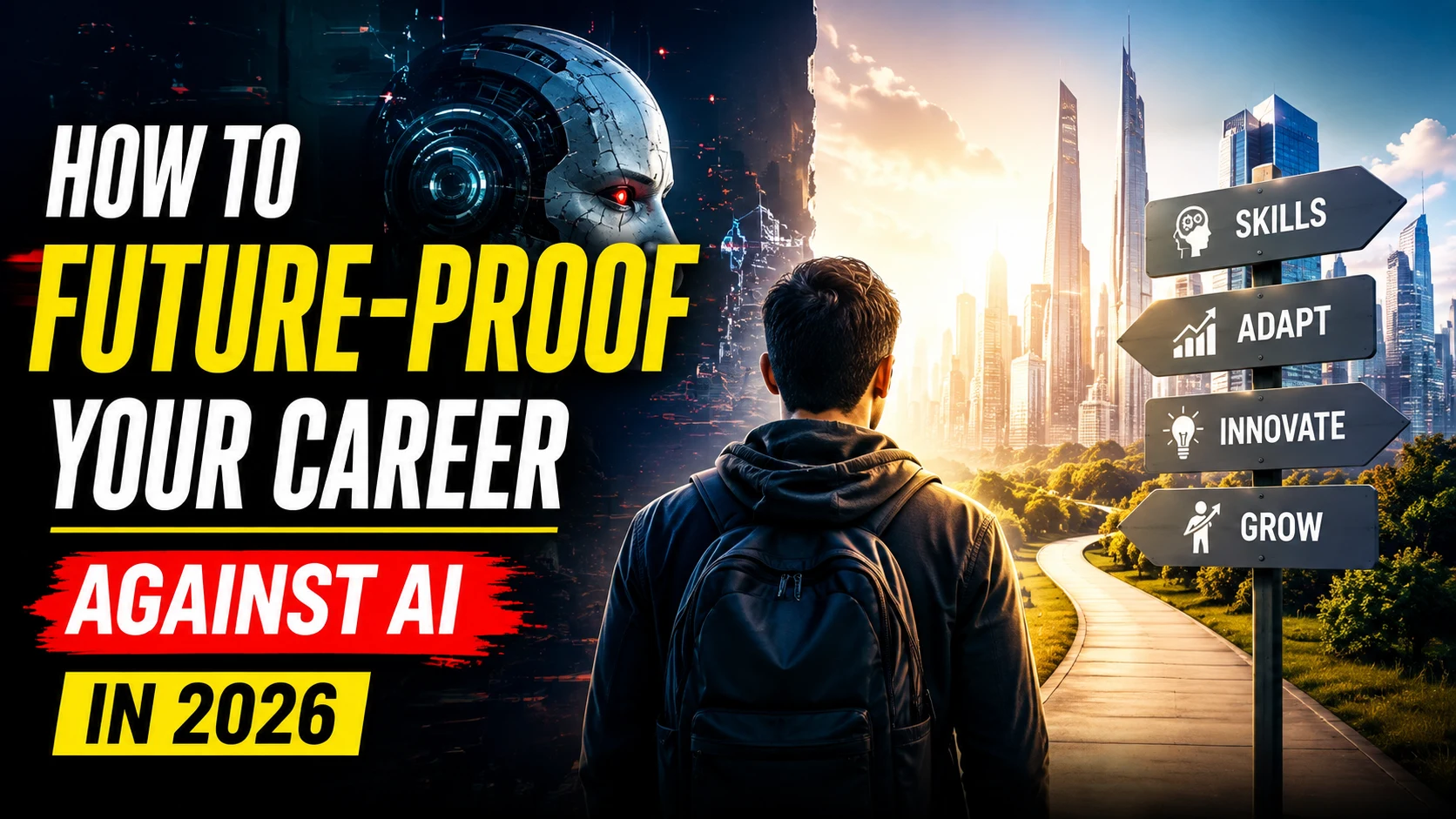
The World Economic Forum’s 2025 Future of Jobs Report delivered a sobering statistic: 23% of all jobs globally will undergo significant changes by 2028. However, this transformation doesn’t equate to mass unemployment. Instead, it signals a massive shift in the skills employers demand.
Here is a comprehensive guide to future-proofing your career in the age of Agentic AI.
The Shift from Automation to Augmentation
We have moved past the era where AI merely drafted emails or generated code snippets. Today, we are dealing with “Agentic AI”—systems capable of independent reasoning, task execution, and multi-step problem solving.
{/* Reason: Separates the hero image from the upcoming data-heavy section for better readability. */}
According to a 2026 PwC report, the companies most exposed to AI are experiencing a massive productivity boom—40% higher growth than their least-exposed counterparts. Crucially, this isn’t leading to workforce reductions. These companies are actually seeing faster headcount growth because they use AI to unlock new value, not just cut costs.
The takeaway? The future belongs to those who view AI as an amplifier of human capability, not a substitute.
5 Strategies to Future-Proof Your Career
To remain indispensable in 2026 and beyond, you must cultivate a blend of technical literacy and uniquely human skills.
1. Master AI Literacy, Not Just Coding
You don’t need to be a machine learning engineer to thrive, but you must be “AI-literate”. This means understanding what AI can do, what it can’t, and how to interact with it effectively.
- Understand the basics: Grasp concepts like generative vs. discriminative models and supervised vs. unsupervised learning. This foundational knowledge prevents costly misunderstandings.
- Learn to orchestrate: Move beyond simple prompting. The next frontier is managing “networks of agents” using frameworks like LangChain or CrewAI to automate complex workflows.
- Embrace continuous upskilling: Platforms like Coursera and Google offer accessible pathways to learn these tools.
2. Double Down on “Human-Only” Skills
As AI absorbs routine cognitive tasks, the skills that are uniquely human become premium assets. The PwC 2026 AI Jobs Barometer notes that AI-exposed roles are 2.5 times more likely to require skills like empathy, judgment, and creativity.
| Skill | Why AI Struggles | Your Advantage |
| Complex Problem Solving | AI is good at structured data; humans navigate ambiguity and nuance. | You can define the right problem to solve before deploying AI. |
| Emotional Intelligence (EQ) | AI can mimic tone, but cannot build genuine trust or navigate workplace politics. | Strong relationships and stakeholder management are irreplaceable. |
| Ethical Judgment | Algorithms lack moral compasses and can perpetuate bias. | You provide the necessary oversight, ensuring AI aligns with corporate values. |
3. Pivot Toward “Professionalized” Roles
AI is creating a two-track job market. While it “democratizes” some tasks (making them easier for anyone to do), it is “professionalizing” others, requiring even deeper human expertise.
According to PwC, these professionalized jobs are growing twice as fast and commanding 42% higher wage growth. Seek out roles where AI enhances your core expertise—whether that’s complex legal analysis, high-level strategic planning, or specialized medical diagnostics.
4. Become an “AI Architect” in Your Domain
Stop being just a user of technology; become a designer of workflows. The most valuable employees are those who can integrate AI into existing systems to solve business problems.
This involves understanding how to connect AI agents to databases, CRMs, and APIs. If you can build a system where an AI agent securely retrieves customer data and drafts a personalized response for your review, you become an indispensable asset.
5. Seek Out Automation-Resistant Industries
If you are considering a career pivot, look toward sectors where human interaction or complex physical work is paramount.
- Healthcare: While AI assists in diagnostics, the empathy and physical care provided by nurses and therapists cannot be automated.
- Skilled Trades: Electricians and plumbers navigate unpredictable physical environments that robots cannot cost-effectively manage.
- Education: Early childhood educators rely on deep interpersonal connections that are fundamentally human.
The Bottom Line
The narrative that “AI will take all our jobs” is a distraction. The reality is far more nuanced. The AI workforce transformation is here, and it is rewarding those who adapt.
Your goal for 2026 is not to compete with AI on speed or data processing. Your goal is to be the human who directs the AI, exercises the judgment it lacks, and builds the relationships it cannot form. By mastering AI literacy while doubling down on your uniquely human traits, you can build a career that isn’t just safe from AI, but empowered by it.
Also Read “The Truth About AI ‘Hallucinations’ — Why They Still Happen”