If you think artificial intelligence is just a glorified chatbot that writes emails and occasionally hallucinates facts, you are already falling behind. The tech world has quietly moved past simple text generators into a much more autonomous territory. We have officially entered the era of the “AI agent”—a digital worker that doesn’t just talk, but actually does the work.
For years, we have been conditioned to treat AI as a digital encyclopedia. You type a prompt, it gives you an answer, and the interaction ends. But AI agents are rewriting this dynamic, transforming enterprise workflows and fueling a market that is expected to explode from $7.6 billion in 2025 to a staggering $182.9 billion by 2033.
So, what exactly is this technology, and why is every major boardroom suddenly obsessed with it?
Chatbot vs. AI Agent: The Crucial Difference
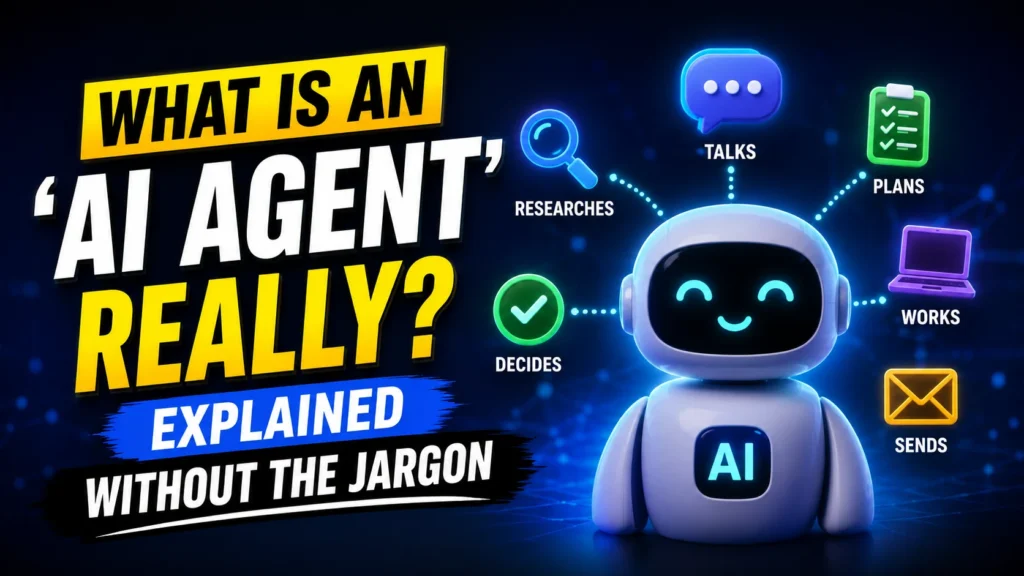
To understand an AI agent, you first need to understand what it is not. It is not a chatbot.
A traditional chatbot is highly reactive. It waits for your input, processes it, spits out a text-based reply, and goes back to sleep. It is a simple “message in, text out” system. If a chatbot hits a roadblock, it stops and asks you for help.
An AI agent, however, is proactive and goal-oriented. You do not give it a prompt; you give it an objective.
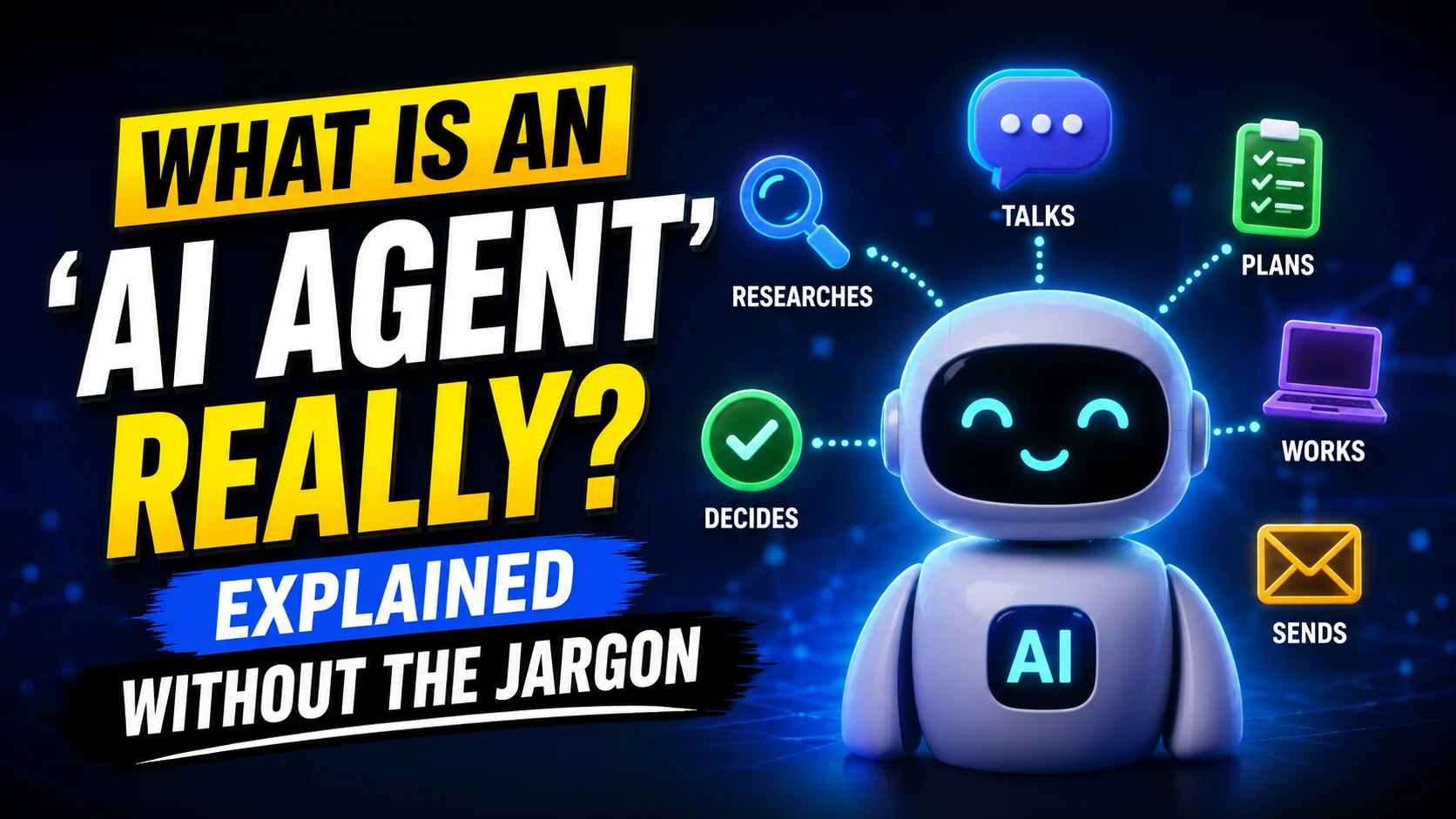
If you ask a chatbot to “research competitor pricing,” it will generate a generic summary based on its training data. If you give that same command to an AI agent, it operates entirely differently. It will independently browse current competitor websites, extract the live pricing data, open a spreadsheet, input the numbers, format the cells, and email the final report to your team.
It doesn’t just reason; it takes action across multiple systems until the goal is achieved.
How Does an AI Agent Actually Work?
While the underlying math is incredibly complex, the workflow of an AI agent relies on a shockingly human-like loop of logic. Every functional AI agent requires a few core components to operate:
- The Brain (Foundation Model): This is the large language model (like GPT-4, Claude, or Gemini) that gives the agent its ability to reason, understand context, and make decisions.
- The Hands (Tool Calling): Unlike chatbots, agents are connected to external software via APIs. They can access your CRM, your Google Calendar, web browsers, or internal databases to execute tasks.
- The Memory: Agents can recall past interactions. They maintain short-term memory for ongoing tasks and long-term memory to learn your preferences over time.
- The Loop: The agent observes a situation, decides on the next logical step, takes action, checks the result to see if it worked, and repeats this cycle until the primary goal is completed.
Real-World Examples: Not Just Sci-Fi Anymore
The shift toward “agentic AI” is not a futuristic projection; it is already generating massive revenue and cutting costs in 2026. Companies that are seeing the highest returns are not just layering AI on top of old processes—they are redesigning their workflows from scratch.
Consider these live, in-production examples:
- Klarna’s Customer Service Revolution: The buy-now-pay-later giant deployed a single AI agent that currently handles the equivalent workload of 853 full-time employees. Operating across 35 languages, it resolves customer issues in under two minutes, saving the company a reported $60 million annually.
- JPMorgan’s Army of Agents: The banking institution runs over 450 active agentic AI deployments simultaneously every day. These agents automate trade settlements and detect complex fraud in real-time.
- General Mills’ Supply Chain: The food company uses an AI system to autonomously assess more than 5,000 daily shipments. It evaluates routing, timing, and vendor performance without waiting for human approval, generating over $20 million in savings.
The Rise of “Tiered Autonomy”
The most successful AI agents operate on a principle called “tiered autonomy.” In this model, the AI handles routine decisions, data extraction, and pattern recognition instantly, without human oversight. However, when it encounters an exception, a high-risk scenario, or something requiring nuance, it immediately routes the problem to a human supervisor.
The agent does the heavy lifting; the human exercises the final judgment.
The Bottom Line
We are rapidly moving from an internet where we do the clicking, searching, and organizing, to an internet where software does it for us. By 2028, industry analysts predict that 33% of all enterprise software will include agentic AI capabilities, a massive leap from less than 5% in 2025.
The Takeaway: The professionals who thrive in the next decade won’t necessarily be the ones who know how to write the best text prompts. They will be the ones who know how to effectively manage, audit, and collaborate with digital AI agents. It is time to stop asking what AI can write for you, and start asking what it can do for you.
Chatbot vs AI Agent: The Difference Explained
This quick technical explainer breaks down the exact moment a reactive chatbot evolves into a proactive AI agent through tool calling and loops.
Also Read ChatGPT vs Claude vs Gemini (2026): Which AI Subscription Is Actually Worth Your Money?