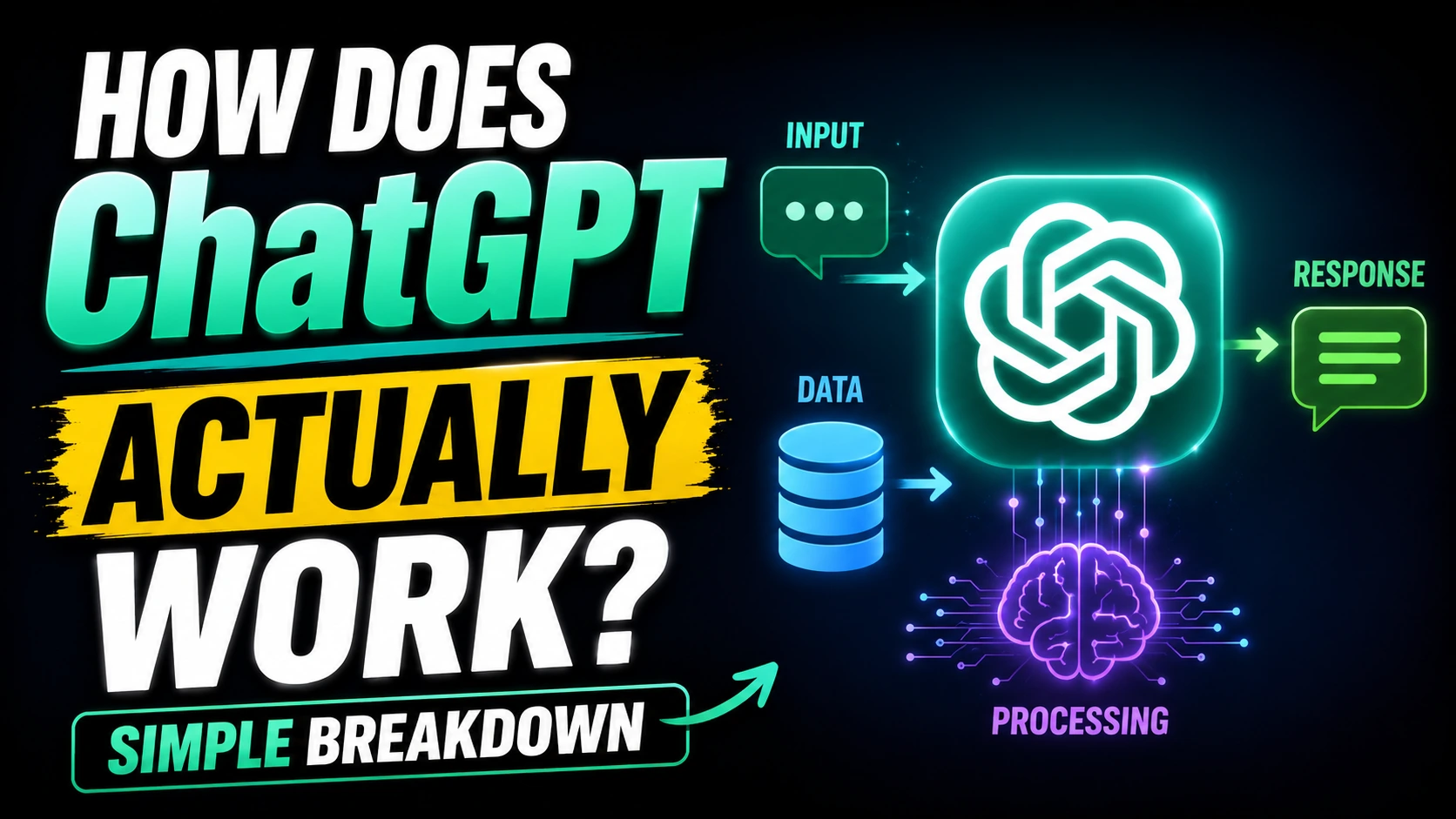
If you’ve spent any time online recently, you’ve likely interacted with ChatGPT. It’s writing emails, debugging code, drafting essays, and even generating recipes. But behind the seemingly magical interface lies a complex, highly engineered system.
How exactly does a computer program learn to “speak” so fluently? It doesn’t have a brain, feelings, or actual understanding. Instead, it relies on advanced mathematics, massive amounts of data, and a groundbreaking architecture. Let’s break down the mechanics of ChatGPT—simply, accurately, and without the jargon.
1. The Foundation: Transformers and Large Language Models
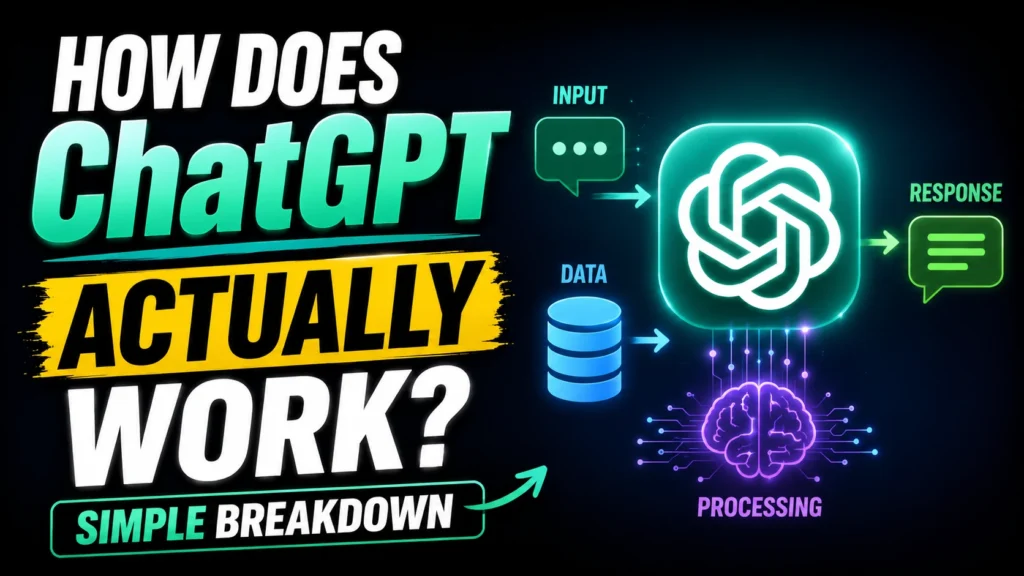
At its core, ChatGPT is a Large Language Model (LLM). You can think of an LLM as a highly sophisticated predictive text engine, similar to what’s on your smartphone, but on a massive scale.
The real magic behind ChatGPT is the Transformer architecture. Introduced by Google researchers in 2017, the Transformer revolutionized how machines process language. Before this, AI models read text sequentially (word by word), which made it hard to grasp the context of long sentences.
The Transformer, however, uses a mechanism called Self-Attention. This allows the model to look at an entire sentence at once and weigh the importance of every word in relation to the others, regardless of where they are in the sequence.
0:00 / 0:00
2. Breaking Down the Language: Tokenization
Before ChatGPT can process your prompt, it has to translate human language into something a computer understands: numbers. This process is called Tokenization.
- Tokens, Not Words: The model doesn’t read words; it reads “tokens.” A token can be a single character, a chunk of a word, or an entire word.
- The Math: According to OpenAI, 1,000 tokens are roughly equivalent to 750 words.
- Encoding: Once the text is broken into tokens, each token is converted into a numerical vector (an “embedding”). This allows the AI to calculate the mathematical relationships between different concepts.
3. The Training Phase: Reading the Internet
ChatGPT didn’t wake up knowing how to write a sonnet or explain quantum physics. It had to be taught. This happens in two main phases:
Phase 1: Pre-training (Learning the Patterns)
The model is fed colossal amounts of text data from the internet—books, articles, websites, and conversations. During this unsupervised phase, its only job is to predict the next word in a sequence. By doing this billions of times, it learns grammar, facts, reasoning abilities, and even biases present in the data.
Phase 2: Fine-Tuning and RLHF (Learning to be Helpful)
A model that just predicts the next word isn’t very useful as an assistant; it might just ramble or spit out toxic internet text. To make it conversational and safe, OpenAI uses a technique called Reinforcement Learning from Human Feedback (RLHF).
- Human Input: Human reviewers rate the model’s responses, ranking which answers are most helpful, accurate, and safe.
- Reward System: The model is trained to generate responses that maximize this human-defined “reward.” This is what makes ChatGPT polite, structured, and conversational.
The Scale of the Operation
The underlying models power an unprecedented user base. As of February 2026, ChatGPT reached an astonishing 900 million weekly active users, making it the first app to hit 1 billion active users within three years of launch.
- Processing Power: The model processes an estimated 2.5 billion prompts per day.
- Evolution: While the free tier relies on robust older models (like GPT-3.5), paid tiers use more advanced multimodal platforms (like GPT-4 and beyond) capable of processing text, images, and massive document libraries simultaneously.
The Bottom Line
ChatGPT isn’t thinking; it’s calculating. It’s an incredibly advanced pattern-recognition system built on the Transformer architecture, trained on the collective text of the internet, and refined by human feedback.
Understanding how it works demystifies the “magic” and helps us use the tool more effectively. It’s a powerful assistant, but it’s essential to remember that it generates responses based on statistical probability, not actual comprehension.
Always verify important facts, and treat the AI as a highly capable collaborator rather than an infallible oracle.
Also Read ChatGPT vs Claude vs Gemini (2026): Which AI Subscription Is Actually Worth Your Money?