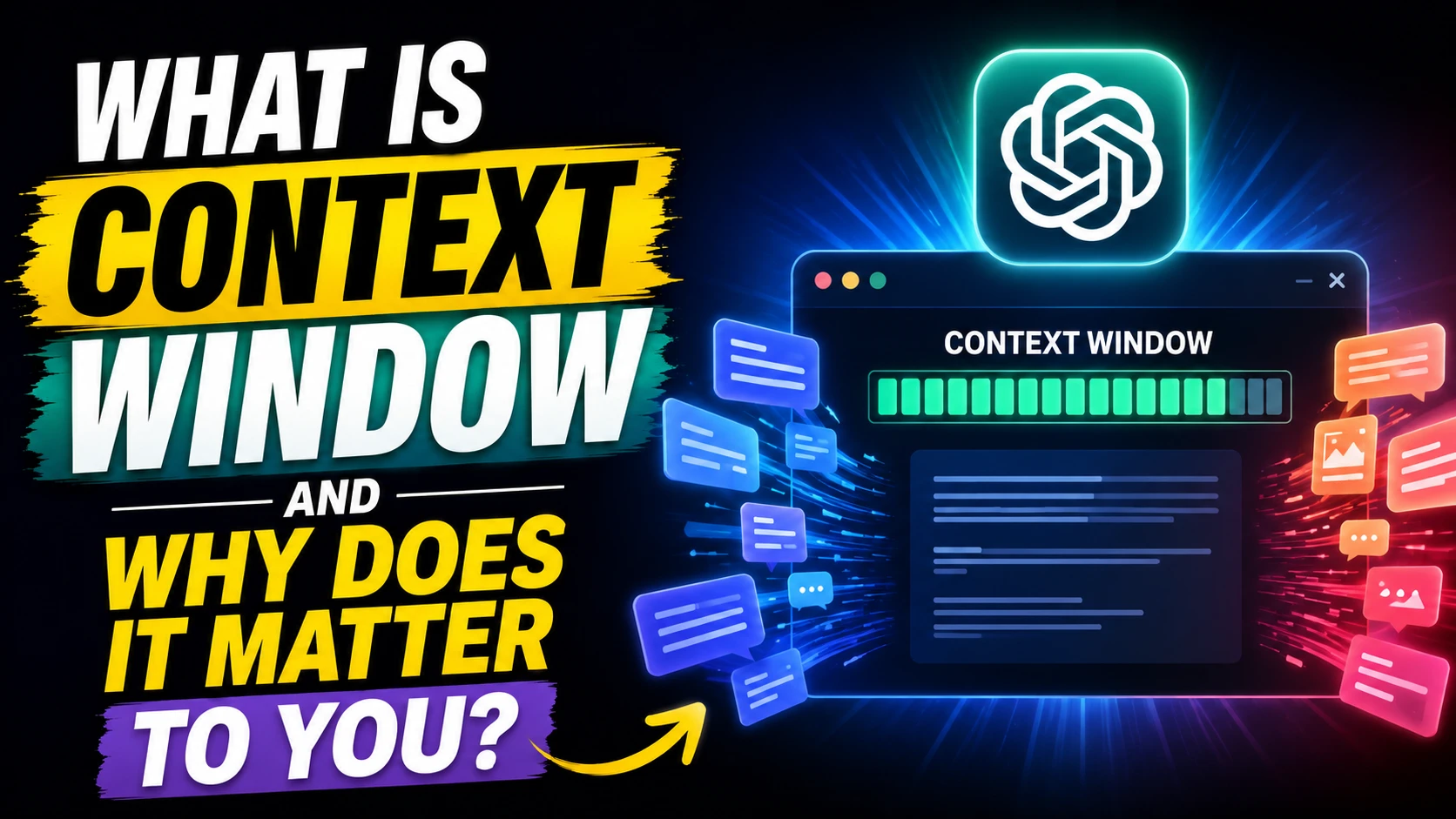
Ever felt like your AI chatbot just forgot what you were talking about five minutes ago? That is not a glitch—that is the limit of its “context window” in action. As artificial intelligence rapidly evolves in 2026, this behind-the-scenes metric has become the single most important factor determining whether an AI acts like a brilliant assistant or a forgetful intern.
The Basics: What Is an AI Context Window?
Context length—often referred to as the context window—is essentially the short-term memory of a Large Language Model (LLM). It dictates exactly how much text the model can read, process, and reason over at any one time.
To understand this, you need to understand “tokens,” which are the basic units of text an AI reads. As a rough rule of thumb, one token equals about four characters in English, meaning 1,000 tokens is roughly 750 words. Therefore, a model boasting a 1-million-token context window can hold about 750,000 words—or roughly 1,500 pages of text—in its working memory simultaneously.
Think of the context window as the size of a physical desk. You can only spread out so many documents before things start falling off the edges. When your input and the AI’s ongoing responses exceed this limit, the model starts silently dropping the oldest tokens to make room for new ones. This is exactly why a long chat session can suddenly feel disconnected.
5 Reasons Why the Context Window Matters to You
You might not be an AI developer, but the size of an AI’s context window directly impacts your daily digital life. Here is why this specification is critical:
- Seamless, Uninterrupted Conversations: A larger context window allows you to have hours-long brainstorming sessions without constantly reminding the AI of the original premise. It retains the nuances, preferences, and rules established at the start of your chat.
- Analyzing Massive Documents in Seconds: In the era of massive LLMs, professionals can upload 500-page financial reports, entire legal case files, or dense research papers, and ask the AI to synthesize the information instantly.
- Flawless Code Generation for Developers: Software engineers rely on AI to build and debug complex applications. A small memory means the AI forgets earlier architectural constraints. A massive context window allows the AI to ingest an entire mid-sized software repository at once.
- Cost-Effectiveness in Business: For enterprise users utilizing Retrieval-Augmented Generation (RAG), choosing a model with the right context size balances performance with API costs. In 2026, filling a 1-million token window can cost anywhere from $0.14 to over $5.00 depending on the model.
- Fewer AI “Hallucinations”: When a model is forced to guess because it dropped crucial information from its memory, it hallucinates. Keeping everything in view ensures grounded, fact-based answers.
The 2026 AI Space Race: A Multi-Million Token Era
Just three years ago, a 32,000-token limit was considered generous. Today, the leading generative AI developers are battling in the millions. Here is how the top flagship models stack up in the latter half of 2026:
| AI Model | Developer | Context Window Size | Equivalent Text Length |
| Llama 4 Scout | Meta | 10 Million Tokens | ~15,000 Pages |
| Claude Mythos 5 | Anthropic | 1 Million+ Tokens | ~1,500 Pages |
| Gemini 3.1 Pro | 1 Million+ Tokens | ~1,500 Pages | |
| GPT-5.6 Sol | OpenAI | 1.05 Million Tokens | ~1,500 Pages |
| DeepSeek V4 | DeepSeek | 1 Million Tokens | ~1,500 Pages |
(Data reflects verified industry models and benchmark platforms as of August 2026.)
The Catch: Raw Capacity vs. True Fidelity
While the numbers sound staggering, there is a catch. Industry experts note that “the hard problem in 2026 is no longer raw capacity but effective context length”.
It is relatively easy to build a model that accepts 10 million tokens. It is remarkably difficult to ensure the AI can find one specific fact in that massive haystack without hallucinating or slowing to a crawl. Independent benchmarking platforms like BenchLM reveal that premium models—such as Claude Mythos 5 and Gemini 3.1 Pro—lead the pack not just because they have large windows, but because they can actually reason effectively and retain fidelity across them.
The Bottom Line: Your Next Steps
Understanding the AI context window empowers you to choose the right tool for the job. If you are summarizing a quick email, a smaller, token-efficient model works perfectly. But if you are feeding a chatbot your company’s entire policy manual, you need the massive processing power of the latest million-token flagships.
The Takeaway: The next time you use generative AI, treat its memory like a desk space. Do not clutter it with irrelevant documents, but do not be afraid to utilize its full capacity when complex reasoning is required. Ready to test the limits? Try uploading a massive PDF to your favorite AI platform today and watch how it synthesizes the data—you might just be witnessing the future of work.
Also Read ChatGPT vs Claude vs Gemini (2026): Which AI Subscription Is Actually Worth Your Money?