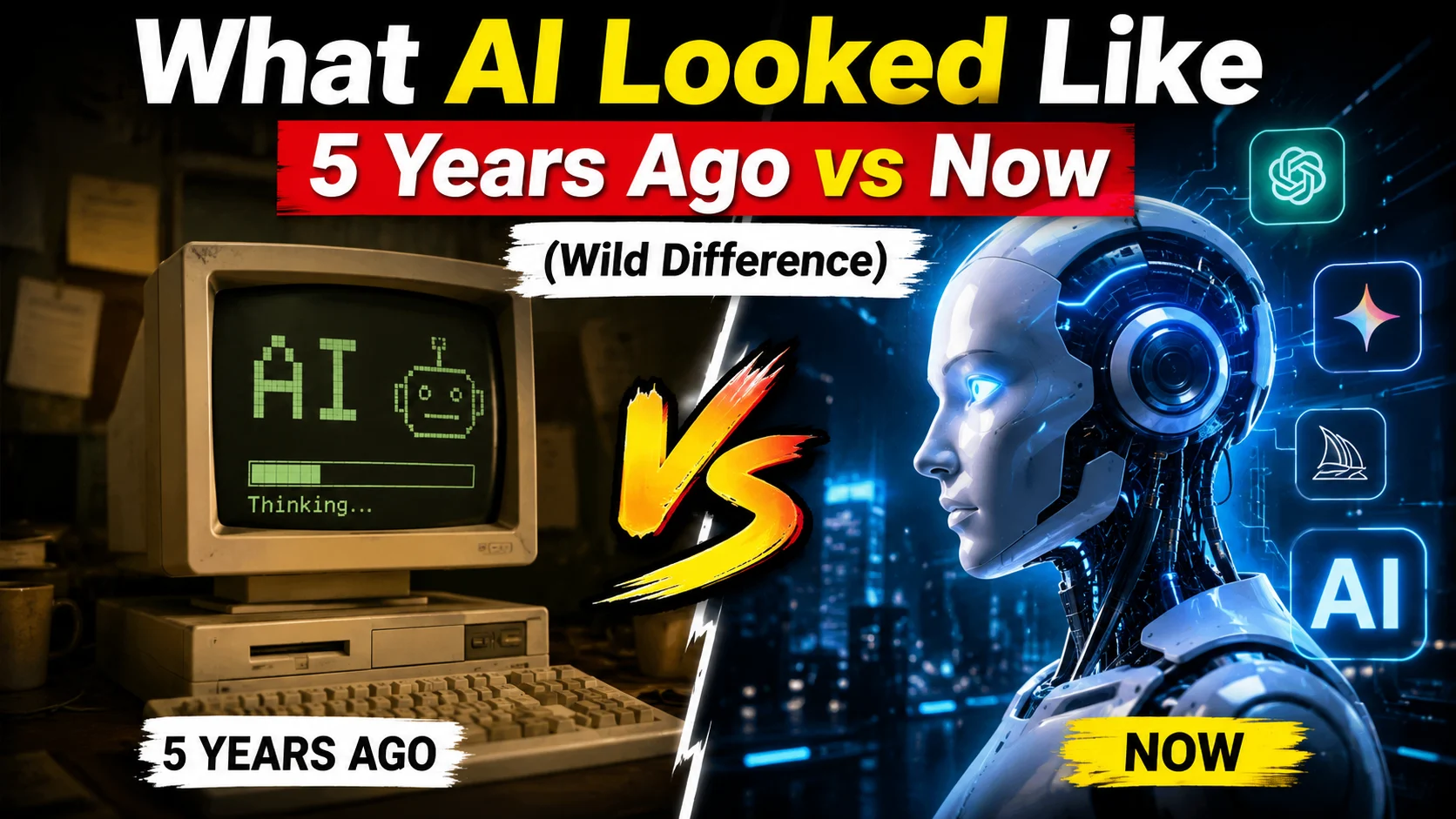
If you rewind the clock just five years to 2021, Artificial Intelligence was a fascinating but deeply flawed parlor trick. If you asked an AI to draw a human, you’d likely get a terrifying amalgamation of extra fingers and distorted eyes. If you asked it to write a poem, it sounded like a robotic translation. Fast forward to 2026, and the landscape is unrecognizable.
Today, AI doesn’t just assist; it operates autonomously. It’s winning gold medals at the International Mathematical Olympiad, generating photorealistic videos that understand physics, and writing the very code that runs our digital world. The evolution of generative AI over the last half-decade hasn’t just been a step forward—it has been an explosive leap that has rewritten the rules of technology, business, and daily life.
Here is an honest, data-backed look at exactly how wild the difference is between the AI of 2021 and the AI of today.
The 2021 Reality: Promising, But Clunky
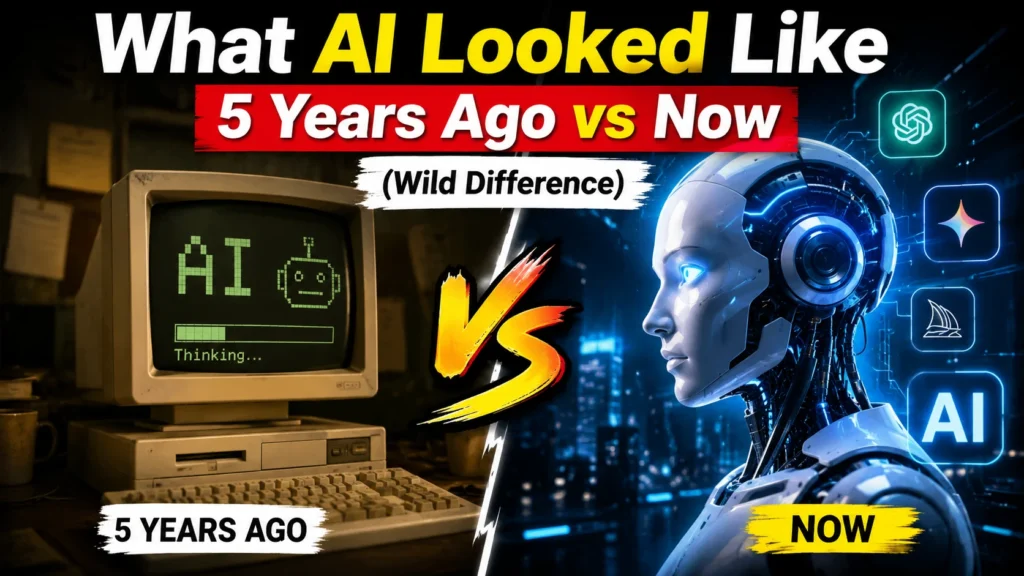
Five years ago, we were living in the era of early large language models (LLMs) and experimental image generators. The buzz was real, but the practical application was heavily bottlenecked.
- Text Generation: OpenAI had released GPT-3 to developers, but the world hadn’t yet met ChatGPT (which wouldn’t arrive until late 2022). Chatbots on websites were mostly rigid, frustration-inducing decision trees that ultimately forced you to shout “speak to a human.”
- Visual AI: Image generators like the original DALL-E were just emerging. They could blend concepts together, but the outputs were low-resolution, cartoonish, and notoriously terrible at rendering human hands or coherent text. Video generation was entirely limited to jittery, artifact-heavy deepfakes.
- The Workplace: AI was largely an enterprise niche. Data scientists used it for predictive analytics, but the average office worker was not collaborating with an AI on a daily basis.
The 2026 Reality: The Era of Multimodal Agents
Today, AI capability is not plateauing—it is accelerating and reaching more people than ever. According to the Stanford HAI 2026 AI Index Report, organizational adoption of AI has reached a staggering 88%, and 4 out of 5 university students now use generative AI in their daily workflows.
We have moved past simple text prompts into the era of multimodal foundation models. Today’s systems (like GPT-4o, Gemini 3, and Claude 3.5) can see, hear, speak, and reason in real-time.
- Flawless Media Generation: AI video models don’t just paste pixels together; they understand the physical world. Models like Google DeepMind’s Veo 3 can simulate real-world physics—like buoyancy or object permanence—without ever being explicitly programmed to do so.
- Elite Problem Solving: The benchmarks that measured AI intelligence in 2021 are hopelessly outdated today. AI has moved from answering multiple-choice questions to solving PhD-level science problems. In 2025, an AI model earned a gold medal at the International Mathematical Olympiad, working end-to-end in natural language.
- Global Parity: The geopolitical AI race has shifted. The once-dominant gap between U.S. and Chinese models has effectively closed, with models from both nations trading the top spot on global leaderboards.
The Software Revolution: AI as the Ultimate Co-Pilot
Perhaps nowhere is the 5-year difference more stark than in software engineering. In 2021, tools like GitHub Copilot were in beta, offering glorified autocomplete for developers.
By 2026, AI is a fundamental multiplier for engineering teams. Elite development teams now see AI handling 40% to 60% of their actual code generation.
Furthermore, AI agents have moved from simply answering questions to actively completing tasks across operating systems, driving a massive leap in productivity. However, this speed has exposed new bottlenecks: as AI writes code faster, the pressure has shifted to human reviewers to ensure quality and integration.
The “Jagged Frontier” of 2026
Despite these breathtaking advancements, AI in 2026 remains deeply paradoxical. Researchers call this the “jagged frontier” of intelligence.
While a top-tier AI can write a flawless Python application in seconds or solve an Olympiad-level math theorem, it can still trip over seemingly trivial human tasks. For instance, the same AI that masters complex logic reads an analog clock correctly only about 50% of the time (compared to 90% for humans). Similarly, while AI thrives in software, physical robots still fail at roughly 88% of unstructured household tasks.
The Takeaway
The difference between AI five years ago and today is the difference between a prototype and a power grid. In 2021, we were amazed that AI could speak our language. In 2026, we are learning how to manage AI systems that can often out-reason us in specialized domains.
As AI continues to transition from an assistive tool to an autonomous agent, the question is no longer if AI can do a job, but how humans will adapt to oversee, integrate, and govern it.
What’s your next move? Don’t wait for the next five years of evolution to pass you by. Start auditing your daily workflows today—identify one repetitive task or complex bottleneck in your routine, and test an AI tool to solve it. The future belongs to those who learn to collaborate with the machine, not compete with it.
Also Read What Is Context Window and Why Does It Matter to You?