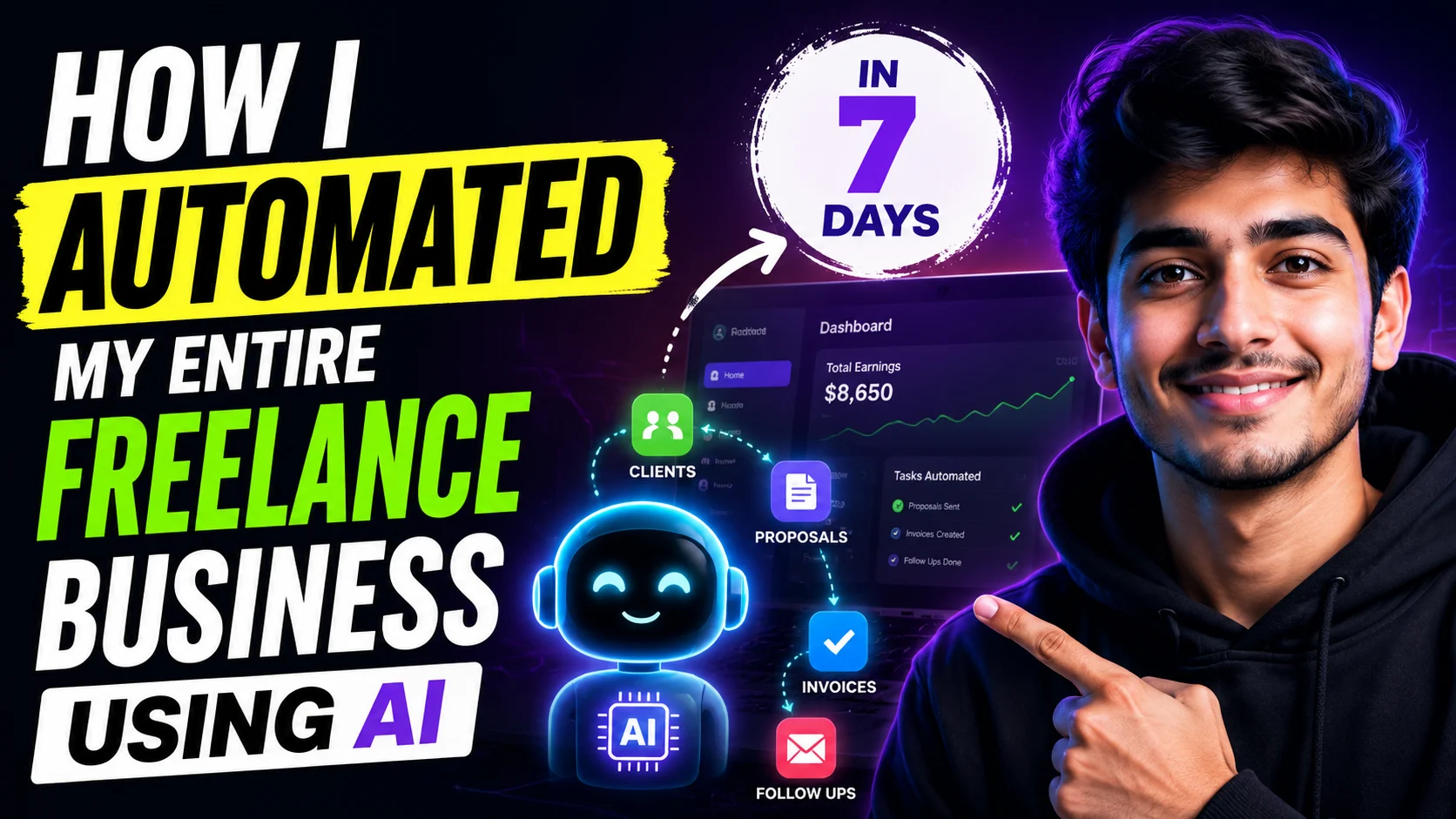
I used to spend up to 15 hours a week just chasing invoices, writing repetitive proposals, and staring at blank screens. Then, I decided to treat my freelance business like a scalable tech startup and integrated Artificial Intelligence into every daily workflow. Within exactly one week, I reclaimed my lost hours, doubled my creative output, and transformed my business from a chaotic hustle into a streamlined, high-earning machine.
If you are a freelancer feeling the burn of administrative bloat, you are not alone. According to the 2026 Upwork Future Workforce Index, 84% of freelancers now regularly use AI tools, up from just 41% in 2023. We have crossed a tipping point where AI is no longer a novelty; it is the fundamental infrastructure of the modern independent worker.
Here is the exact blueprint of how I automated my freelance business in seven days—and how you can replicate it to become an “AI Orchestrator.”
The Tipping Point: Why AI is No Longer Optional
The freelance market has embraced AI much faster than traditional corporate environments. Data shows that among the top 2% of elite freelancers, over 80% report that AI has significantly improved both their earning potential and their overall productivity.
The goal isn’t to let AI do your job for you, but to let AI do the chores so you can focus on the craft. Upwork data reveals that freelancers who combine AI fluency with deep domain expertise—dubbed “AI Orchestrators”—earn up to 45% more per hour for complex projects.
Here is how I structured my 7-day transition to join their ranks.
Days 1-2: Automating Client Acquisition and Proposals
The biggest drain on any freelancer’s time is the pitch process. Customizing proposals takes hours, and the conversion rate is historically low.
To fix this, I built an automated lead-generation engine:
- Workflow Orchestration:I used tools like Zapier and Make (formerly Integromat) to scrape job boards and LinkedIn for specific keywords matching my niche.
- The AI Agent: I connected these feeds to a Large Language Model (LLM). Now, when a relevant job is posted, the AI cross-references the job description with my portfolio and drafts a customized first-pass proposal.
- The Human Touch: I spend just five minutes reviewing, editing for tone, and hitting send.
The Result: I reduced my pitching time from 8 hours a week to just 90 minutes, while increasing my output volume.
Days 3-4: Supercharging Core Work Delivery
Whether you are a developer, designer, or writer, the blank page is your biggest enemy. AI excels at breaking that initial friction.
I began using AI not to finalize products, but to generate the foundational scaffolding:
- For Content & Strategy:AI summarizes dense industry reports, extracts competitor messaging, and generates detailed outlines.
- For Coding & Design:It handles boilerplate code, generates API documentation, and creates rapid visual mood boards.
As Nick Bloom, an economics professor at Stanford University, points out: “The value is not showing up evenly; it is concentrated in more complex work where people are applying expertise, judgment, and business context on top of AI”. AI drafts the foundation; I apply the expert polish.
Days 5-6: Putting Admin and Finances on Autopilot
Missed deadlines, scope creep, and tax-season panic are the silent killers of a freelance business. I handed these over to automated systems.
- Smart Bookkeeping:I integrated AI-assisted accounting tools (like QuickBooks AI) that automatically categorize transactions, extract data from receipts via OCR, and project future cash flows based on my current pipeline.
- Meeting Summaries: I deployed AI note-takers for all client calls. They automatically transcribe the meeting, extract action items, and draft a follow-up email before I even leave my desk.
By automating these administrative functions, I effectively hired a virtual assistant for a fraction of the cost, saving an estimated 3-5 hours a week on email and communication alone.
Day 7: The Human Element and Refinement
The final day wasn’t about adding more tools; it was about auditing the system. AI is a powerful amplifier, but it requires supervision. I spent Day 7 building a library of tested prompts and refining my workflows to ensure my unique voice and strategic thinking remained front and center.
The most valuable freelancers in 2026 combine technical AI skills with highly human traits—problem-solving, critical thinking, and adaptability. AI handles the routine, but I handle the relationships.
Your Next Move
The freelance economy is bifurcating. There are those who compete against AI on price, and those who use AI to compete on value, speed, and strategic insight.
Takeaway & Call to Action: You don’t need to overhaul your business overnight. Start small. For the next week, track your time and identify the top three repetitive administrative tasks draining your energy. Choose just one AI tool to automate the worst offender. Reclaim those hours, reinvest them into high-value client strategy, and watch your freelance business scale.
Also Read GitHub Copilot vs. ChatGPT: The Ultimate Showdown for Engineering Students