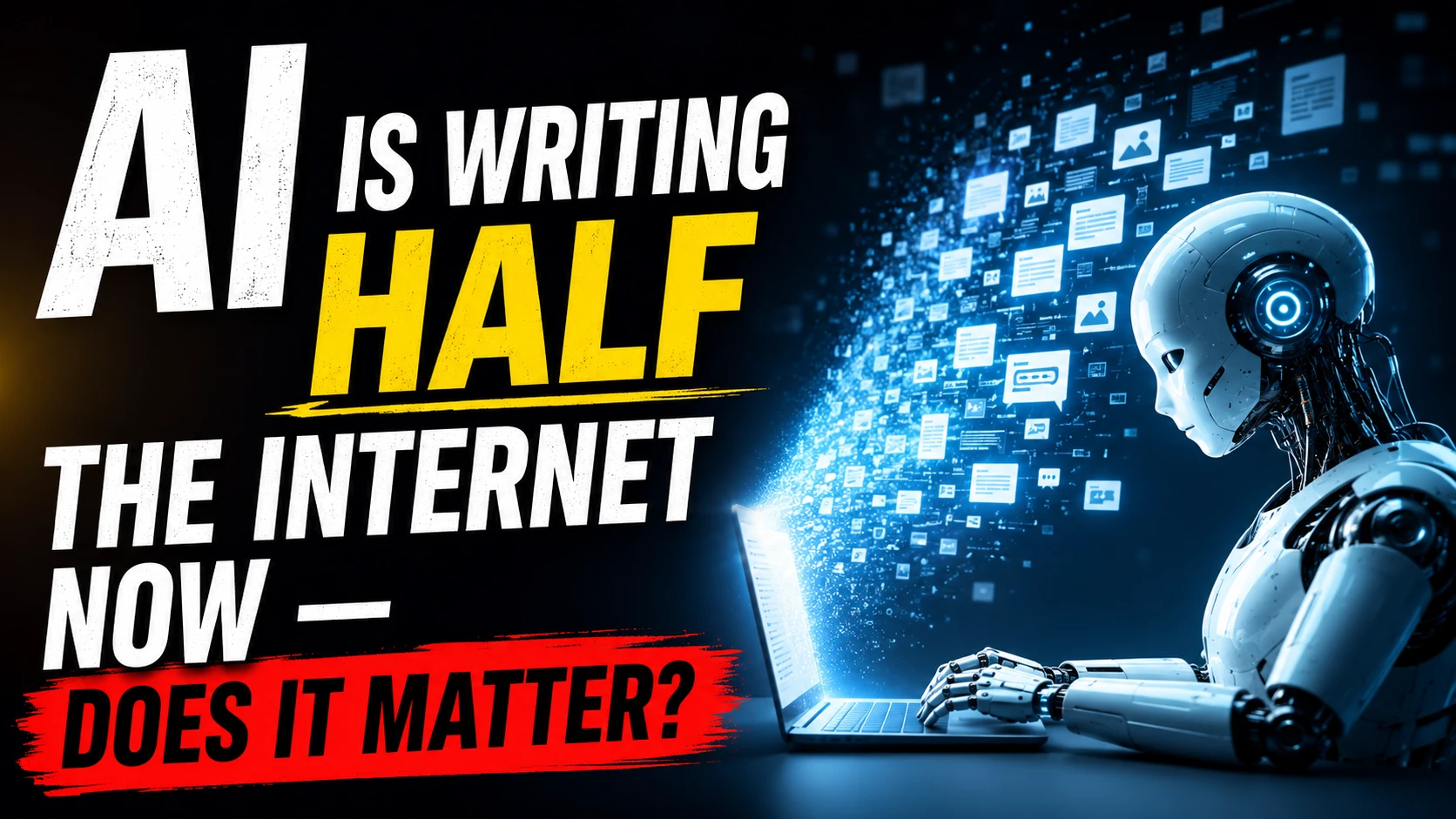
It happened quietly, right under our noses. Today, nearly every second article, review, or blog post you read online is written—or heavily assisted—by a machine. The internet has officially crossed the artificial intelligence rubicon, but the real question isn’t how much AI is writing; it’s whether we should actually care.
For the past two years, digital platforms have been quietly flooded with generative AI content. Since the explosive launch of ChatGPT in late 2022, the digital publishing landscape has fundamentally shifted. But before we mourn the death of human creativity or declare the internet a wasteland of bots, let’s look at what the data actually tells us.
The 50% Tipping Point: What the Data Says
We have finally reached the inflection point. A massive 2026 study by the digital marketing firm Graphite analyzed over 55,000 webpages and found that roughly half (49.9%) of newly published English-language online articles were primarily generated by AI.
The integration of AI goes even deeper when you look at partial assistance. A separate analysis of 900,000 newly created web pages revealed a staggering reality:
- 74.2% of new web pages contained at least some AI-generated content.
- 25.8% were categorized as “pure human”.
- 2.5% were categorized as “pure AI” with no human touch.
This data confirms that artificial intelligence is no longer a novelty tool used by tech enthusiasts—it is the default writing assistant for the modern web.
Debunking the “90% AI” Myth
You may have seen a terrifying statistic circulating on social media: “90% of all online content will be AI-generated by 2026.”
This claim, which originally stemmed from a misinterpreted Europol report on synthetic media and disinformation, is spectacularly flawed,. It ignores the basic math of the internet. We are sitting on more than three decades of accumulated human content—from Wikipedia’s 60 million articles to the Internet Archive’s 735 billion saved pages.
For AI to constitute 90% of the entire web, it would have to out-publish 30 years of global human output in just a few months. What is actually happening is a shift in new content volume, not a complete erasure of our digital history.
The Plateau Effect: Interestingly, the relentless surge of AI content seems to have hit a ceiling. After jumping from near zero to 48% by late 2024, the growth curve flattened, hovering around 50% for the last five quarters.
What Exactly Is AI Writing?
If half of the web’s new articles are synthetic, why doesn’t the internet feel completely alien? Because of what the AI is being tasked to write.
AI isn’t writing Pulitzer-winning investigative journalism or deeply personal memoirs. Instead, it is being weaponized for volume. The vast majority of AI-generated articles consist of low-stakes, formulaic content. The bots are busy writing:
- SEO Listicles: The endless “Top 10 Weekend Getaways” or “Best Toasters of 2026” guides.
- Product Reviews & Summaries: Regurgitated spec sheets posing as hands-on reviews.
- Corporate Copy: Standardized press releases, cover letters, and generic marketing fluff.
As Binghamton University researchers note, the primary economic purpose of this synthetic content is to capture search traffic and persuade, not to express originality or human creativity.
Does It Actually Matter?
Yes and no.
On one hand, the automation of mundane text is a natural technological evolution. We don’t mourn the loss of human switchboard operators, and we probably won’t mourn the loss of human-written SEO recipe introductions. AI tools integrated natively into platforms like Google Docs and Gmail make basic communication faster and more accessible.
On the other hand, a web dominated by AI threatens to create an “echo chamber of mediocrity.” Generative AI models are trained on existing human data. If future models are forced to train on today’s synthetic content, we risk a digital feedback loop where the internet becomes increasingly generic, losing the nuance, lived experience, and localized context that only humans provide.
Furthermore, there is a very real concern about the erosion of trust. While deepfakes and AI-generated news haven’t caused the apocalyptic electoral outcomes some predicted, they have certainly contributed to a baseline cynicism among digital consumers.
The Takeaway: Your Voice is Now a Premium Asset
We are moving out of the era where volume wins on the internet. As AI drives the cost of producing average content to zero, authentic human insight is becoming a premium commodity.
The future is not human versus AI; it is human with AI. The creators, journalists, and brands that survive this transition won’t be the ones rejecting technology—they will be the ones who use AI for efficiency while fiercely protecting their editorial judgment, original research, and unique voice.
What you can do: Next time you are reading a product review or a news update, look for the “human fingerprint”—personal anecdotes, novel insights, and unpredictable creativity. Support platforms that invest in real journalism. In an internet flooded with synthetic noise, your attention is the most powerful vote you have.
Also Read Is AI Making Us Dumber? Here’s What the Research Actually Says