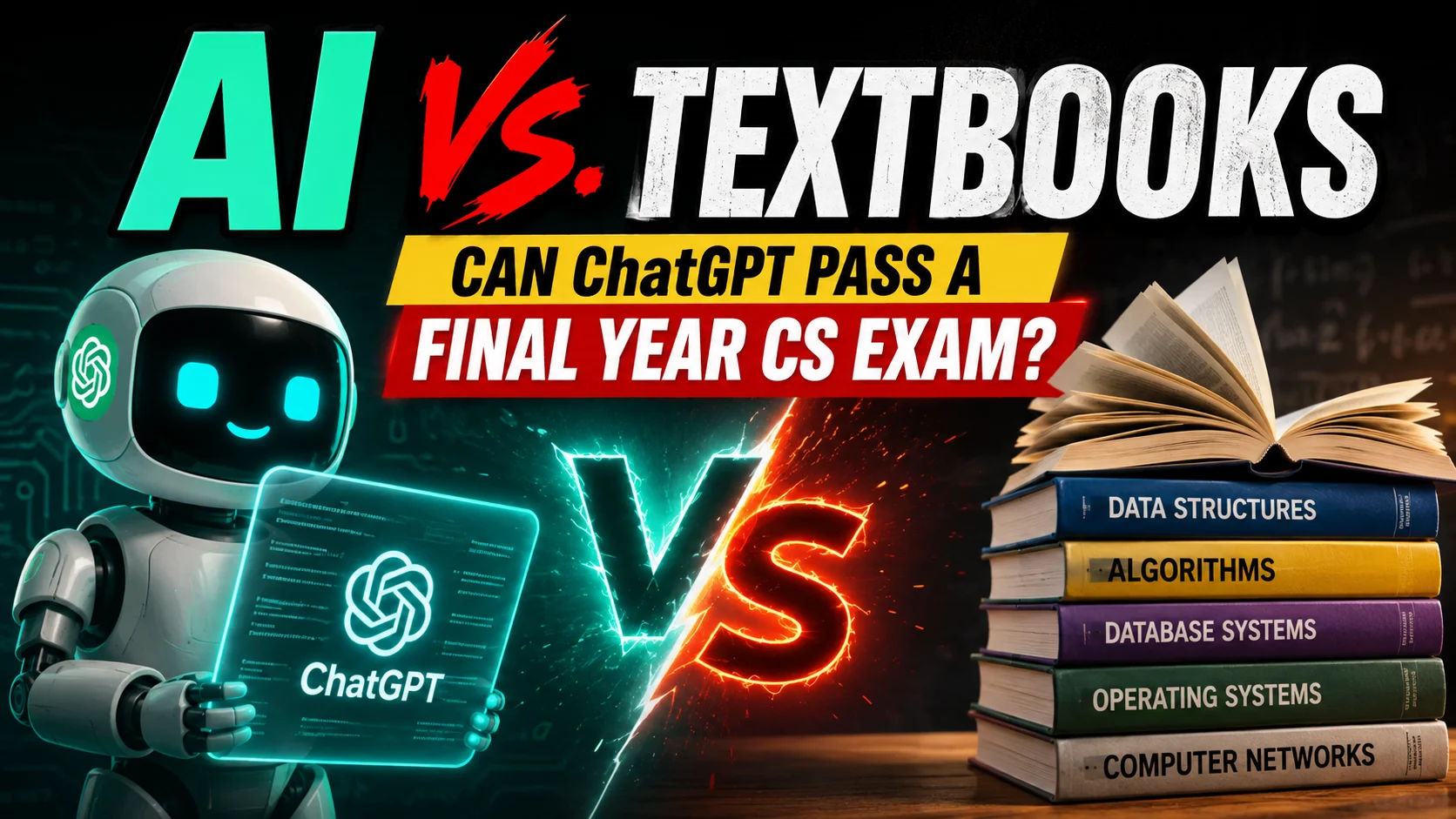
Imagine sitting in a grueling university examination hall, sweating over complex algorithm puzzles, while an invisible competitor silently churns out the correct answers in mere seconds. Since its explosive debut, generative AI has been touted as the ultimate homework helper, but academics have been asking a far more serious question: Can a chatbot actually pass a rigorous, university-level computer science exam?
The short answer is yes—but the reality of how it does it, and what it means for human students, is a wake-up call for the global education system.
{/* Reason: A visual illustrating the intersection of students, code, and AI helps ground the article’s theme of AI in university settings. */}
The Ultimate Test: ChatGPT in the Exam Hall
To find out if large language models (LLMs) could handle genuine academic rigor, researchers Sebastian Bordt and Ulrike von Luxburg from the University of Tübingen put ChatGPT to the ultimate test. In a benchmark benchmark study, they fed the AI a complete undergraduate computer science exam focused on “Algorithms and Data Structures.”
To ensure absolute fairness, researchers hand-copied the AI’s responses onto standard exam sheets and slipped them into a stack of 200 human student papers for a blind grading process.
The results were paradigm-shifting. ChatGPT scored 20.5 out of 40 points, narrowly passing the exam. It proved that an AI, trained on vast swathes of internet data, could hold its own in a highly technical, logic-heavy academic environment alongside university undergraduates.
From Barely Passing to Top of the Class
While early iterations of ChatGPT simply scraped by with average grades, the technology has evolved at a breakneck pace. Subsequent research comparing newer models paints a more intimidating picture for human competitors.
Recent evaluations of advanced AI models—including GPT-4, Gemini, and Claude—on introductory programming curricula revealed staggering performance gaps:
- The Human Average: In a recent university programming study, the average student achievement score sat at roughly 56 out of 100.
- The AI Average: Advanced models like ChatGPT and Claude scored an impressive 86, placing them squarely in the upper achievement band of the class (equivalent to an A- or B+ grade).
These tools excel at generating code snippets, summarizing complex software documentation, and solving introductory-level object-oriented programming tasks. For standard, textbook-style problems, AI has essentially become the ultimate straight-A student.
The Catch: Why AI Still Has Blind Spots
However, before tech companies replace their entire junior engineering teams with chatbots, researchers have identified critical weaknesses in how AI processes computer science.
- Misinterpreting Implicit Rules: AI frequently struggles when task difficulty increases. It often fails to grasp implied requirements that a human student would naturally understand through context and intuition.
- The Hallucination Factor: LLMs are prone to generating highly confident but entirely incorrect code, failing to provide comprehensive solutions for multi-layered architectural problems.
- Lack of Genuine Comprehension: Because exam questions often mirror homework problems and open-source code already present in AI training data, researchers caution against assuming the chatbot actually understands computer science. It is recognizing mathematical and linguistic patterns, not exercising independent logic.
The “Lazy Brain” Epidemic
Perhaps the most alarming finding comes not from the AI’s performance, but from the human brain’s reaction to it.
An MIT study analyzing brain activity revealed that students relying heavily on ChatGPT exhibited the lowest neural engagement and consistently underperformed at behavioral and cognitive levels. When tasked with rewriting code or text without the tool, the AI-reliant group remembered very little of their own work. The convenience of ChatGPT bypasses the deep cognitive processing required for long-term memory building.
Furthermore, an empirical study on programming education published in 2026 highlighted a double-edged sword: while students using ChatGPT completed tasks faster and wrote code more efficiently, they demonstrated decreased creativity, diminished code readability, and a heavy reliance on ready-made solutions over collaborative problem-solving.
What This Means for the Future of Tech Education
The realization that an AI can comfortably pass a computer science degree is forcing global universities to rethink how they teach. The era of grading students purely on basic syntax and code generation is over. Educators are now shifting towards evaluating critical thinking, software architecture, and secure coding practices—skills that still require a human touch.
The Takeaway: ChatGPT is undeniably a powerful co-pilot, capable of acing exams and streamlining menial coding tasks. But relying on it to do the heavy lifting will ultimately short-circuit your own cognitive development. As artificial intelligence continues to evolve, the most valuable computer scientists won’t be the ones who can write standard code from memory—they will be the ones who know how to critically analyze, secure, and innovate upon the code that AI generates.
Are you a student or developer using AI in your workflow? How do you balance efficiency with active learning? Share your thoughts and join the conversation online.
Also Read What Happens When You Ask 10 Different AIs the Same Question