The digital media landscape is facing an unprecedented velocity crisis. Content creators and publishers are caught in a relentless trap: the need to scale production rapidly to capture audience attention, up against the hard boundaries of human burnout and shrinking editorial budgets. For years, the industry’s answer was simple scheduling tools, but a quiet architectural shift is fundamentally redefining how online publications operate.
Enter the era of the autonomous newsroom. Moving far beyond the rigid rules of old-school plugins, forward-thinking publishers are deploying AI agents to manage end-to-end content lifecycles.
When implemented correctly, an AI content workflow doesn’t replace the critical eye of a human journalist. Instead, it acts as a highly efficient digital chief of staff—handling the heavy lifting of data gathering, drafting, and optimizing while leaving final editorial control precisely where it belongs: with humans.
Moving Beyond Scheduling: What is Agentic AI?
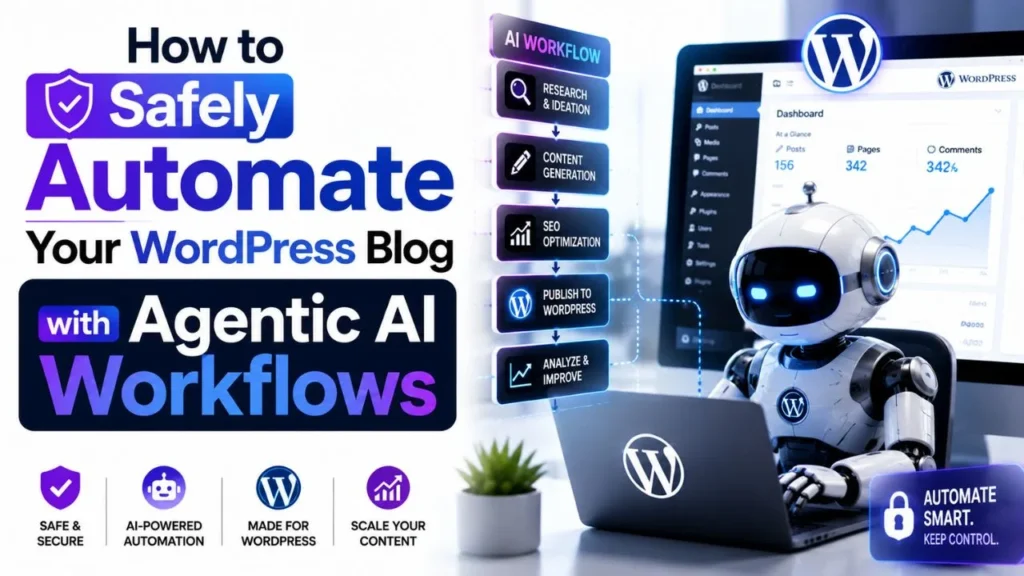
Traditional WordPress automation usually meant setting up basic RSS feed cross-posters or using time-delayed queues. These tools are fundamentally passive; they follow static rules without any understanding of context.
Agentic AI introduces a paradigm shift. An AI agent is design-engineered to plan multi-step tasks, evaluate data quality, adapt to unexpected errors, and interface directly with complex web environments. In the context of digital publishing, this means an agent can actively track breaking trends, synthesize research, draft fully articulated articles, and format them for the web without requiring constant manual intervention at every single step.
The Technical Engine: REST API, Application Passwords, and n8n
Building a enterprise-grade, reliable framework for blog publishing automation requires looking past superficial, heavy plugins that bloat your site’s loading speed. The most stable architectures rely entirely on the core programming infrastructure of WordPress itself.
+------------------+       Secure Handshake (HTTPS)       +-----------------------+
|  AI Orchestrator | -----------------------------------> |  WordPress REST API   |
|     (e.g., n8n)  | <----------------------------------- | (/wp-v2/posts engine) |
+------------------+      Using Application Passwords     +-----------------------+
1. The WordPress REST API
The true foundational bridge for automation is the native WordPress REST API. This built-in interface allows external software applications to securely pass data directly back and forth with your website’s database. Using specific programmatic channels, or “endpoints” (specifically the /wp-v2/posts endpoint), an external system can view, create, edit, or delete posts instantly.
2. Guarding the Gate with Application Passwords
Security is the biggest point of failure for amateur setups. Exposing your main administrator credentials to an external script is an open invitation to hackers. Modern WordPress architecture solves this via Application Passwords. These are unique, randomly generated strings created within a specific user’s dashboard profile. They act as limited, easily revocable security keys meant exclusively for API access over HTTPS, ensuring your master login remains untouched.
3. Smarter Scheduling via External Orchestrators
While WordPress includes a internal scheduling mechanism known as WP-Cron, it has a fatal flaw: it is completely passive. WP-Cron only executes tasks when a live visitor lands on the site. If your blog experiences a traffic lull at 3:00 AM, your scheduled automation routine simply won’t run.
To achieve true operational reliability, professional setups use dedicated external workflow orchestrators like n8n. These platforms run on strict system-level clocks or respond instantly to incoming webhooks, acting as a reliable, external central nervous system for your entire operations layout.
Blueprint of a Professional AI Content Pipeline
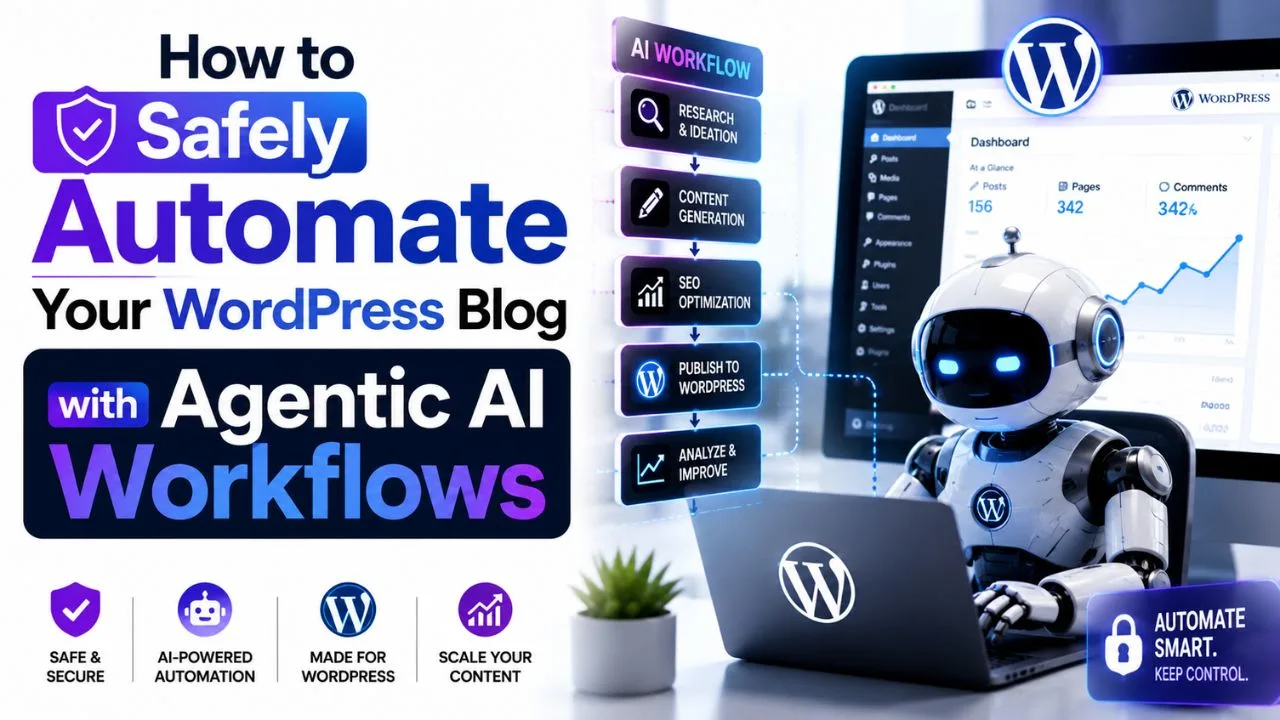
A robust, secure agentic system breaks the production process down into discrete, highly monitored modules rather than generating everything in a single, unmonitored flash:
- Discovery & Verification: The initial agent continuously cross-references vetted data sources, industry whitepapers, or trusted news feeds to isolate relevant story ideas based on pre-set parameters.
- Contextual Synthesis & Drafting: A separate generation agent takes the verified reference facts and builds out a structured draft, strictly adhering to an uploaded document detailing your publication’s specific stylistic guidelines and voice.
- The Technical Polish: A dedicated SEO agent systematically scans the raw draft to write clear meta descriptions, structure text logically using proper header hierarchies, and insert alt-text attributes for image layouts.
- The API Payload Delivery: The central orchestration tool packages the clean HTML code, assigned category tags, and meta information into a secure text payload, pushing it safely into the WordPress database via the REST API.
The Double-Edged Sword: Speed vs. Hallucinations
The operational benefits of adopting an agentic setup are clear. Newsrooms can maintain an incredibly consistent publishing cadence, allowing human writers to step away from repetitive data aggregation and pivot entirely toward original investigative journalism, field interviews, and deep-dive analysis.
However, over-automation introduces severe liabilities. The primary risk is AI hallucination—the tendency for large language models to convincingly fabricate data points, historical context, or quotes out of thin air. Relying blindly on an unchecked automated system will quickly destroy a publication’s hard-earned credibility.
Furthermore, major search engines have deployed highly sophisticated core ranking algorithms designed to flag and downrank low-effort, mass-produced digital noise. If an automated workflow simply copies what is already on the web without adding unique value, the website risks receiving steep search visibility penalties.
Implementing the ‘Human-in-the-Loop’ Blueprint
To successfully navigate these operational hazards, professional publishers enforce a strict structural rule: the automation pipeline must never have the authority to push an article live to the public.
When your orchestrator delivers the final data payload to the WordPress REST API, the post status parameter must be explicitly defined as "draft" or "pending".
This creates an unskippable safety gate. A human editor must log in to visually review the text, independently fact-check the key details, verify original sourcing, and manually hit the final “Publish” button. Additionally, the Application Passwords should be tied exclusively to restricted, lower-level user profiles (like an “Author” or “Editor” role) to ensure that even if an API key is leaked, the core site security settings remain completely safe from exploitation.
The Takeaway
Agentic AI workflows represent a powerful new era for digital media, but they are a tool for amplification, not an editorial replacement. By utilizing clean infrastructure like the WordPress REST API and orchestrators like n8n, you can cleanly systematically eliminate hours of administrative overhead.
Your Next Step: Avoid the temptation to automate your entire website overnight. Start small. Pick one repetitive, low-risk bottleneck in your current daily routine—such as auto-generating SEO meta descriptions for human-written pieces or formatting incoming raw text wires—and build a safe, secure integration around it. Once your team establishes comfortable guardrails, you can gradually scale up your automated horizons.