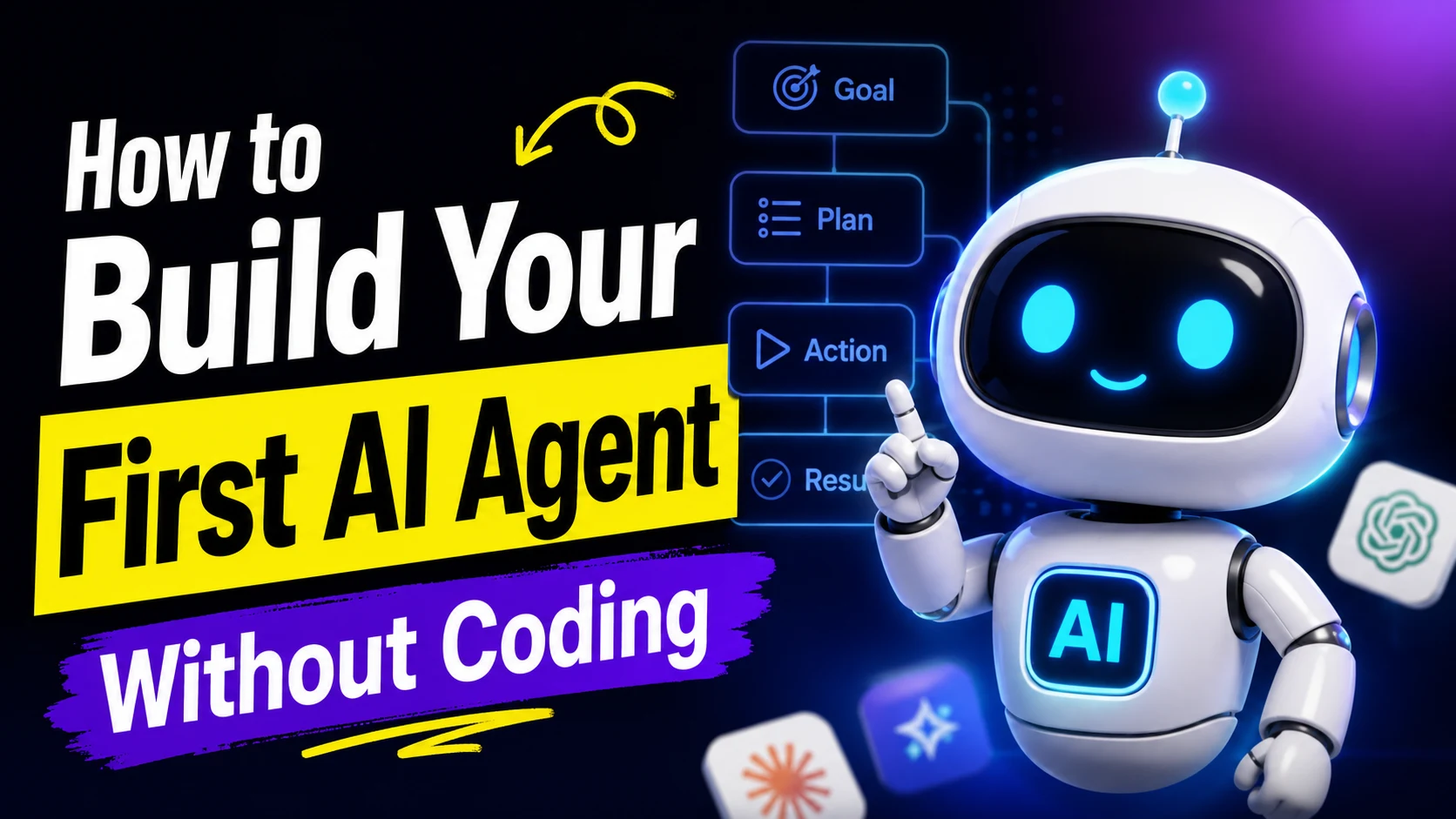
The idea of building artificial intelligence used to conjure images of complex code, massive server racks, and teams of highly specialized engineers. Not anymore.
Welcome to 2026, the year “no-code AI agent builders” have moved from experimental sandboxes to essential business infrastructure. Research firm Gartner recently forecast that the worldwide AI platforms and models market will grow a staggering 63% this year to $64 billion. Even more striking? Gartner predicts AI agents will outnumber human sales reps 10 to 1 by 2028.
But what is an AI agent, and how can you build one if you don’t know Python from C++? Let’s break it down.
Understanding the AI Agent
Before building, it helps to understand what an AI agent actually is.
Unlike a basic chatbot that simply answers questions based on a script, an AI agent can:
- Reason: Understand context and break down a complex goal.
- Act: Use tools, APIs, and software (like sending an email or updating a CRM).
- Remember: Retain context from past interactions or access specific databases.
Think of it less like a calculator and more like a digital intern. You give it a goal, and it figures out the steps to get there.
Step 1: Define the Problem
The biggest mistake teams make is trying to build an “everything agent.” The most successful AI deployments start small and specific.
Instead of building an agent to “handle customer support,” build an agent to “triage incoming support tickets, tag them by urgency, and draft a response for a human agent to review.”
Ask yourself:
- What repetitive task eats up my team’s time?
- What specific systems (Gmail, Slack, HubSpot) are involved in that task?
- What is a clear definition of success for this task?
Step 2: Choose Your Platform
The market for no-code builders has exploded. These platforms offer drag-and-drop interfaces that let you connect logic, language models, and actions visually.
Here are a few prominent options in 2026:
- Metaflow AI: Often cited as a top choice for marketing workflows.
- Zapier / n8n: Excellent if you already rely heavily on these platforms for traditional automation.
- Relevance AI / Gumloop: Strong contenders for general-purpose agent building.
The 2026 Shift: The best platforms now emphasize “Generative UI”. Instead of just spitting out text, these agents generate actionable interfaces—like a customized dashboard or a formatted report—based on what you need at that exact moment.
Step 3: Select the “Brain” (LLM)
Your agent needs a reasoning engine. Most platforms let you plug in a Large Language Model (LLM) of your choice.
- GPT-4o or Claude 3.5 Sonnet: Great for complex reasoning and nuanced writing.
- Llama 3 or Mistral: Often faster and more cost-effective for simpler, high-volume tasks.
Step 4: Give It Tools and Memory
This is where the agent becomes useful.
- Tools: Connect your agent to your existing software. If it’s a sales agent, it needs access to Salesforce or HubSpot. If it’s an internal HR agent, it needs access to your employee directory.
- Memory: Give it documents to read. This is often called RAG (Retrieval-Augmented Generation). You upload your company FAQs, product manuals, or past successful sales pitches, and the agent uses that data to inform its actions.
Step 5: Test, Refine, and Deploy
AI agents require supervision, especially early on.
- Run test scenarios: Feed it dummy data and watch how it reasons through the problem.
- Check for “hallucinations”: Ensure it’s relying on the memory you provided, not inventing facts.
- Deploy with a “human in the loop”: For the first few weeks, have the agent draft actions (like an email response) but require a human to click “send.”
The Takeaway: It’s About System Design, Not Coding
The barrier to entry for AI has shifted. It’s no longer about whether you can write the code; it’s about whether you understand your business processes well enough to automate them.
As Dan Gottlieb, VP Analyst at Gartner, recently noted regarding sales agents, “AI agents should not be viewed as a shortcut to sales productivity… If [the underlying] systems are fragmented, the agents will scale the fragmentation.”
The tools are ready and waiting. Your first step isn’t learning to code—it’s mapping out the workflow you want to automate. Start small, connect your systems, and watch your new digital intern get to work.
Also Read 5 AI Announcements This Week You Missed (and Why They Matter)