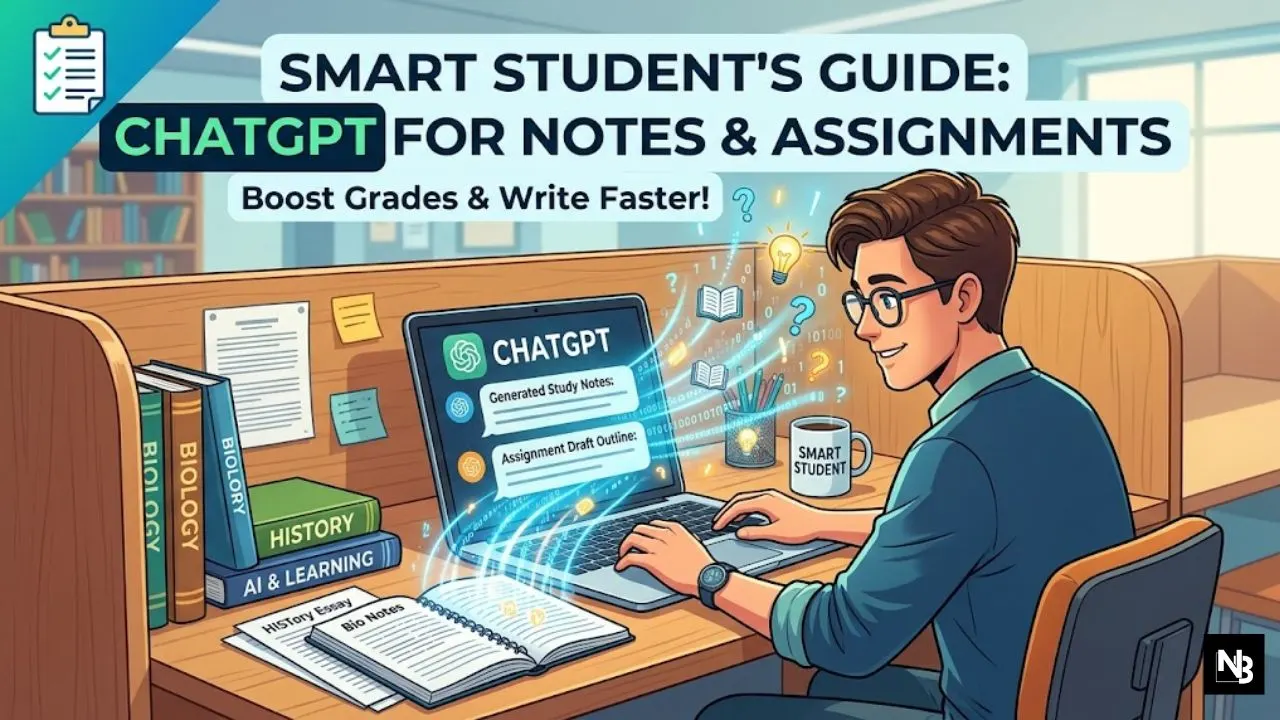
Late-night cramming, endless reading lists, and the dread of a blinking cursor on a blank document—student life has always been a battle against time. But the rapid rise of generative AI is rewriting the rules of academic prep. Today, millions of students are turning to ChatGPT to organize chaotic lecture notes, decode dense textbook chapters, and brainstorm assignment ideas in seconds.
However, using AI for schoolwork is a double-edged sword. While ChatGPT is an incredibly powerful study assistant, relying on it blindly can lead to factual errors and serious academic integrity violations. If you are looking for a smart way to study faster, here is a practical, unbiased guide on how to use ChatGPT for study notes and assignments responsibly.
Transforming Chaos into Clarity: How to Use ChatGPT for Study Notes and Assignments
One of the most effective ways to use ChatGPT is as a personalized, on-demand tutor. It excels at breaking down overwhelming amounts of information into digestible chunks.
Instead of re-reading a 40-page chapter three times, students can use the AI to streamline their revision process. Here is how:
- Summarizing Dense Material: Paste lengthy articles, historical texts, or lecture transcripts into ChatGPT and ask it to extract the core arguments. It can condense a sprawling chapter into a half-page summary.
- The “Explain Like I’m 5” Technique: Struggling with complex concepts like quantum mechanics, macroeconomics, or cell mitosis? Asking ChatGPT to “explain this in simple terms” or “use a real-world analogy” can instantly clarify confusing topics.
- Instant Flashcards and Quizzes: Active recall is proven to be one of the best study methods. You can feed your notes to the AI and instruct it to generate multiple-choice quizzes, fill-in-the-blank questions, or standard flashcards to test your knowledge before an exam.
ALSO READ– ChatGPT vs Gemini in 2026: Which AI Is Better for Everyday Use?
Brainstorming and Outlining: ChatGPT for Assignments
When it comes to essays and research papers, staring at a blank screen is often the hardest part. ChatGPT can help you overcome writer’s block, provided you use it as a co-pilot rather than a ghostwriter.
- Generating Outlines: If you have a prompt but do not know how to structure your essay, ask ChatGPT to build a skeletal outline. It can suggest a logical flow for your introduction, body paragraphs, and conclusion.
- Brainstorming Angles: Need a unique perspective for a history paper or a debate topic? The AI can provide a list of pros, cons, and alternative viewpoints to help you build a stronger, more nuanced argument.
- Polishing Grammar and Flow: Once you have written your first draft, ChatGPT can act as a proofreader. It can flag grammatical errors, suggest better vocabulary, and improve the readability of your sentences without changing your original meaning.
The Danger Zone: Limits and Academic Risks
While the benefits are immense, educators globally warn against the misuse of AI in academics. Using ChatGPT responsibly means understanding its limitations.
- AI Hallucinations: ChatGPT is a language model, not a search engine. It predicts the next logical word in a sentence, which means it can—and frequently does—make up facts, dates, and non-existent book citations. Always cross-check data with trusted academic sources.
- Loss of Original Voice: Essays generated entirely by AI tend to be repetitive, overly formal, and lacking in personal insight. Submitting a purely AI-written assignment deprives you of the critical thinking process that education is meant to foster.
- Plagiarism and Academic Integrity: Most schools and universities now use AI-detection software. Submitting copied AI text as your own work is considered academic misconduct and can lead to failing grades or expulsion. Follow your institution’s specific guidelines regarding AI usage.
Cheat Sheet: The Best AI Prompts for Students
To get the best results, you need to write specific, detailed prompts. Avoid vague requests. Instead, try these proven templates:
- For Revision: “I am studying [Topic/Subject]. Turn these notes into 10 multiple-choice questions to test my knowledge. Provide the answers and explanations at the end.”
- For Simplification: “Explain the concept of [Complex Topic] using simple language and a real-world analogy suitable for a high school student.”
- For Outlining: “Create a detailed essay outline on [Topic]. Include an introduction with a thesis statement, three main body paragraphs with suggested talking points, and a conclusion.”
- For Proofreading: “Review this paragraph for clarity and grammar. Do not rewrite it entirely, but point out errors and suggest minor improvements for better flow: [Insert Text].”
The Bottom Line
ChatGPT is revolutionizing education, but it is a supplement to your brain, not a substitute for it. It works best when used to organize thoughts, speed up research, and test your knowledge. The most successful students use AI to save time on the tedious aspects of studying, giving them more energy to focus on critical thinking and original writing.
What is your take on AI in the classroom? Have you used ChatGPT to prepare for an exam or outline an essay? Check your university’s AI policy today, try out the prompts above, and take control of your study sessions—smarter, not harder.