If you have ever stared at your resume and wondered why you are getting ghosted by recruiters, you are not alone. In a job market where hiring managers spend an average of just 7.4 seconds scanning a resume, your margins for error are virtually non-existent. But how do you get honest feedback? Your friends will politely tell you it “looks great,” and career coaches often offer vague platitudes.
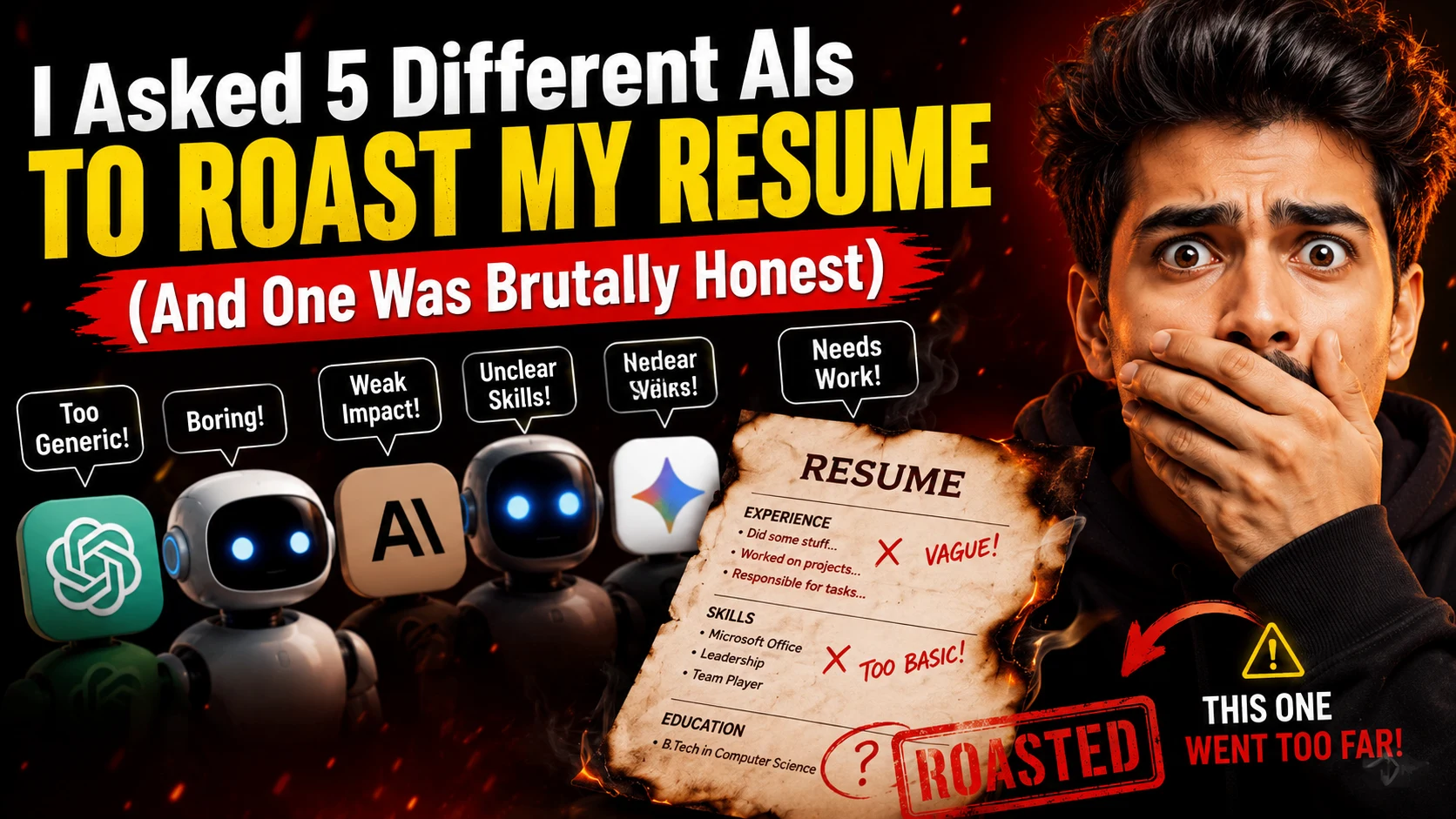
So, I decided to run an experiment. I took my perfectly “safe,” slightly padded resume and fed it to five different AI models—ChatGPT, Claude, Gemini, Grok, and Perplexity. My prompt was simple: “Act as a tired, caffeinated recruiter. Roast this resume. Tell me exactly why you would throw it in the trash, and then tell me how to fix it.”
The results were eye-opening, hilarious, and, in one case, absolutely savage. Here is what happened when I let the machines tear apart my career history.
The Lineup: How the 5 Models Performed
Every AI has a different personality and a different approach to analyzing text. Here is how they handled the task of ripping my resume to shreds.
1. ChatGPT: The Overachieving Strategist
ChatGPT didn’t just roast me; it delivered a comprehensive strategic teardown. It immediately identified my reliance on “fluff” words.
- The Roast: “You claim to be a ‘results-driven professional,’ but there isn’t a single result on this page. This reads like a job description that you copied and pasted. You managed a team? Great. Was it a team of two or two hundred?”
- The Fix: ChatGPT rebuilt my bullet points using the STAR (Situation, Task, Action, Result) method, demanding that I add metrics to every single line. It was highly effective at taking vague duties and restructuring them into action-oriented achievements.
2. Claude: The Detail-Oriented Critic (The Winner)
Claude was the clear winner of this experiment. It provided the most nuanced, context-aware feedback, reading between the lines to find the actual value in my work history.
- The Roast: Claude was polite but surgical. “Your opening summary is a wall of text that says nothing unique about you. You are hiding your best achievement—a 40% reduction in processing time—at the very bottom of your experience section. A recruiter will never read that far.”
- The Fix: Claude excelled at information hierarchy. It reorganized my resume to put the most impressive, quantifiable data front and center. It didn’t just rewrite my bullets; it explained why the new versions would perform better in an Applicant Tracking System (ATS).
3. Gemini: The Structural Organizer
Gemini was less interested in my phrasing and more concerned with how my resume was built.
- The Roast: “Your formatting is inconsistent. You used three different date formats, and your skills section is a disorganized dump of keywords. An ATS will likely fail to parse this correctly.”
- The Fix: Gemini was incredibly useful for cleaning up the structure. It provided a clear, ATS-friendly template and showed me exactly where to place keywords pulled directly from target job descriptions. It is the best tool if your resume is visually chaotic.
4. Grok: The Brutally Honest Menace
If you want to cry a little bit, give your resume to Grok. Designed by xAI with minimal content restrictions, Grok delivered the brutal honesty I asked for.
- The Roast: “This resume is the human equivalent of a participation trophy. ‘Collaborated with cross-functional stakeholders’? So you attended meetings and breathed air. There is absolutely nothing here that proves you actually shipped a product.”
- The Fix: While the delivery was harsh, Grok was excellent at forcing me to cut the corporate jargon. It made me realize that phrases like “passionate self-starter” are completely invisible to hiring managers.
5. Perplexity: The Industry Researcher
Perplexity took a different approach, analyzing my resume against current industry trends.
- The Roast: “You are applying for roles in 2026, but your skill set looks like it belongs in 2022. You list ‘Microsoft Office’ as a key skill, which is assumed for any professional role, while failing to mention any modern data analysis tools.”
- The Fix: Perplexity was fantastic at identifying missing keywords and suggesting industry-specific terminology that would make my resume look more current and competitive.
The 3 Things AI Hated Most About My Resume
Across all five models, three consistent themes emerged. If you are updating your resume, these are the red flags you need to fix immediately:
- The “So What?” Failure: Most of my bullet points described what I did, not what I achieved. Every bullet must pass the “So What?” test. If you can’t attach a number, a specific outcome, or a measurable impact to a bullet point, delete it.
- The Buzzword Soup: Words like “leveraged,” “synergy,” and “dynamic” take up valuable real estate without proving anything. Replace them with concrete action verbs like “built,” “shipped,” or “grew.”
- The Fluff Summary: A professional summary that starts with “Hard-working professional seeking opportunities…” is a waste of the most important six seconds of a recruiter’s time.
The Takeaway: Stop Asking Your Friends for Resume Advice
The truth is, humans are too nice to give you the resume feedback you actually need. We gloss over the clichés and ignore the lack of metrics because we don’t want to hurt our friends’ feelings.
AI has no such reservations. It is excellent at compression, ruthless about jargon, and completely objective.
Your Action Plan: Don’t let AI write your resume from scratch—it will invent metrics and sound robotic. Instead, write your best draft, and then ask an AI to roast it. Use a prompt like: “Act as a critical recruiter. Read my resume and identify any bullet points that lack quantifiable metrics, flag any generic buzzwords, and tell me exactly why this would get rejected.”
Take the criticism, add your real numbers, and watch your callback rate climb.
Also Read The Secret AI Tools YouTubers Are Using to ‘Steal’ Millions of Views