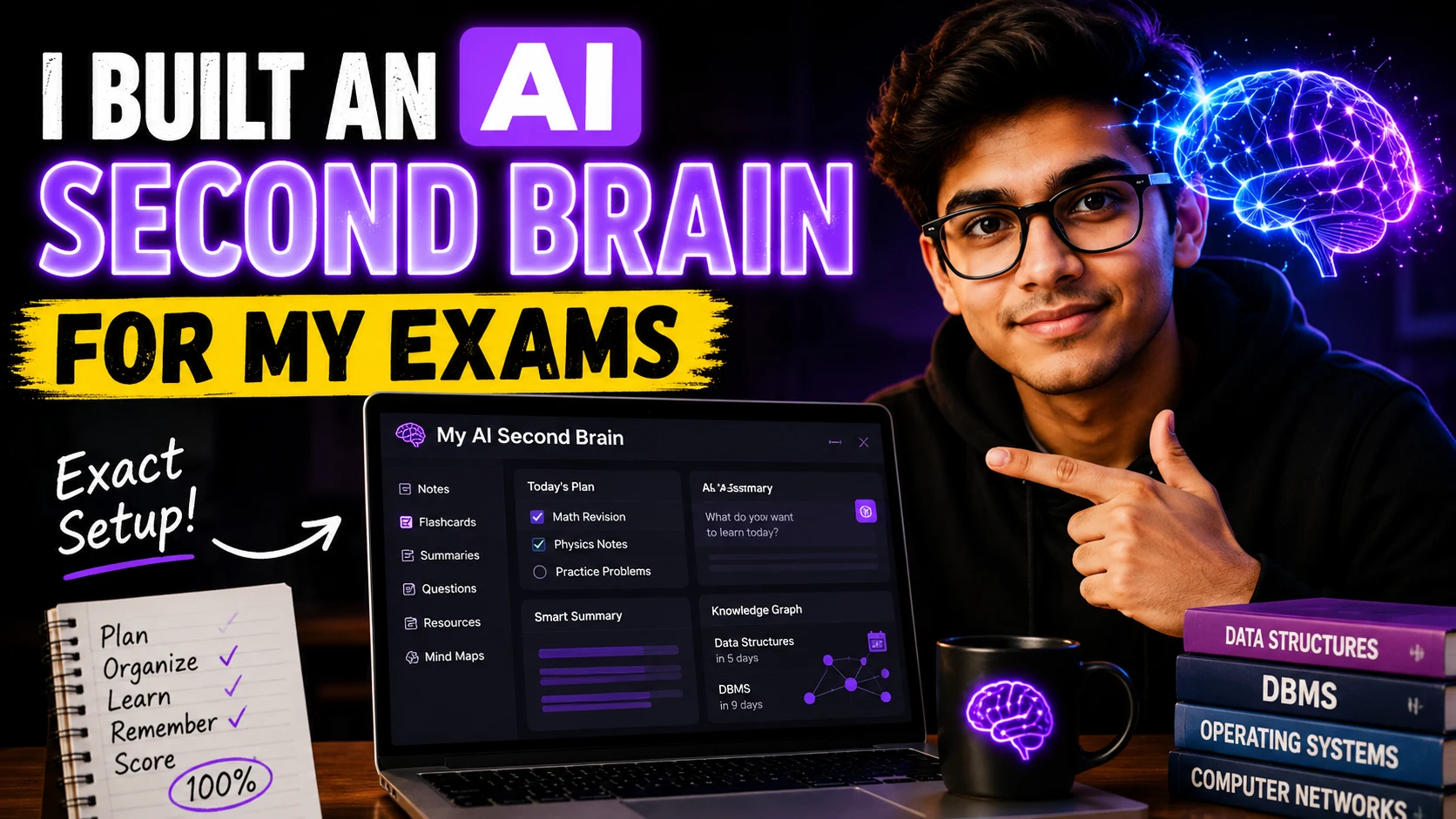
You are three weeks away from finals, staring at a mountain of unread PDFs, disorganized lecture notes, and dozens of scattered browser tabs. The hardest part of exam preparation isn’t necessarily understanding the material; it is actually finding the exact piece of information you need during revision. What if you could build a digital mind that remembers every paper, connects every concept, and automatically generates custom quizzes based purely on your curriculum?
Welcome to the era of the AI “Second Brain.” As a student navigating an increasingly overwhelming volume of information, relying on human memory alone is no longer a badge of honor—it is a massive bottleneck. Over the last semester, I replaced my chaotic folders and notebooks with a streamlined AI-driven personal knowledge management (PKM) system.
Here is exactly how it works, the tech stack I use, and how you can build your own to double your study efficiency.
What Exactly is an ‘AI Second Brain’?
When most students hear “AI,” they think of asking ChatGPT to write an essay or summarize a topic. That approach is flawed because generic AI relies on past training data and frequently hallucinates facts.
An AI second brain operates differently. It is a closed-loop system that acts as a secure vault for your specific knowledge. You feed it your lecture notes, course readings, and project ideas. When exam season arrives, the AI acts as your personal tutor, reading only the materials you have collected. It synthesizes your curriculum, surfacing connections between subjects you might have otherwise missed.
The Tech Stack: Choosing Your Weapons
There is no “perfect” app—only the app that matches how your brain naturally processes information. My setup relies on a combination of highly specialized tools rather than a single bloated software:
- Notion AI (The Organizer): Best for students who thrive on structure. Notion is ideal for creating databases, Kanban boards, and syllabus trackers.Its built-in AI excels at taking messy meeting notes and turning them into structured, actionable study points.
- Obsidian (The Networker): The undisputed heavyweight for privacy and “networked thinking.” Obsidian stores your files locally on your device and visualizes your notes as a dynamic “knowledge graph”. You can visibly see how your computer science algorithms connect to your mathematics theorems.
- Google’s NotebookLM (The Synthesizer): A game-changer for heavy research and exam prep. You can upload up to 50 source documents per notebook, and the AI will only answer questions based strictly on those specific files, completely eliminating the risk of hallucinations.
My Exact 4-Step Exam Workflow
Building the system is only half the battle; maintaining it is where most students fail. Here is the frictionless workflow that keeps my second brain organized:
1. Frictionless Capture (The Input Phase)
During a lecture, I do not waste time formatting. I take rapid, raw notes directly in my app. When assigned a dense academic paper, I upload the PDF into my workspace and immediately write a two-line summary in my own words explaining why it matters.The goal is to capture ideas instantly, whether I am at a keyboard or recording a voice note mid-walk.
2. Same-Day Processing (The Magic Habit)
A second brain quickly becomes a digital junk drawer if left untended. Every evening, I spend exactly 10 minutes processing the day’s inputs. I merge duplicate notes, file them into specific course folders, and flag confusing concepts for later review.
3. Concept Linking (Networked Thinking)
This is where the real learning happens. Instead of isolating subjects, I use backlinks to connect them. By typing [[concept]] in Obsidian, a note about cognitive load in my psychology folder instantly links to user experience principles in my design folder. Two weeks before an exam, I look at my Obsidian graph: the notes with the most visual links are my core, high-yield topics.
4. AI-Powered Active Recall (The Output Phase)
Rereading notes is a universally inefficient study method. Instead, I leverage my AI for active recall and spaced repetition. I prompt NotebookLM with commands like: “Pull everything I saved about inflation and quiz me on the core formulas”. Because the system only references my notes, every generated practice question perfectly mirrors my actual syllabus.
The Real-World Verdict: Does It Work?
The compounding value of a well-maintained second brain is staggering. Academic research analysts note that the sheer volume of reading required in higher education often defeats a student’s discipline. Traditional organization breaks down under the weight of hundreds of PDFs.
By centralizing your knowledge, you stop hunting for lost files. You transition from a passive reader scrambling before deadlines to an active director of your own knowledge base. The links between notes reveal arguments and structures you would never have seen otherwise.
The Bottom Line: Do not wait until your final year or thesis defense to build this system. The compounding magic of an AI second brain comes from years of accumulated material. The system that will save your grades in Year 4 is the one you start building in Year 1.
Your Next Step: Start small today. Pick one tool—Notion for database planning or Obsidian for fast, linked notes. Create a single folder for your toughest current class, upload your syllabus, and start capturing. Your future self will thank you.
Also Read What Happens When You Ask 10 Different AIs the Same Question