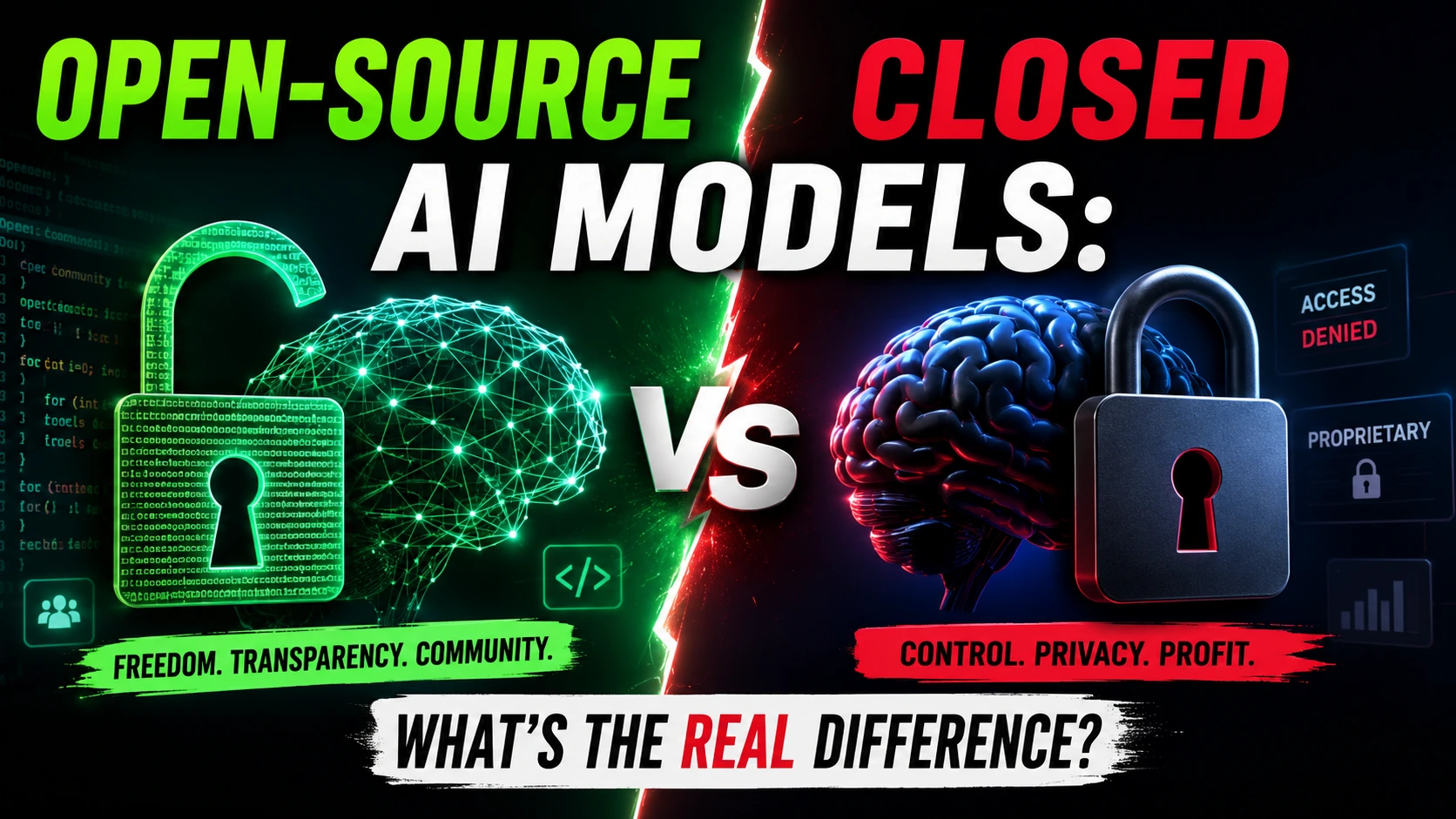
The artificial intelligence revolution has quietly fractured into two warring camps, and the winner will dictate the future of global technology. On one side stand the closed-source giants like OpenAI, offering highly polished but secretive “black box” models. On the other is a surging open-source rebellion, democratizing access to AI code for everyone from garage tinkerers to national governments.
But for businesses, developers, and everyday users navigating this rapidly shifting landscape, what is the actual difference between open-source and closed AI models? Here is everything you need to know.
The Walled Gardens: What is Closed AI?
Closed-source AI models—like OpenAI’s ChatGPT, Anthropic’s Claude, and Google’s proprietary models—are proprietary systems. The companies that build them keep the underlying code, training data, and neural weights strictly confidential. Users and developers interact with these models through web interfaces or APIs, paying for access but never seeing what happens under the hood.
The advantages:
- Unmatched Polish: Closed models typically excel in fluid, conversational explanations and general-purpose generative tasks.
- Ease of Use: They are plug-and-play. You don’t need specialized hardware or a team of engineers to start using a closed model.
- Built-in Guardrails: Because the developers control the ecosystem, they can enforce strict safety and ethical guidelines.
The catch:
The biggest drawback is the “black box” problem. Because the architecture is hidden, organizations cannot fully audit how the AI arrives at its conclusions. For mission-critical sectors like healthcare or finance, this lack of traceability is a significant regulatory hurdle. Furthermore, using these models means sending your private queries and corporate data to third-party cloud servers.
Power to the People: The Open-Source Rebellion
Open-source (or “open-weight”) AI models take the opposite approach. Pioneered by Meta’s Llama family, Mistral, and more recently, China’s DeepSeek, these models allow anyone to download, inspect, and modify their underlying architecture for free.
The open-source ecosystem is currently experiencing explosive growth. By 2025, Hugging Face—the premier hub for open AI—grew to 13 million users, hosting millions of public models and datasets.
The advantages:
- Cost and ROI: A recent IBM study of IT decision-makers found that 51% of businesses using open-source AI tools saw a positive return on investment, compared to just 41% of those relying exclusively on closed systems.
- Data Privacy: Open models can be downloaded and run locally on a company’s own hardware (on-premises or air-gapped deployments), ensuring sensitive data never leaves the building.
- Customization: Developers can fine-tune these models on local data for highly specific use cases.
The DeepSeek Disruption
The debate between open and closed models was completely upended in early 2025 with the viral release of DeepSeek-R1. Developed by a Chinese startup, DeepSeek-R1 proved that an open-source, cost-focused, reasoning-oriented framework could go toe-to-toe with OpenAI’s most powerful closed models.
This triggered a massive strategic shift across the industry. Companies that previously favored closed approaches, such as Baidu and Tencent, decisively pivoted toward open-source releases to remain competitive. DeepSeek’s success proved that the open-source community wasn’t just imitating closed models—it was actively driving state-of-the-art innovation.
3 Core Differences You Need to Know
If you are deciding which ecosystem to adopt, it boils down to three fundamental differences:
- AI Sovereignty and Control: Open-source AI is increasingly tied to national and corporate sovereignty. Governments (like South Korea’s National Sovereign AI Initiative) and large enterprises are investing in open models because it allows them to build domestic, independent AI systems without relying on foreign-controlled cloud infrastructure.
- Transparency vs. Fluency: While a closed system like ChatGPT is vastly superior at crafting effortless, human-like narratives, an open model like DeepSeek provides higher transparency. Developers can modify the codebase to understand exactly how a specialized technical or mathematical conclusion was reached.
- The Deployment Cost: Closed models lock you into subscription fees or pay-per-token API costs, which scale exponentially as your usage grows. Open models require upfront investment in computing hardware but eliminate recurring licensing fees.
The Verdict: Which One Wins?
There is no single victor in the AI race—only the right tool for the right job. If your priority is instant deployment, creative writing, and zero maintenance, closed AI models remain the gold standard. However, if your organization demands absolute data privacy, cost control at scale, and the ability to audit the AI’s logic, open-source models are undeniably the future.
The Takeaway: The era of relying exclusively on one AI provider is over. In 2026 and beyond, the most successful organizations will use hybrid systems—leveraging closed models for general tasks and deploying specialized, locally hosted open-source models for their most sensitive data.
Before you integrate AI into your daily workflow or business strategy, ask yourself: Who actually owns the data you are typing into the prompt box?
Also Read ChatGPT vs Claude vs Gemini (2026): Which AI Subscription Is Actually Worth Your Money?