You sit down at your desk, coffee in hand, ready to tackle the day’s most important project. Three hours later, you have replied to forty emails, attended a status meeting that could have been a message, and updated three different project tracking boards. You are mentally drained, yet the actual work has not even begun.
If this sounds familiar, you are not alone. You are simply caught in the modern workplace epidemic known as “work about work.” But what if you could bypass the chaos and structure your entire week in under ten seconds? By combining a proven productivity framework with generative AI, reclaiming your time is now as simple as executing a single, well-engineered prompt.
The ‘Work About Work’ Epidemic
Before looking at the solution, it is vital to understand the scale of the problem. A comprehensive global study by Asana, surveying over 10,000 knowledge workers, revealed a staggering statistic: the average employee spends 60% of their time on tasks that take them away from meaningful work.
This “work about work” includes searching for information, switching between apps, managing shifting priorities, and chasing project updates. When quantified, the numbers are alarming. Annually, the average knowledge worker loses 103 hours to unnecessary meetings, wastes 209 hours on duplicative tasks, and spends 352 hours merely talking about work.
This constant state of administrative overhead creates chronic stress and delayed projects. To break the cycle, professionals must fundamentally change how they allocate their time.
The Science of Timeboxing
To eliminate decision fatigue, experts point to one methodology above all others: timeboxing. In a comprehensive review of 100 different productivity tools and techniques, the Harvard Business Review ranked timeboxing as the number one most effective practice.
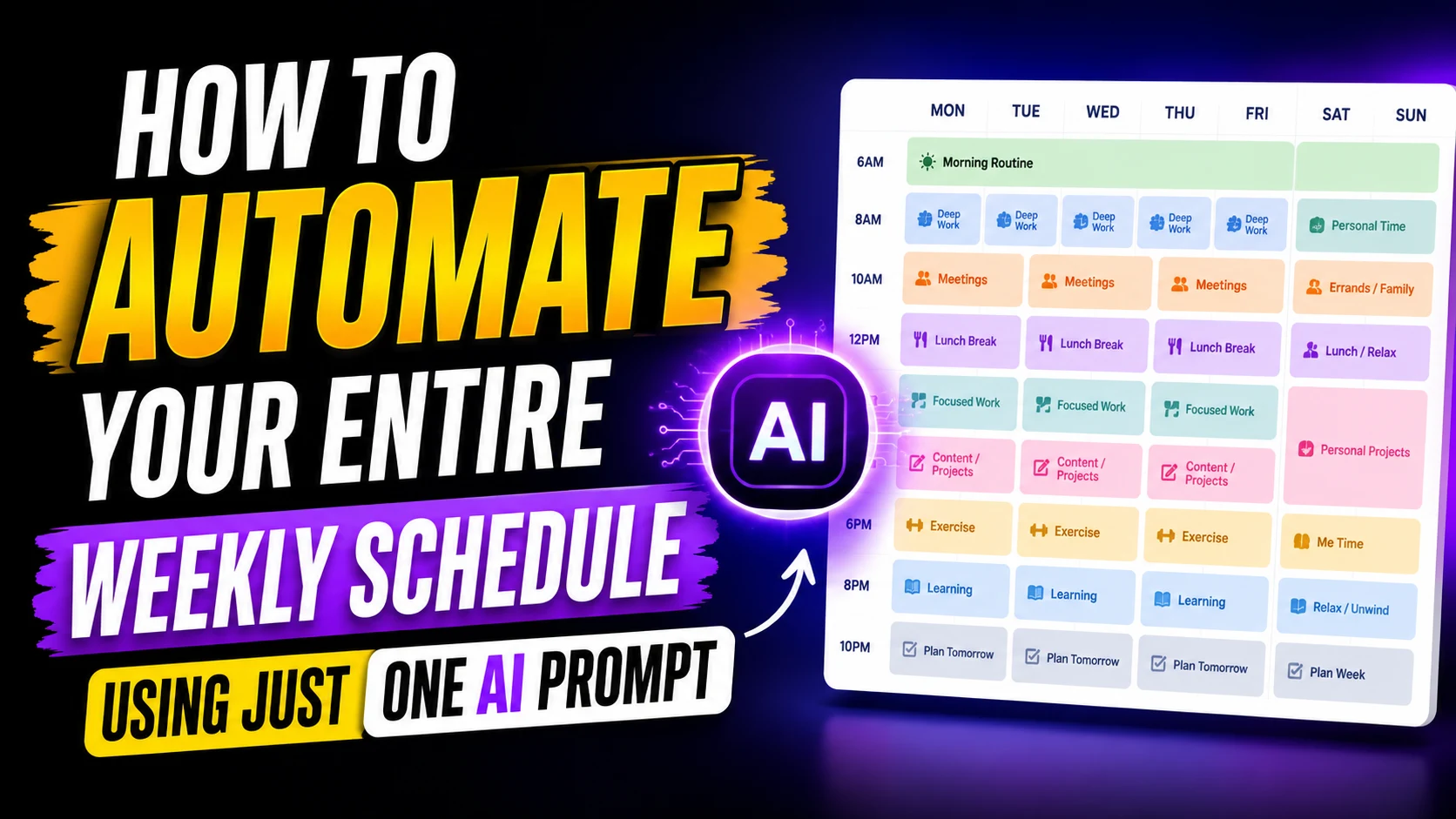
Timeboxing is the practice of allocating a fixed, non-negotiable block of time on your calendar for a specific task—and stopping when the time is up. It forces you to shift from ineffective multitasking to hyper-focused monotasking. Research indicates that only 2.5% of people can multitask effectively, making focused execution critical for high performance.
The challenge? Manually mapping out a timeboxed calendar for an entire week is tedious. It becomes just another piece of “work about work.” This is where artificial intelligence bridges the gap.
The Ultimate AI Scheduling Prompt
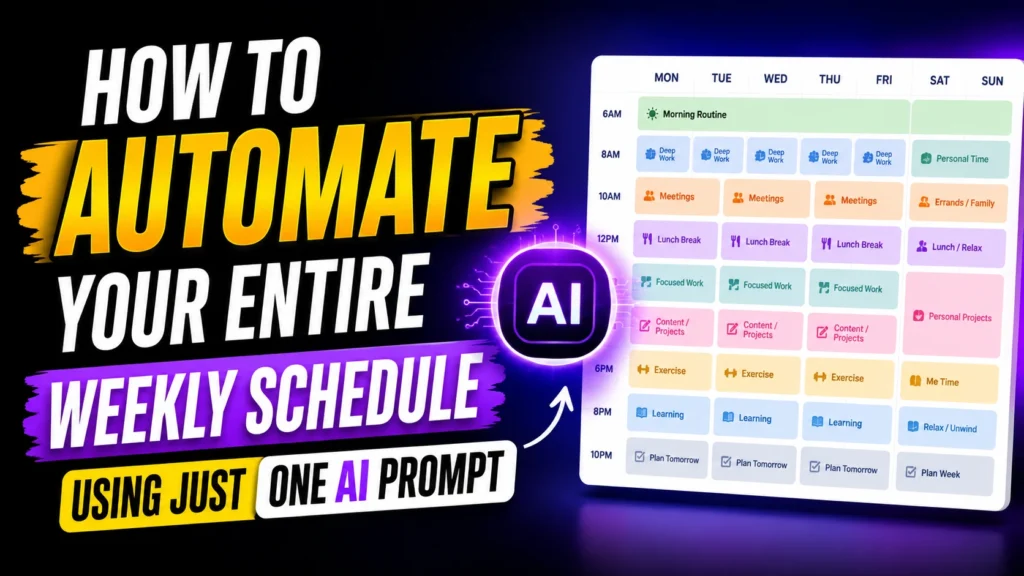
By feeding your raw to-do list into an AI tool like ChatGPT, Claude, or Gemini, you can generate an optimized, timeboxed schedule instantly.
To automate your week, copy and paste the following “Mega-Prompt” on Monday morning:
“You are an elite executive productivity coach. I need you to organize my unstructured to-do list into a strict, timeboxed weekly schedule from Monday to Friday (9 AM to 5 PM). Here is my to-do list: [Insert raw list here, noting any strict deadlines or pre-existing meetings].
Follow these strict rules:
1. Prioritize deep, complex tasks for the morning when cognitive energy is highest.
2. Group shallow tasks (email, admin, quick calls) into a single 45-minute block in the afternoon.
3. Apply the 20% rule: add a 20% time buffer to every task, as humans naturally underestimate how long work takes.
4. Schedule two 15-minute screen-free breaks per day.
5. Output the final schedule in a clear, day-by-day table format with three columns: Time, Task, and Outcome Goal.”
Why This Framework Succeeds
This prompt does not just organize your time; it applies established psychological principles to optimize your output.
- Mitigates Decision Paralysis: Staring at a list of fifteen disjointed tasks causes overwhelm. By converting a generic to-do list into a chronological sequence of boxes, AI removes the friction of deciding what to do next.
- Neutralizes the Planning Fallacy:People consistently underestimate how long tasks take by 20% to 40%. By hardcoding a time buffer into the prompt, the AI ensures your schedule remains realistic and prevents the cascading delays that ruin a workweek.
- Eliminates Perfectionism: Timeboxing creates a healthy constraint. When the calendar dictates that a report must be drafted between 10:00 AM and 11:30 AM, it forces execution over endless, perfectionist tweaking.
The Takeaway: Protect Your Time
Technology should eliminate administrative friction, not create it. By outsourcing the cognitive load of scheduling to AI, you transition from reacting to your inbox to actively designing your day.
Your Action Step: Tomorrow morning, do not write a to-do list. Instead, jot down your tasks, plug them into the AI prompt above, and let the algorithm build your timeboxes. Stick to the generated schedule for just three days. You will likely find that the hours you previously lost to the chaos of coordination are suddenly yours again.
Also Read What Happens When You Ask 10 Different AIs the Same Question