Ask any professional using generative AI today, and you’ll likely hear the same frustration: the output is only as good as the instructions. We’ve all stared at a blinking cursor, typed a vague request, and received a robotic, generic response in return. The problem isn’t the artificial intelligence—it’s our lack of a communication framework.
If you want to stop guessing and start getting professional-grade results from tools like ChatGPT, Claude, or Gemini, you don’t need a degree in computer science. You simply need a repeatable structure.
Why Ad-Hoc Prompting is Failing You
Ask ten people how to write a good AI prompt, and you will get ten different answers. Some suggest keeping it brief, while others swear by adding pages of context. The truth is, “ad-hoc” prompting—making it up as you go along—is fundamentally inconsistent. You might write a brilliant prompt for one task, but struggle to replicate that success the next day.
AI prompt engineering frameworks solve this. They act as formulas you can apply to any task to guarantee consistency, speed up your workflow, and establish a high-quality baseline. While tech giants battle over whether OpenAI’s latest GPT model or Anthropic’s Claude is superior, industry experts agree on one thing: model selection alone doesn’t guarantee results; the real differentiator lies in how you structure your requests.
Here are the top five AI prompt frameworks you need to turn large language models from unpredictable experiments into reliable digital assistants.
1. RTF (Role, Task, Format): The Quick Fix
When you need information fast and don’t have time for complex instructions, the RTF framework is your best friend. It turns vague requests into structured, actionable insights by defining three simple parameters.
- Role: Who is the AI acting as? (e.g., A senior financial analyst)
- Task: What exactly do you want it to do? (e.g., Identify potential risks in this Q3 earnings report)
- Format: How should the answer look? (e.g., A concise executive summary with bullet points)
Real-World Example: “Act as an expert SEO copywriter. Review this blog draft and suggest five alternative headlines. Present the output as a numbered list.”
2. CRAFT (Context, Role, Action, Format, Tone): The Daily Driver
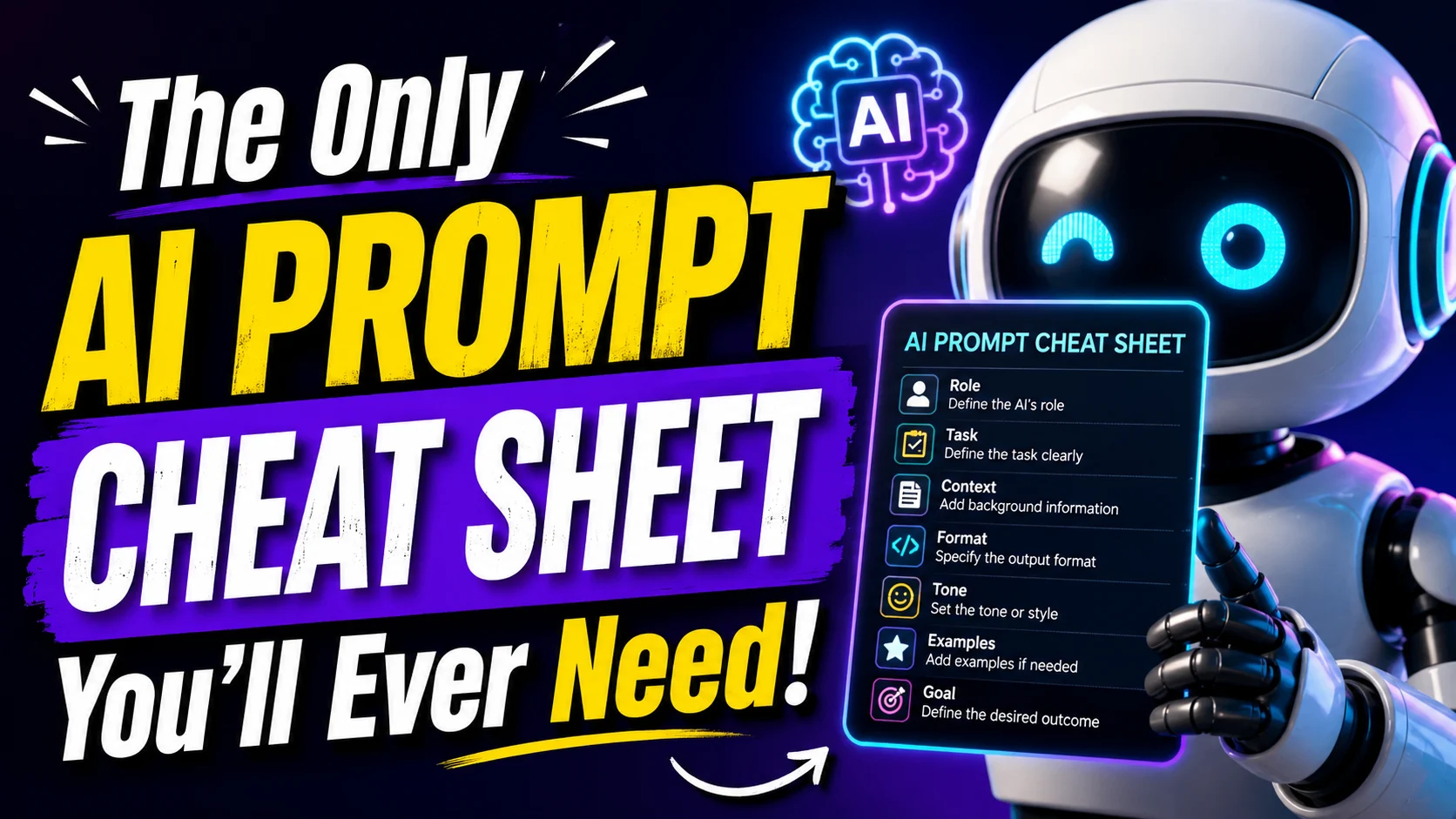
Consider CRAFT your default framework for 80% of your knowledge work. It builds on the RTF model by adding two crucial elements that prevent AI from sounding like a machine: Context and Tone.
- Context: What is the background situation?
- Role: Who is the AI?
- Action: What is the specific task?
- Format: How should it be structured?
- Tone: How should it sound?
Real-World Example: “Our software startup is launching a new feature tomorrow (Context). Act as a B2B product marketer (Role) and write an email announcement to our existing customers (Action). Keep it under 200 words (Format) in a highly enthusiastic, conversational tone (Tone).”
3. RISE (Role, Input, Steps, Expectation): The Process Builder
For multi-step, logical tasks, vague prompts lead to AI hallucinations. The RISE framework excels here by breaking down the workflow into sequential actions, ensuring the AI doesn’t skip critical thinking steps.
- Role: The persona the AI should adopt.
- Input: The raw data or text you provide.
- Steps: The logical, numbered sequence the AI must follow.
- Expectation: The exact final deliverable.
Real-World Example: “Act as a meticulous proofreader (Role). Here is my rough draft [Input]. First, fix all grammatical errors. Second, rewrite passive sentences to active voice. Third, flag any confusing paragraphs (Steps). Provide the final version with your changes highlighted in bold (Expectation).”
4. BAB (Before, After, Bridge): The Storyteller
Business leaders and marketers frequently need to communicate change, sell a vision, or pitch a product. The BAB framework forces the AI to frame its output as a compelling narrative rather than a dry list of facts.
- Before: Describe the current challenge or pain point.
- After: Describe the ideal future state once the problem is solved.
- Bridge: Explain how your solution connects the two.
Real-World Example: “Write a LinkedIn post using the BAB framework. The Before state is a sales team struggling with manual data entry. The After state is a team closing 30% more deals because they have free time. The Bridge is our new automated CRM tool.”
5. CARE (Context, Action, Result, Example): The Executive Communicator
When reporting to a board, summarizing a quarter, or writing a performance review, clarity is paramount. The CARE framework helps redefine prompts into structured, evidence-based narratives.
- Context: The situation or challenge faced.
- Action: What was done to address it.
- Result: The quantifiable outcome.
- Example: A concrete instance to bring the data to life.
Real-World Example: “Help me write a project update for our stakeholders. The context was a delayed supply chain. The action was onboarding two local vendors. The result was a 15% reduction in shipping times. Include a brief example of how this helped our biggest client.”
The Takeaway: Stop Typing, Start Structuring
Generative AI is not a search engine; it is a reasoning engine. Treating it like a traditional Google search is the fastest way to get mediocre results.
Your call to action is simple: pick just one of these frameworks—start with RTF—and use it exclusively for your next five prompts. You will immediately notice a dramatic shift in the quality, accuracy, and professionalism of the AI’s responses. Once you master the structure, you master the machine.
Also Read How to Automate Your Job Search Using AI (Step-by-Step)