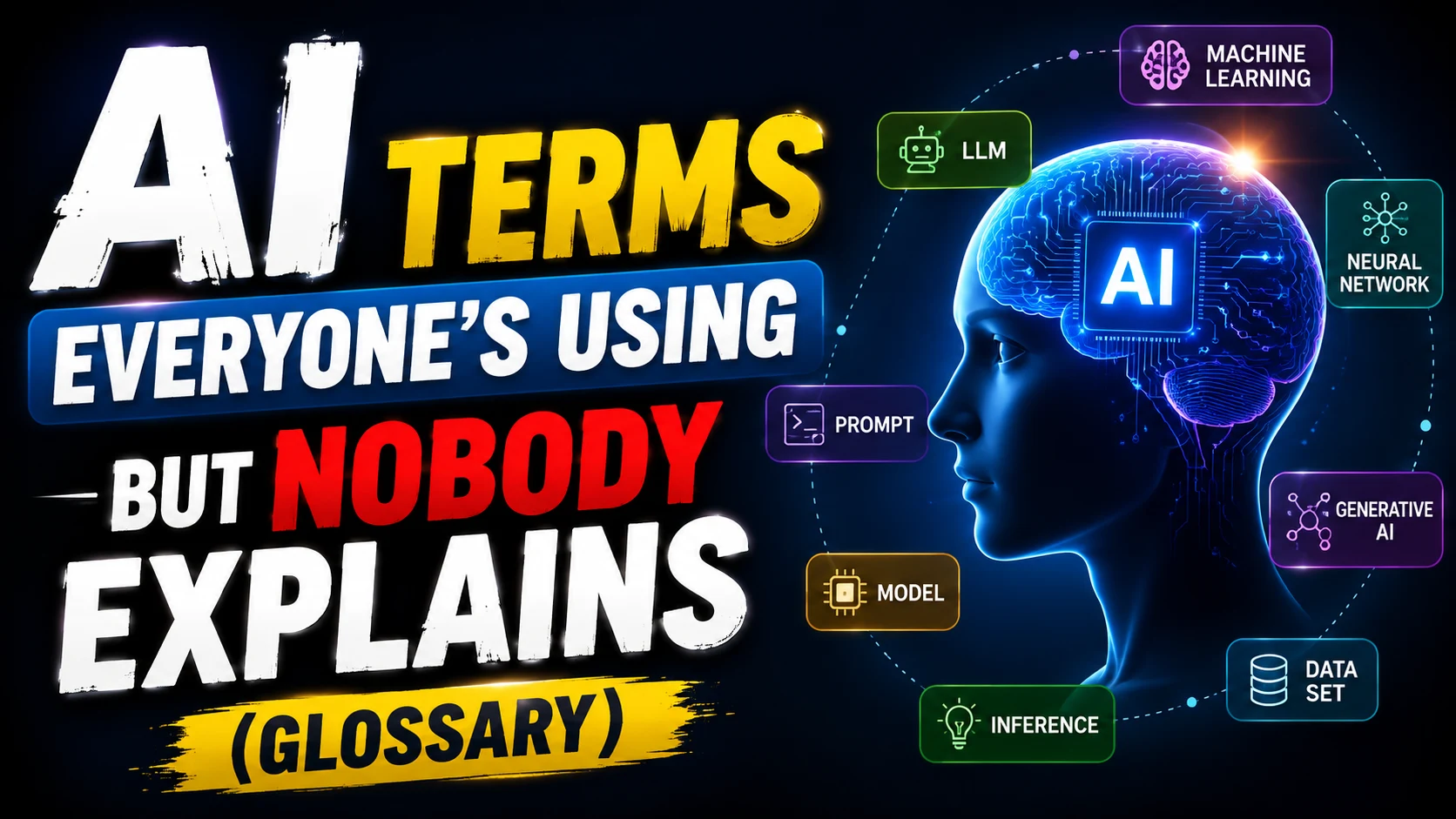
Walk into any boardroom, scroll through LinkedIn, or chat with a teenager today, and you’ll hear the same alphabet soup: RAG, LLMs, and Agentic AI. We are living in a moment where artificial intelligence is moving faster than our ability to understand the words describing it. But if you nod along in meetings while secretly Googling what a “context window” is, you’re not alone—and it’s time to finally decode the jargon.
According to recent enterprise surveys, over 80% of organizations now use artificial intelligence in at least one business function, yet a fraction of the workforce actually understands the technology powering it. The gap isn’t a lack of interest; it’s a lack of plain English.
Here is your essential AI glossary—stripped of the Silicon Valley techno-babble and explained with real-world examples.
1. Large Language Model (LLM): The “Engine”
Whenever you type a prompt into ChatGPT or Claude, an LLM is doing the heavy lifting.
What it means:
A Large Language Model is a sophisticated algorithm that has been trained on a massive amount of text—essentially reading millions of books, articles, and websites. By analyzing how human language works, it learns to predict what word should logically come next in a sentence.
The real-world example:
Think of an LLM as the world’s most advanced “autocomplete.” Just like your phone guesses the next word in your text message, an LLM does this on a monumental scale. It doesn’t actually think or feel; it mathematically calculates the best possible response based on patterns.
- Key takeaway: If an AI tool writes text, translates languages, or summarizes emails, an LLM is the engine running under the hood.
2. Retrieval-Augmented Generation (RAG): The “Open-Book Exam”
This is arguably the most important acronym for businesses today, as it bridges the gap between general AI and company-specific knowledge.
What it means:
Standard AI models only know what they were originally trained on. If you ask them about yesterday’s news or your company’s private HR policy, they have no idea. RAG (Retrieval-Augmented Generation) fixes this by allowing the AI to search a specific database, fetch the correct documents, and then generate an answer based on those facts.
The real-world example:
Imagine taking a test. A standard LLM takes the test from memory (and might guess if it forgets). An AI using RAG is allowed to take an open-book test. It looks up the correct textbook page first, ensuring its answer is accurate and up-to-date.
- Why it matters: RAG prevents AI from making things up and keeps proprietary company data secure.
3. Hallucination: The “Overconfident Liar”
AI is incredibly smart, but it has a fatal flaw: it hates saying “I don’t know.”
What it means:
An AI hallucination occurs when a model confidently presents false, invented, or illogical information as absolute truth. Because these systems are designed to generate human-sounding text, they will seamlessly string together plausible-sounding lies if they lack the correct data.
The real-world example:
If you ask an AI to summarize a legal case that never happened, it might not just tell you the case is fake. Instead, it might invent a judge, a ruling, and a fictional settlement amount.
- The golden rule: Never blindly trust AI outputs for high-stakes decisions, factual citations, or complex math without human verification.
4. Context Window: The “Short-Term Memory”
Have you ever had a long conversation with a chatbot, only for it to suddenly forget what you said five minutes ago? You just hit the context window limit.
What it means:
The context window is the maximum amount of information (measured in “tokens,” or word fragments) an AI can hold in its active memory at one single time. Once you exceed this limit, the AI starts “forgetting” the earliest parts of the conversation.
The real-world example:
Think of the context window like a whiteboard. You can only write so many words on it before you run out of space. To write something new, you have to erase the oldest information at the top. While early models had tiny whiteboards (maybe a few pages of text), modern models boast massive context windows capable of holding entire 500-page books at once.
5. Agentic AI (Agents): The “Doer”
We are currently shifting from AI that simply answers questions to AI that takes action. This is where Agentic AI comes in.
What it means:
Agentic AI refers to systems designed to pursue goals independently. Instead of just generating text, AI agents can use software tools, browse the web, make decisions, and execute multi-step workflows without a human holding their hand.
The real-world example:
A standard AI can write an email for you. An Agentic AI can read your inbox, write the email, open your calendar, check your availability, schedule a meeting with the recipient, and send the invite—all on its own.
- The future: Agents are transforming AI from a passive brainstorming partner into a proactive digital employee.
The Bottom Line
The artificial intelligence landscape is shifting from a hype cycle into an era of practical application. You don’t need a PhD in computer science to thrive in this new economy, but you do need to speak the language. Understanding terms like RAG, Hallucination, and Agentic AI isn’t just about sounding smart in meetings; it’s about knowing how to safely and effectively deploy these tools to make your life easier.
What’s your next step?
Take one of these terms and spot it in the wild this week. Test a chatbot’s context window, or look for signs of a hallucination in an AI-generated summary. The best way to learn the future is to start using it today.
Also Read ChatGPT vs Claude vs Gemini (2026): Which AI Subscription Is Actually Worth Your Money?