The global freelance economy is undergoing its most brutal correction in a decade. A landmark Harvard and Imperial College study revealed that freelance writing jobs plummeted by over 30%, while coding and graphic design gigs saw immediate double-digit drops following the mainstreaming of generative AI. But this isn’t a story about the death of the gig economy—it is a ruthless evolution where artificial intelligence is permanently separating commoditized workers from high-earning strategists.
In 2026, AI is no longer a futuristic novelty; it is the fundamental infrastructure of remote work. According to preliminary data from the Freelancer Kompass 2026 report, a staggering 84% of freelancers now regularly use AI software, a dramatic jump from just 41% in 2023.
The writing is on the wall: clients are no longer paying human rates for generic output. However, the market has essentially split. While the floor for basic execution has collapsed, the ceiling for specialized talent is higher than ever. Recent platform data indicates that freelancers who pivot to AI-related projects and workflows are currently earning 44% more per hour than their peers.
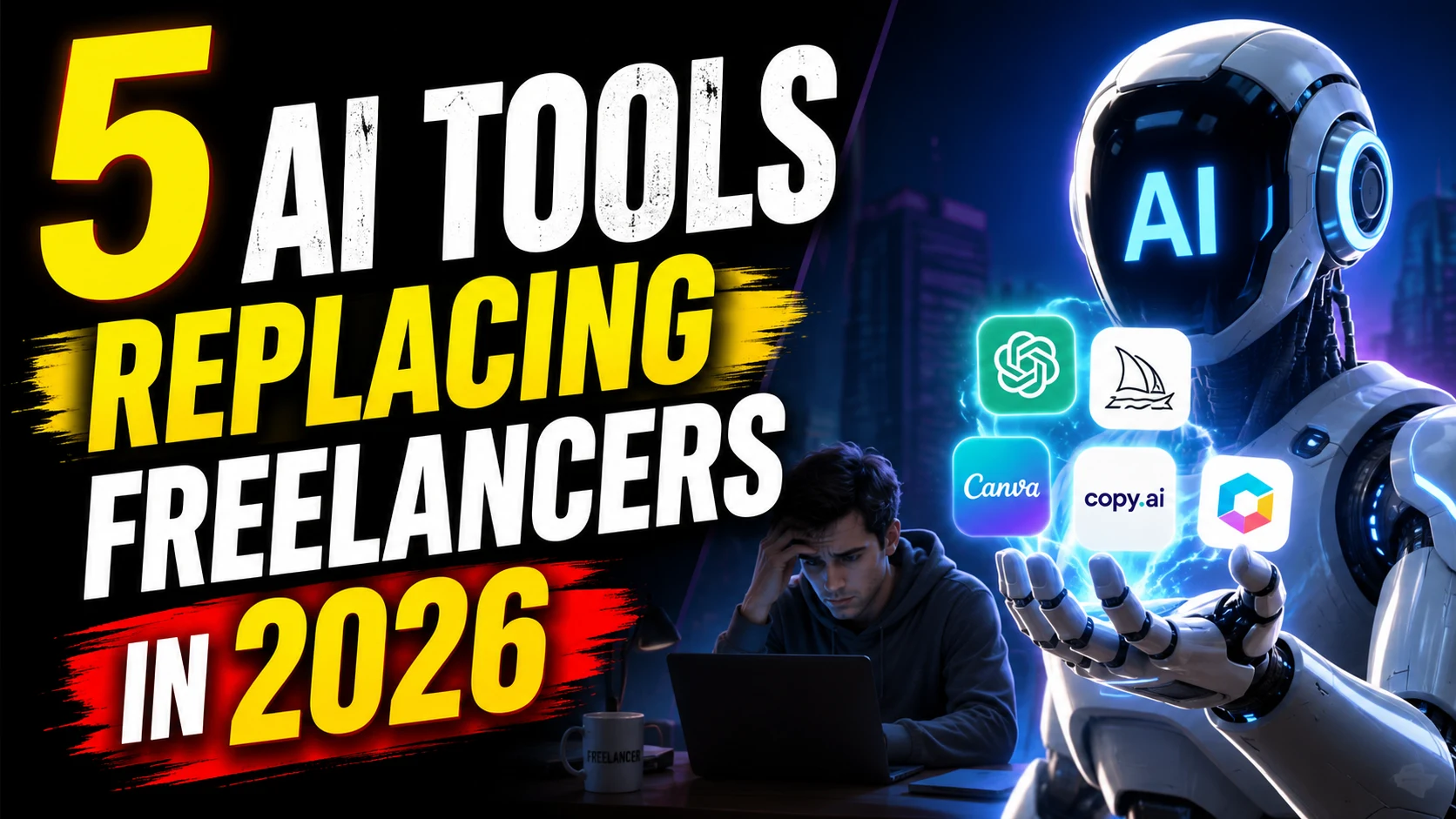
5 AI Tools Disrupting the Freelance Market in 2026
The disruption is being driven by a specific stack of sophisticated platforms that have moved from simple chat interfaces to complex, automated agents. Here are the five AI tools actively displacing traditional freelance roles today:
1. ChatGPT Enterprise & Claude Team
- Roles Impacted: General copywriters, administrative assistants, and customer support agents.
- The Disruption: These foundational models have evolved past simple drafting. They now integrate directly into company workflows to outline content, summarize extensive meeting transcripts, and draft pitch-perfect client emails. For businesses, paying a freelancer by the hour for basic research or generic blog posts is no longer financially viable when Claude or ChatGPT can produce the same output in seconds.
2. Jasper AI
- Roles Impacted: Junior marketers, social media managers, and SEO writers.
- The Disruption: Built specifically for digital marketing agencies, Jasper generates ad variations, landing page copy, and email sequences while maintaining consistent brand voice across multiple assets. It has effectively automated the “heavy lifting” of content marketing, forcing human marketers to pivot from basic execution to high-level brand strategy.
3. Midjourney & Adobe Firefly
- Roles Impacted: Entry-level graphic designers and illustrators.
- The Disruption: The demand for basic logo concepts, mood boards, and stock-style illustrations has evaporated. Adobe Firefly’s seamless integration into existing design suites allows in-house teams to generate layouts, remove backgrounds, and create concept mockups instantly, eliminating the need to outsource straightforward visual tasks.
4. GitHub Copilot & Codeium
- Roles Impacted: Junior developers, QA testers, and web designers.
- The Disruption: Software and app development freelance jobs fell by nearly 21% after the initial AI wave hit platforms. Today, tools like Copilot are providing 20–40% productivity gains by automating code generation, debugging, and testing. Early-career coding tasks are heavily automated, meaning clients only hire freelance developers for complex architecture and deep problem-solving.
5. Synthesia & ElevenLabs
- Roles Impacted: Voiceover artists, video editors, and on-camera presenters.
- The Disruption: Synthetic media has reached near-human parity. ElevenLabs generates incredibly natural-sounding narrations, while Synthesia deploys AI-generated human avatars for corporate training and marketing videos. This innovation wipes out the need for expensive studio time, lighting crews, and freelance talent for standard corporate broadcasting.
The “10-80-10” Rule: How Top Earners Are Fighting Back
If basic execution is being outsourced to machines, how do human freelancers survive? The answer lies in rapid adaptation.
Industry experts and top-earning freelancers in 2026 have adopted what productivity coaches call the “10-80-10 rule” for workflow management:
- The First 10% (Human): High-level strategy, creative direction, and client framing.
- The Middle 80% (AI): Using tools like Jasper or Copilot for heavy drafting, coding, and implementation.
- The Final 10% (Human): Rigorous quality control, fact-checking, and adding the distinctive human nuance that clients value.
By shifting from pure “doers” to “editors and consultants,” freelancers are increasing their project capacity and commanding higher rates. For example, a copywriter who previously charged $45 an hour for writing can reposition themselves as an “AI content strategy consultant” charging $125 an hour for designing the automated workflow.
The Bottom Line
The narrative that “AI will replace freelancers” is only half true. AI is replacing complacent freelancers. The freelance platforms market itself is booming, projected to reach $9.91 billion globally in 2026 due to the rise of specialized remote work. There is more money in the gig economy than ever before—it is simply being redirected to those who wield technology best.
As we move deeper into 2026, proficiency with automation tools is no longer a competitive advantage—it is a baseline requirement.
The Takeaway for Professionals: If you are still doing everything manually, you are competing against a global workforce that can deliver faster and cheaper using software. Your next move is clear: audit your daily workflow, identify the most repetitive tasks, and start integrating AI today. Stop selling your hands, and start selling your judgm