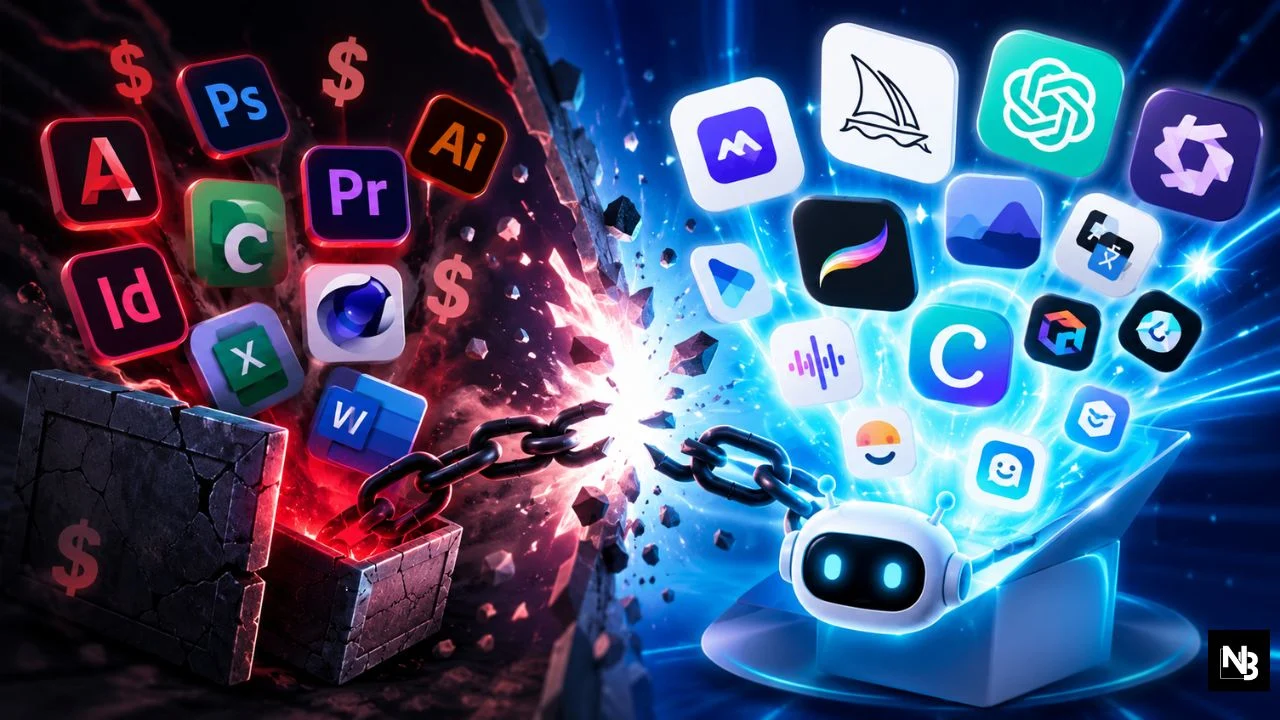
For years, the digital economy has been gated by a quiet but aggressive barrier to entry: the monthly software subscription. From independent digital publishers to student engineers, creators have found themselves trapped in a web of recurring fees for essential tools. Today, however, an aggressive wave of free and open-source artificial intelligence is actively dismantling this premium Software-as-a-Service (SaaS) monopoly, fundamentally altering the economics of digital entrepreneurship.
What was once an industry dominated by enterprise pricing is now being aggressively undercut by tech giants and open-source communities. For the bootstrapped web developer or the independent news blogger in India’s expanding digital frontier, this shift is not just convenient — it is an economic lifeline.
Here is a deeply researched look at the 25 free AI tools that are actively rendering expensive legacy software obsolete, alongside an analysis of the structural realities driving this shift.
1. The Disruption of Content & SEO
The days of paying upwards of $50 a month for AI copywriting and basic SEO optimization are ending. Large Language Models (LLMs) have commoditized text generation, allowing independent publishers to scale content without enterprise budgets.
- Google Gemini: With direct web access, it replaces paid data-crunching and trend-analysis tools, offering real-time research capabilities.
- Claude 3.5 Sonnet (Free Tier): Widely regarded as the industry standard for nuanced writing, replacing premium, rigid copywriting software like Jasper.
- Perplexity AI: Functions as a conversational answer engine, bypassing traditional, ad-heavy search and replacing paid academic or market research databases.
- Microsoft Copilot: Integrated with GPT-4, it serves as a powerful alternative to Grammarly Premium for deep structural editing and rewriting.
- Harpa.ai: A robust Chrome extension that acts as a free alternative to paid SEO scraping and web-page summarization tools.
- Rytr (Free Tier): Offers a lightweight alternative to pricey SEO content planners and metadata generators for early-stage blogs.
2. Democratizing Code and Web Development
For students and early-stage tech founders, the cost of development environments and coding assistants previously required institutional backing. That infrastructure is now freely available.
- Cursor IDE: The free tier of this AI-first code editor effectively replaces paid subscriptions to GitHub Copilot for early-stage developers.
- Vercel v0: Generates deployable React code from simple text prompts, replacing expensive UI/UX prototyping software.
- Blackbox.ai: Serves as a free alternative to premium cloud-based code generation and debugging environments.
- Hugging Face: This massive open-source repository replaces the need for proprietary model APIs, allowing developers to build on community-driven models.
- LM Studio: Allows users to run advanced LLMs locally on their own hardware, entirely bypassing expensive cloud-computing API costs.
ALSO READ The AI Illusion: Testing 2026’s Best AI Presentation Makers Uncovers a 44% Accuracy Crisis
3. The Collapse of the Visual Design Paywall
High-end graphic design and image manipulation were historically locked behind Adobe’s ecosystem. AI has decentralized these capabilities, allowing digital marketers to produce high-CTR visual assets at zero cost.
- Leonardo.ai: A highly capable, free-tier alternative to the paid-only Midjourney for producing photorealistic imagery and digital art.
- Microsoft Designer: Powered by DALL-E 3, it replaces Canva Pro for bulk social media asset and thumbnail creation.
- Upscayl: An open-source, locally run tool that replaces expensive image upscaling software like Topaz Gigapixel.
- Clipdrop (by Stability AI): Offers free daily limits that replace Adobe Photoshop’s generative fill for basic web imagery manipulation.
- Krea.ai: A disruptive alternative to premium real-time rendering and visual enhancement software.
4. Video and Audio Post-Production
Rich media was once the most capital-intensive format to produce. AI automation has drastically lowered the floor, allowing solo creators to match the output of small production agencies.
- CapCut (Desktop): Its aggressive rollout of free AI auto-captions and tracking effectively replaces Adobe Premiere Pro for short-form digital publishers.
- Adobe Podcast Enhance: A free, web-based AI tool that cleans up poor microphone quality, replacing expensive audio plugins like iZotope RX.
- ElevenLabs (Free Tier): Replaces traditional voiceover contractors and clunky, paid Text-to-Speech (TTS) software with cinematic human voices.
- Opus Clip (Free Limits): Automates the process of finding viral hooks and repurposing long-form video into YouTube Shorts, replacing human editors.
- Luma Dream Machine: Offers free generation limits that rival paid video-generation platforms like Runway Gen-3.
5. Workflow and Business Operations
Administrative overhead and pitch creation are being streamlined by autonomous agents, removing the need for sprawling enterprise software suites.
- Gamma.app: Replaces Microsoft PowerPoint and pitch-deck software by generating highly visual, formatted presentations from a single text prompt.
- Zapier (Free Tier) / Make.com: AI-assisted workflow builders that replace expensive enterprise automation tools by connecting disparate web apps.
- ChatPDF: Replaces premium document analysis software, allowing users to instantly parse and query heavy regulatory documents or academic PDFs.
- Liner: An AI copilot for web highlighting and research organization, replacing premium tools like Evernote or Notion’s paid tiers.
- Google AI Studio: Provides free, generous API limits for developers to build custom workflows, replacing the need for paid enterprise API access during the prototyping phase.
ALSO READ Surviving the Algorithm: The Best AI Tools for Content Creators in 2026 Amid New Global Regulations
The Structural Reality: The Hidden Cost of “Free”
While the democratization of these tools is an undeniable boon for the public, it is vital to analyze why tech giants and venture-backed startups are operating at a massive compute loss to offer them.
The institutional reality is that user data is the new currency. Free AI tools are predominantly loss-leaders designed to ingest massive amounts of human input—code, articles, proprietary business strategies, and creative workflows. In many cases, the users are actively, albeit unknowingly, training the next generation of models that will eventually replace the very workflows they are currently optimizing.
Furthermore, building a digital business entirely on free-tier infrastructure introduces systemic vulnerability. Platforms frequently change their API limits, introduce sudden paywalls, or alter their algorithms without regulatory oversight. For an independent publisher running a news domain or an affiliate marketing network, a sudden shift in a tool’s free-tier policy can halt operations overnight.
The Path Forward
The current era of free AI software represents a rare window of opportunity. The barrier to entry for building a digital media platform, an e-commerce brand, or a tech startup is no longer capital—it is curiosity and adaptability.
However, long-term sustainability requires strategic caution. Users must treat free AI tools as launchpads rather than permanent infrastructure, remaining agile enough to migrate between platforms as the market inevitably consolidates. The democratization of software is here, but in the digital economy, efficiency is only as valuable as the independence of the person wielding it.