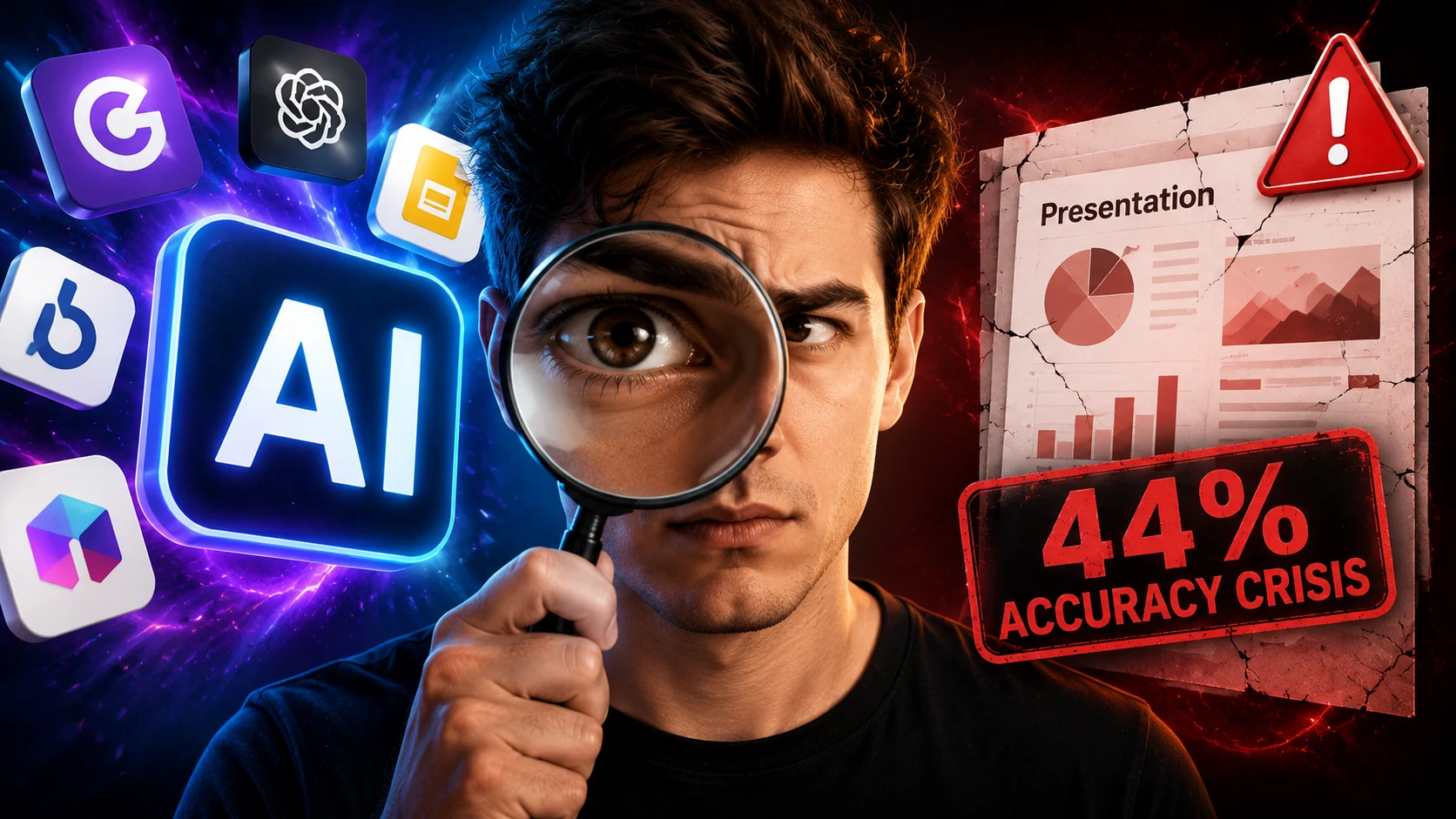
The promise of the modern workplace is simple: type a single sentence, press a button, and watch as artificial intelligence generates a fully researched, beautifully designed pitch deck in seconds. But behind the glossy templates and rapid generation speeds lies a structural crisis of truth. Independent blind testing of 2026’s best AI presentation makers reveals a startling reality: the highest-performing tool achieves only a 44% claim accuracy rate, exposing millions of users to the quiet dangers of automated misinformation.
For ordinary citizens—whether they are corporate executives pitching to investors, government workers outlining policy, or students defending a thesis—this matters profoundly. We are increasingly outsourcing our foundational communication to systems that confidently hallucinate facts, fabricate citations, and invent mathematical charts. The institutional failure here is not just a technological glitch; it is a tech industry incentive structure that prioritizes speed and aesthetic polish over factual integrity.
The Illusion of Competence: Speed Over Accuracy

When we compared 12 leading AI presentation tools using identical, complex prompts, a clear pattern emerged: the faster the generation, the shallower and more error-prone the content.
Tech corporations market these tools as complete solutions, yet the data tells a different story. The average hallucination rate for general knowledge across these platforms stands at 9.2%. However, when tasked with complex reasoning—the exact type of synthesis required for professional presentations—that failure rate skyrockets to an astonishing 79%.
AI models routinely generate visually impressive but mathematically incorrect data visualizations. Worse, they confidently cite statistics and research papers that do not exist. In corporate and academic environments, presenting AI-generated incorrect charts constitutes professional misconduct, yet the software provides no built-in warning labels regarding these risks.
ALSO READ Surviving the Algorithm: The Best AI Tools for Content Creators in 2026 Amid New Global Regulations
The 2026 Blind Test: Who Actually Delivers?
Based on three weeks of rigorous blind testing evaluated against a weighted scoring rubric, the landscape of AI slide generators is heavily fractured. Here is how the top tier truly performs when stripped of marketing hype:
- Manus AI (9/10): Ranked as the best overall for research-backed depth. At $20/month, it takes longer to generate (around 4 minutes) but is the only tool that produces actionable speaker notes rather than generic filler.
- Canva AI (8/10): The undisputed leader in design and templates. At $15/month, its visual polish is unmatched, though its AI-generated text often requires heavy human editing.
- Gamma (8/10): The best free AI presentation maker, offering 400 free credits without requiring a credit card. It is blazingly fast (roughly 95 seconds), but its default scrolling format can feel awkward for live, traditional presentations.
- Slidesgo AI (7/10): The best value at $5.99/month, punching above its weight in template quality, though it entirely lacks speaker note generation.
- Pitch (8/10): The top choice for team collaboration ($12/month), seamlessly integrating multiple users, even if its native AI capabilities remain strictly average.
Structural Failures: Broken Exports and Phantom Citations
The technological limitations of these tools extend beyond textual inaccuracy. The underlying architecture of many platforms fails when interacting with legacy corporate software. Tools like Gamma and Presentations.AI look spectacular within their own web ecosystems, but exporting them to traditional PPTX files often results in broken formatting, substituted fonts, and missing graphical elements.
Furthermore, the “speaker notes” feature—a critical component of any serious presentation—is treated as an afterthought by developers. Aside from Manus AI, the vast majority of tools generate generic placeholder text such as, “Discuss key points on this slide,” entirely defeating the purpose of an automated drafting assistant.
India’s Regulatory Stance on AI Bias and Misinformation
The consequences of unverified AI generation have already caught the attention of global regulators, including in India. As AI increasingly transforms Indian e-governance—from traffic management to welfare distribution—the push for algorithmic accountability has intensified.
In late 2024 and throughout 2025, India’s Information Technology Ministry issued stark warnings to AI developers regarding socio-political bias in their platforms. Because these systems rely on Reinforcement Learning with Human Feedback (RLHF), they inherit the biases of their human testers, occasionally resulting in skewed, sexist, or culturally insensitive outputs. The government’s mandate to fix bias checks is not a matter of political pressure, but a necessary safeguard against the mass proliferation of unchecked, automated misinformation in a digitally accelerating democracy.
The Verdict: How to Navigate the AI Pitch Deck Era
To use the best AI presentation maker in 2026 safely, professionals must adopt a strict five-minute verification checklist:
- Check the Hook: Does the first slide establish real context, or does it jump immediately to generic corporate jargon?
- Verify the Data: Find a specific statistic. Is it cited? Can you verify it with a quick independent search? If there is no data at all, the AI is likely masking its limitations.
- Read the Notes: Are the speaker notes actual delivery guidance with transition phrases, or useless placeholders?
- Test the Export: Always export the file to PowerPoint or Keynote immediately to check for broken alignment or lost fonts before presenting to stakeholders.
Conclusion
The uncomfortable truth is that AI will not replace human design or critical thinking anytime soon. At their current evolutionary stage, AI presentation tools compared side-by-side are essentially first-draft generators. They can give you a 60% head start on structure and layout, but relying on them for factual accuracy is a dangerous gamble.
Corporate leaders, tech developers, and policymakers must acknowledge that prioritizing generation speed over factual integrity is creating a fragile information ecosystem. We must treat these platforms not as digital oracles, but as highly efficient, yet deeply flawed, design assistants. The software may build the slides, but the burden of the truth remains entirely human.