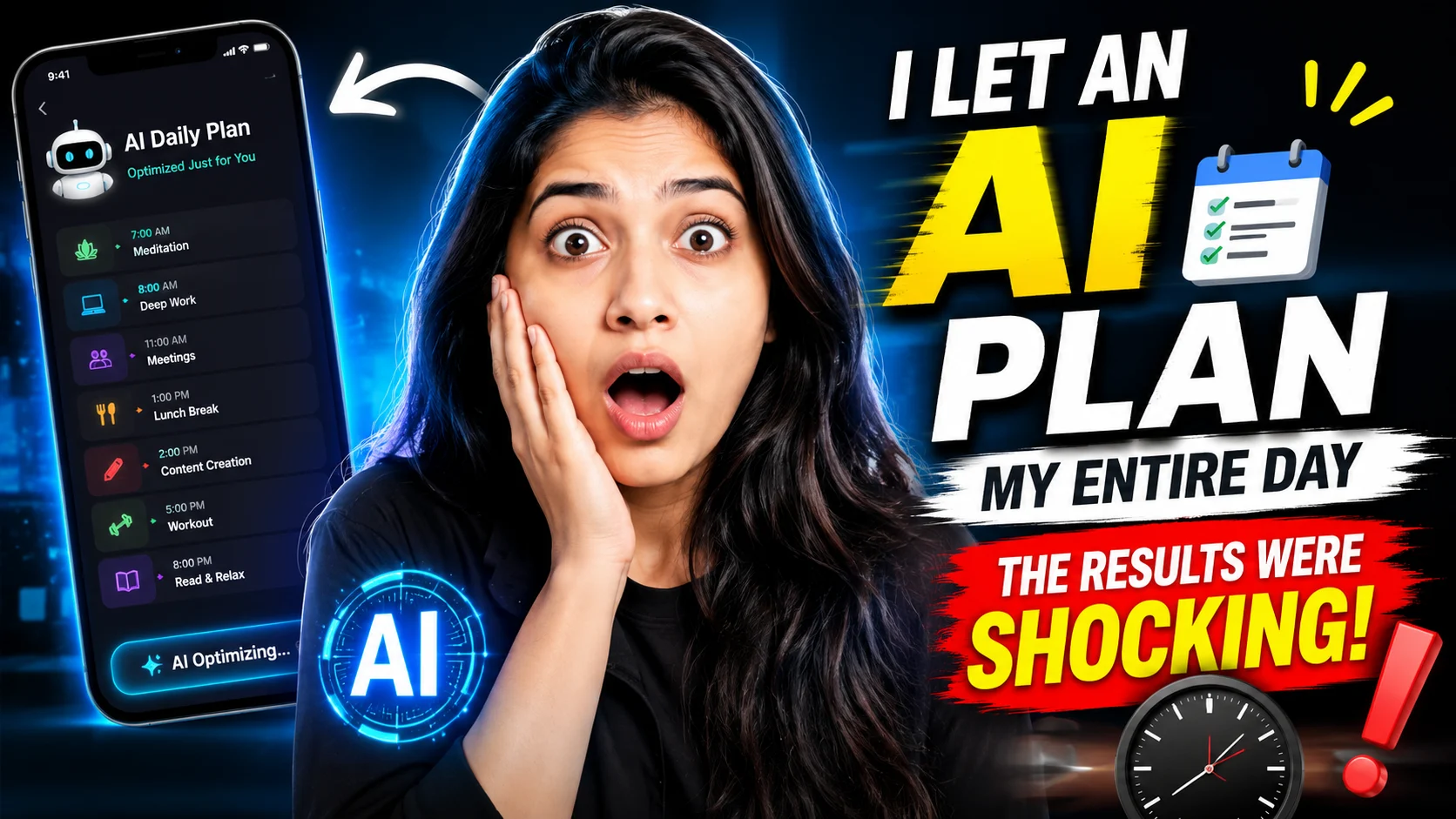
I have always prided myself on my ability to juggle breaking news, editorial meetings, and tight deadlines. But last week, drowning in a sea of unread emails and overlapping calendar invites, I surrendered to the algorithm. I decided to let an AI productivity tool completely dictate my schedule from 8 AM to 8 PM to see if the hype around artificial intelligence could actually fix my chaotic life.
What followed was a masterclass in hyper-efficiency, but it also exposed a dark side to the modern workplace’s obsession with optimization. Here is the unvarnished truth about what happens when you let a machine become your manager.
The Promise of the ‘Perfect’ Day

For months, tech executives have been promising that AI task management tools will revolutionize how we work. And the data backing these claims is undeniably impressive:
- Massive Time Savings: A recent report from the London School of Economics reveals that professionals using AI save an average of 7.5 hours per week—the equivalent of an entire workday.
- The 11-Minute Tipping Point: Microsoft’s research on Copilot users revealed that saving just 11 minutes a day acts as a catalyst, ultimately saving workers the equivalent of an entire work week each year.
- Performance Boosts: The Nielsen Norman Group found that using generative AI improves professional task productivity by an average of 66%.
With statistics like these, I expected an AI daily planner that would seamlessly organize my tasks, prioritize the urgent, and leave me with plenty of time for deep, creative thinking.
The Setup: Handing Over the Reins
I signed up for a leading AI productivity app, fed it my 25-item to-do list, my hard deadlines, and my scheduled meetings. Usually, I rely on a mix of gut instinct, sticky notes, and a messy notepad to navigate my day.
The AI, however, was ruthlessly mathematical. Within seconds, it color-coded my life, blocking out “focus time” and perfectly slotting in 15-minute bursts for email triage. It didn’t care that I prefer a slow morning coffee or that I write better after a casual chat with a colleague. To the ChatGPT-powered schedule, time was just a quantifiable resource to be optimized.
The Reality: Ruthless Efficiency Meets the “Workslop” Problem
By noon, I was undeniably ahead of schedule. The AI had batched my repetitive administrative tasks, allowing me to draft emails and outline articles at a blistering pace. I felt invincible.
However, I quickly slammed into what the tech industry is calling the “workslop” problem. In 2026, research indicates that while individuals save about 2.2 hours per week using AI, a significant portion of that time is often lost across an organization to fixing low-quality, AI-generated output from others—costing nearly $186 per employee per month in lost productivity.
Because my AI planner had squeezed all my communication into tight 15-minute windows, my responses were curt, robotic, and occasionally lacked essential context. I was generating more output, but the human quality of my interactions had plummeted. I was inadvertently contributing to the exact cognitive overload that AI was supposed to cure.
The Productivity-Experience Paradox
By 3:00 PM, I hit a wall. I had written two articles, attended three meetings, and cleared my inbox. On paper, it was my most productive day of the month. In reality, I felt like a machine operating on an assembly line.
This feeling isn’t unique to my experiment. A recent study exploring the “Productivity-Experience Paradox” found that while 84% of professionals reported that AI improved their productivity, a growing minority experienced a significant drop in their mental flow state. Output remains high, but as the researcher noted, “the experience underneath begins to erode”.
The AI didn’t account for the necessity of mental downtime. It viewed a 10-minute gap between meetings not as a chance to breathe, but as an opportunity to review a spreadsheet.
Here is a breakdown of the immediate differences I noticed during the experiment:
| Metric | My Usual Day | The AI-Planned Day |
| Tasks Completed | 12 | 19 |
| Time Spent on Email | 90 minutes | 30 minutes |
| Mental Fatigue Level | Moderate | Extremely High |
| Breaks Taken | 3 (Unplanned) | 1 (Rigidly scheduled) |
The Final Verdict: Is AI the Ultimate Manager?
My experiment proved one thing definitively: AI is an exceptional optimizer, but a terrible boss.
The technology can undoubtedly save you time. As the Adecco Group’s global survey highlighted, AI saves the average worker an hour a day—time that should be redirected toward creative work and strategic thinking. But when we allow algorithms to micromanage our minutes, we strip away the flexibility, spontaneity, and breathing room that make high-quality, creative journalism (or any knowledge work) possible.
The Takeaway: Don’t let an AI task management tool plan your entire day unconditionally. Instead, use AI to automate the drudgery—the data entry, the scheduling conflicts, the first drafts. Reclaim those 11 minutes, or even that hour, but fiercely protect how you spend the time you get back. Productivity is only a means to an end; it shouldn’t be the end itself.
Next time you open your calendar, remember: you are the strategist. The AI is just the intern.
Also Read 3 Banned AI Tools You Weren’t Supposed to Know About