We survived the hype. The breathless predictions of overnight job wipeouts and omnipotent machines that defined the early 2020s have collided with hard corporate reality. As we navigate 2026, artificial intelligence isn’t magic—it’s a complex, high-stakes infrastructure shift where execution matters more than imagination.
The transition from experimental chatbots to “agentic AI”—systems capable of executing multi-step tasks autonomously—has begun. But as businesses pour unprecedented capital into AI integration, a fog of misinformation continues to obscure its real impact.
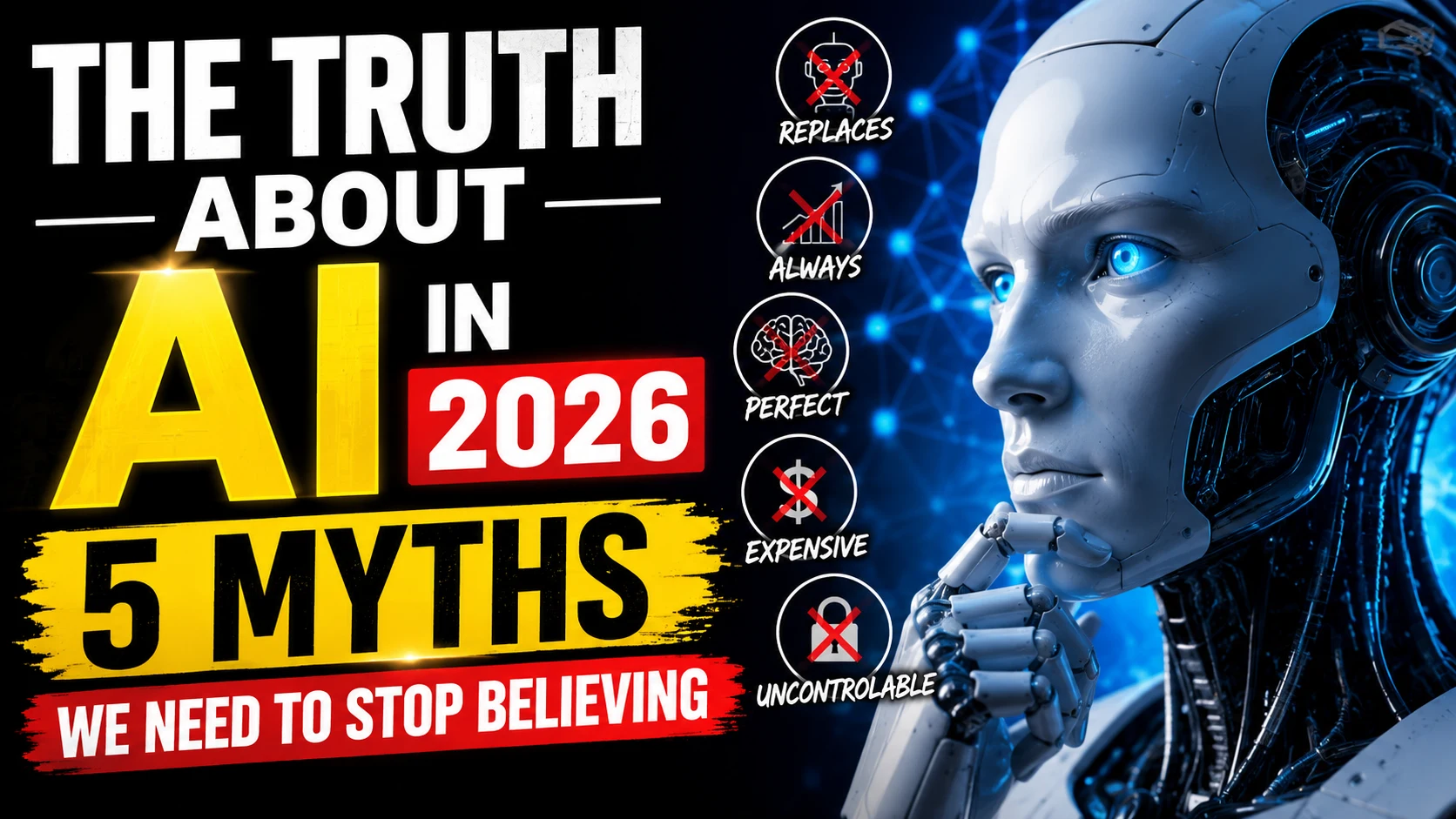
Here are five pervasive myths about AI in 2026, and the reality behind them.
Myth 1: The “Job Apocalypse” is Here
The Reality: The workforce is being redesigned, not replaced.
The narrative that AI will trigger mass unemployment remains one of the most stubborn myths. While layoffs heavily citing “AI restructuring” make headlines, macroeconomic data tells a different story. The World Economic Forum projects a net increase of 78 million jobs driven by AI transitions by the end of the decade.
AI is not replacing the worker; it is replacing the task.
- The real shift: We are moving away from hyper-specialization. Mid-tier employees are transitioning into “agent orchestrators”—professionals who guide and manage multiple AI systems to achieve a business goal.
- The actual risk: The threat isn’t a robot taking your job; it’s a professional who knows how to leverage multi-agent systems taking your job.
Myth 2: “Plug and Play” Instant Productivity
The Reality: The AI “J-Curve” means things get slower before they get faster.
Many executives bought into the illusion that deploying an AI tool would result in an immediate 30% spike in efficiency. Instead, many organizations in 2026 are facing the “Productivity Paradox.”
When companies integrate AI into legacy systems, they often experience a temporary decline in performance.
- Infrastructure bottlenecks: Workflows must be fundamentally redesigned to accommodate AI.
- The skills gap: Employees need time to learn how to prompt, troubleshoot, and trust the output.
- Governance friction: Ensuring data security, compliance, and ethical standards slows down deployment.
The ROI is real, but it is a marathon, not a sprint. The companies winning in 2026 are those treating AI as a structural overhaul, not a software update.
Myth 3: Software Engineering is Dead
The Reality: Coding is augmented, but system architecture is more vital than ever.
In early 2024, the ability of Large Language Models (LLMs) to write functional code led to premature declarations that software engineering was obsolete. The steep sell-off in some software stocks fueled this panic.
In 2026, we know better. While AI agents can generate boilerplate code and accelerate development timelines from weeks to hours, they struggle with complex enterprise architecture, security edge cases, and cross-system integration. The role of the developer has simply evolved. Today’s engineers function more like senior architects—reviewing, refining, and securing AI-generated code rather than writing every line from scratch.
Myth 4: Bigger Models are Always Better
The Reality: 2026 is the year of Small Language Models (SLMs) and Edge AI.
For years, tech giants raced to build the most massive, compute-hungry models possible. But scaling up comes with crippling energy demands and staggering costs.
This year, the industry pivot is unmistakable. Enterprises are actively abandoning massive cloud-based models for everyday tasks, favoring Small Language Models (SLMs).
- Efficiency: SLMs require a fraction of the computational power and can run locally on mobile phones, IoT devices, and industrial sensors (Edge AI).
- Privacy: Because data doesn’t have to be sent to a central cloud, SLMs are a massive win for industries handling sensitive information, like healthcare and finance.
Myth 5: Artificial General Intelligence (AGI) is Imminent
The Reality: We are mastering narrow, “Agentic AI,” not human-like reasoning.
The sci-fi dream of AGI—a single machine with human-level intelligence across all domains—remains elusive. The breakthrough of 2026 isn’t AGI; it is the commercialization of Multi-Agent Systems (MAS).
Instead of one omnipotent “super brain,” we are utilizing networks of highly specialized, narrow AI agents working together. For example, in a hospital, one agent analyzes patient data, another manages scheduling, and a third handles insurance compliance—all communicating with each other seamlessly. This is highly advanced automation, but it is not sentience.
The Bottom Line
The era of AI experimentation is over; the era of AI execution has arrived. The technology is no longer a shiny new toy to impress shareholders—it is a baseline operational requirement.
Your takeaway: Stop waiting for AI to become “perfect” before engaging with it, but don’t expect it to fix broken business processes on its own. The future belongs to those who look past the hype, redesign their workflows, and treat AI as a collaborative partner rather than a magic wand.
Also Read 3 Banned AI Tools You Weren’t Supposed to Know About