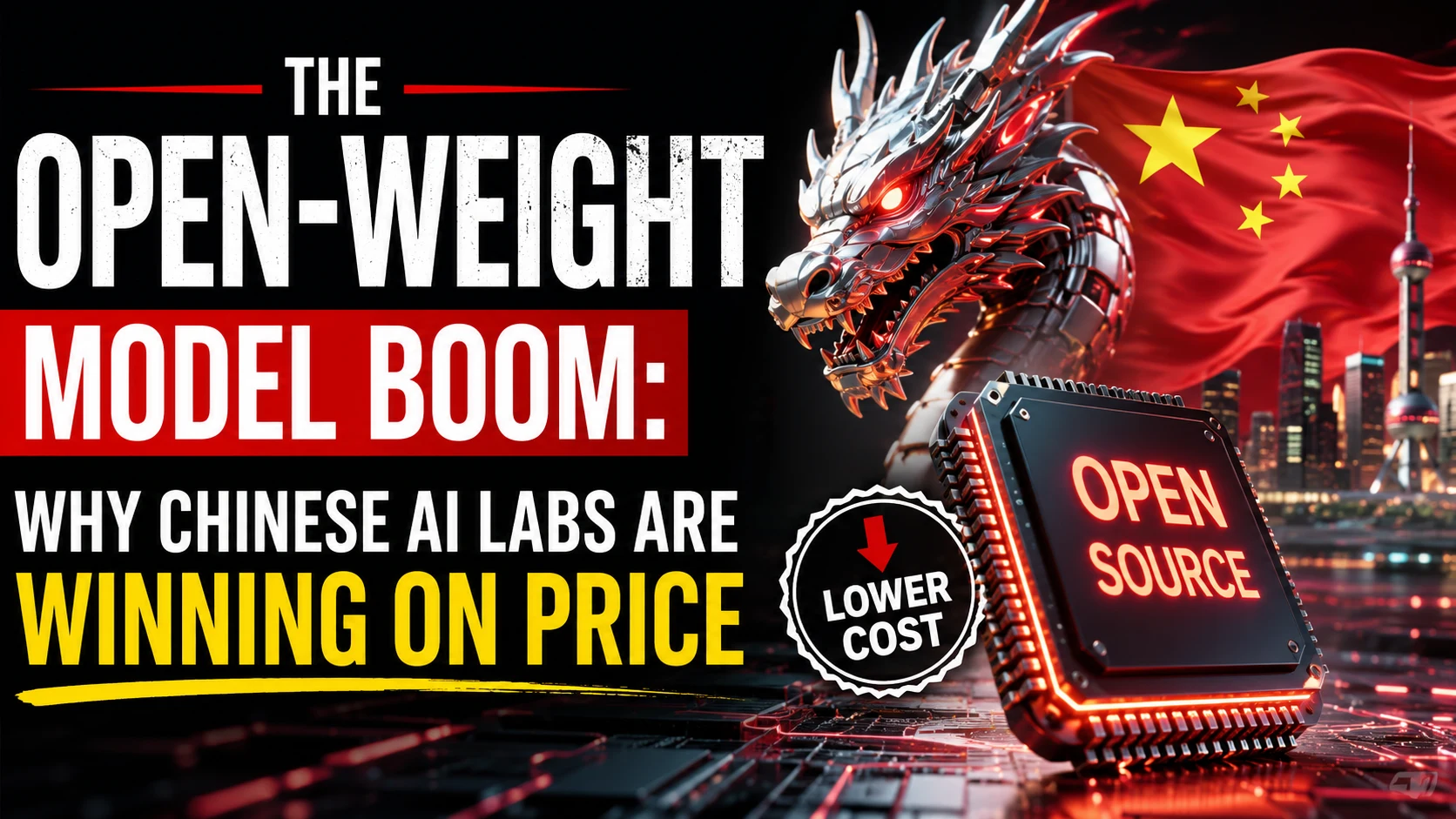
The era of trillion-dollar AI infrastructure monopolies might already be ending. For the past two years, Silicon Valley operated on a simple assumption: building frontier artificial intelligence requires bottomless capital, massive compute clusters, and closed-door ecosystems. Then, a wave of open-weight models from Chinese AI labs shattered that premise, proving that world-class reasoning doesn’t have to break the bank.
Today, models from DeepSeek, Alibaba, and Moonshot AI are not just matching the performance of their American counterparts—they are fundamentally rewriting the economics of artificial intelligence.
The DeepSeek Shockwave
The current price disruption began with DeepSeek, a model that forced the global developer community to rethink AI math. Before DeepSeek’s rise, the consensus was that training a top-tier reasoning model required hundreds of millions of dollars.
DeepSeek flipped the script. Its breakout reasoning model, DeepSeek-R1, reportedly cost under $6 million to train using a cluster of 2,000 H800 chips over 55 days. By utilizing a highly efficient Mixture-of-Experts (MoE) architecture—where only a fraction of its total parameters activate for any given prompt—DeepSeek delivered GPT-4-class reasoning at a fraction of the compute cost.
The impact was immediate and psychological. By open-sourcing the weights and offering incredibly cheap API access, DeepSeek proved that lean, optimized labs could outmaneuver bloated legacy projects.
Beyond the Pioneer: The Qwen and Kimi Ecosystems
While DeepSeek sparked the price war, companies like Alibaba (with Qwen) and Moonshot AI (with Kimi) have turned it into an enterprise siege.
- Alibaba’s Qwen3: Qwen is less about raw disruption and more about deep infrastructure. Qwen3 supports 119 languages and excels at agentic tool-calling, making it a highly versatile choice for developers building autonomous AI systems. Because it is backed by Alibaba Cloud, it seamlessly integrates into enterprise environments, offering a menu of sizes and modalities under the permissive Apache 2.0 license.
- Moonshot AI’s Kimi K3: Billed as one of the world’s largest open-weight models at 2.8 trillion parameters, Kimi K3 has dominated long-context tasks. It can ingest up to a million tokens of context, allowing businesses to analyze entire financial histories or code repositories in a single prompt.
The Economics of the API Price War
The most visible front of this AI race isn’t on benchmark leaderboards—it is on the pricing page. Chinese AI labs are aggressively undercutting US frontier APIs, forcing global businesses to reconsider their vendor lock-in.
The cost disparity is striking:
- API Cost Collapse: Hosted APIs for Chinese models like DeepSeek-R1 and Qwen are consistently priced far below US equivalents. For example, DeepSeek-R1 API input costs hover around $0.55 to $0.70 per million tokens.
- The Self-Hosting Advantage: Because these are open-weight models, businesses aren’t forced to use a vendor API at all. Permissive licenses (like MIT and Apache 2.0) allow companies to download the models and run them on their own hardware.
- Flipping the CapEx Model: Self-hosting shifts the financial burden from unpredictable, per-token API fees to fixed server and MLOps costs—a highly attractive proposition for data-heavy startups.
What This Means for the Global Market
For global businesses—particularly in the US and Europe—this open-weight boom presents both a massive opportunity and a compliance challenge.
While the cost savings are undeniable, using hosted APIs from Chinese vendors often involves offshore data transfers, which triggers a maze of corporate data sovereignty laws. The primary mitigation strategy for Western buyers has been to bypass the hosted APIs entirely and self-host the open weights locally.
The broader takeaway, however, is that AI intelligence is rapidly commoditizing. The moat around proprietary US models is shrinking as open-source alternatives match them in mathematics, coding, and multilingual reasoning.
The Bottom Line: You no longer need to pay frontier-model premiums for frontier-model performance. The open-weight boom has proven that efficiency, not just scale, is the new currency in AI.
Are you currently paying premium rates for proprietary AI? It might be time to audit your API costs. Explore whether an open-weight model like Qwen or DeepSeek could handle your workload at a fraction of the price.
Also Read Why Gemini Keeps Getting Delayed (3rd Time This Year): Inside Google’s AI Stumble