The tech job market in 2026 is brutal, and everyone is scrambling for an edge. With “AI” stamped on every other resume, the sheer volume of artificial intelligence certifications flooding platforms like Coursera, Udemy, and LinkedIn Learning is staggering. But let’s cut through the noise: do hiring managers actually care about them?
The short answer is yes—but only if you choose the right ones. If you rely on a certificate that’s “a mile wide and an inch deep”, your resume might go straight into the rejection pile. Here is the unvarnished truth about which AI certifications will actually move the needle in your career and which ones are just expensive digital paperweights.
The Reality Check: What Employers Actually Want
Before diving into the list, it is crucial to understand how tech recruiters and engineering managers evaluate AI skills today. In 2026, the consensus among hiring teams is clear: projects trump paper.
Certificates are rarely a golden ticket on their own. Instead, they act as a force multiplier. If you have a solid GitHub repository demonstrating that you can build, train, and deploy models, a reputable certification proves you understand enterprise standards, governance, and scalable cloud architectures.
“By themselves they’re kind of worthless. But they’re great pairings if you can express that certificate with a project to demonstrate what you’ve learned.” — Tech Hiring Manager
With that foundational rule established, here are the credentials that actually hold weight.
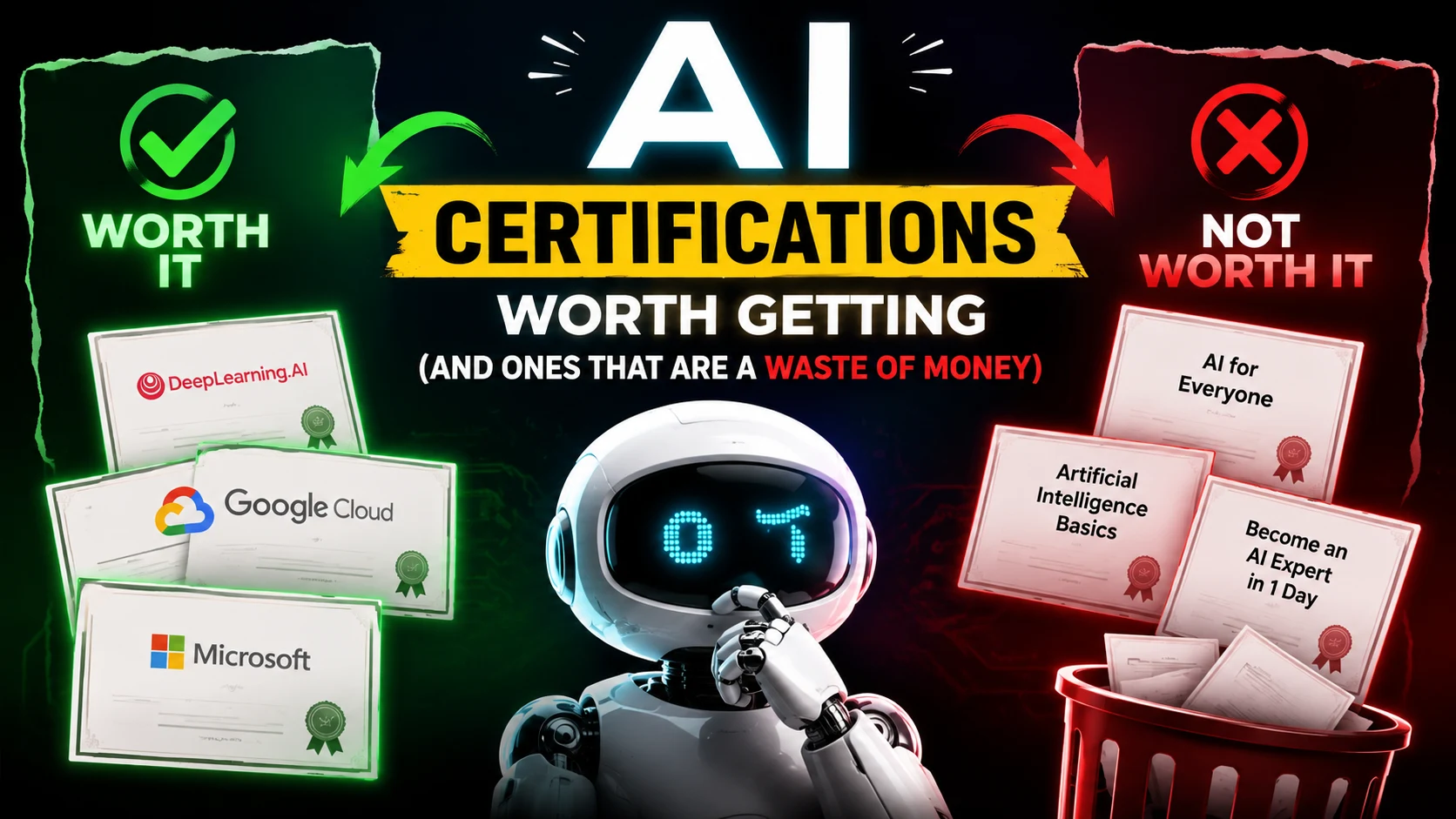
The 5 AI Certifications Worth the Investment
These certifications are respected because they require hands-on technical proficiency, focus on production-ready environments, and are backed by the industry giants defining the AI landscape.
1. Google Professional Machine Learning Engineer
- Target Audience: Experienced ML Engineers (3+ years experience, 1+ year on GCP)
- Cost: ~$200
- Why It Matters: This is the gold standard for ML operations. It doesn’t just test if you know what a neural network is; it tests your ability to design, build, and manage scalable, production-ready ML solutions using Google Cloud, Vertex AI, and MLOps tools. If you are targeting senior roles, this certification signals deep technical competence.
2. AWS Certified Machine Learning Specialty
- Target Audience: ML Engineers and Data Scientists
- Cost: ~$300 (Typically)
- Why It Matters: AWS remains the dominant cloud provider for enterprise workloads. This advanced certification validates your ability to build and deploy ML solutions on AWS, heavily emphasizing Amazon SageMaker, data engineering pipelines, and ML model deployment. It is notoriously rigorous, which is exactly why employers respect it.
3. Databricks Machine Learning Associate
- Target Audience: Data Scientists and ML Engineers
- Cost: $200
- Why It Matters: Databricks has become central to modern data architectures. This certification proves you can handle ML workflows, utilize Databricks ML/AutoML, and manage the full model building and deployment lifecycle within their ecosystem. It is highly practical and directly applicable to the daily tasks of an AI engineer.
4. Microsoft Certified: Azure AI Apps and Agents Developer Associate
- Target Audience: Software Developers transitioning into AI
- Cost: ~$165
- Why It Matters: Replacing the older AI-102 credential, this newly updated certification focuses on where the industry is heading: agentic workflows and generative AI applications. It covers practical integration of Azure AI services, NLP, and RAG (Retrieval-Augmented Generation) pipelines, making it ideal for developers building the next wave of AI products.
5. Stanford Artificial Intelligence Graduate Certificate
- Target Audience: Advanced professionals seeking academic rigor
- Cost: $19,682–$24,224 (Requires 1-3 years)
- Why It Matters: While expensive and time-consuming, this is one of the few academic certificates that carry the weight of a degree. It requires a strong math and programming background and dives deep into probabilistic modeling, robotics, and deep learning. It is best suited for those aiming for pure research or high-level architecture roles where theoretical depth is critical.
The Certifications That Are a Waste of Money
Not all credentials are created equal. You should generally avoid certifications that exhibit these red flags:
- “No Coding Required” Masterclasses: If a course promises to make you an “AI Expert” without writing a single line of Python, it is essentially an elongated vocabulary lesson. These are fine for executives needing a high-level overview, but they will not help you land a technical role.
- Generic Platform Certificates: A generic “Intro to AI” certificate from a MOOC platform often carries very little weight with hiring managers, who generally view them as “a mile wide and an inch deep”. They show curiosity, not capability.
- Vendor-Agnostic Bootcamps (Without a Portfolio): Expensive, fast-track bootcamps that offer a proprietary certification at the end are risky. Unless that bootcamp requires you to build a substantial, original project (not just following a tutorial), the certificate itself is often meaningless to recruiters.
The Bottom Line: How to Actually Get Hired
Certifications only work when they validate existing, demonstrated skills. If you are serious about breaking into AI or leveling up in 2026, adopt this strategy:
- Build First: Create a project that solves a real problem. Deploy a model, build a RAG application, or create an agentic workflow. Host it on GitHub and write a clear README.
- Certify Second: Choose one difficult, vendor-specific certification (like AWS or GCP) that aligns with the stack you used in your project.
- Combine the Narrative: On your resume and in interviews, do not just list the certification. Explain how the knowledge you gained helped you architect and optimize your project.
Stop collecting digital badges and start writing code. The certifications worth getting are the ones that prove you already know how to do the work.
Also Read 5 Ways Freelancers Are Using Artificial Intelligence to 10x Their Output