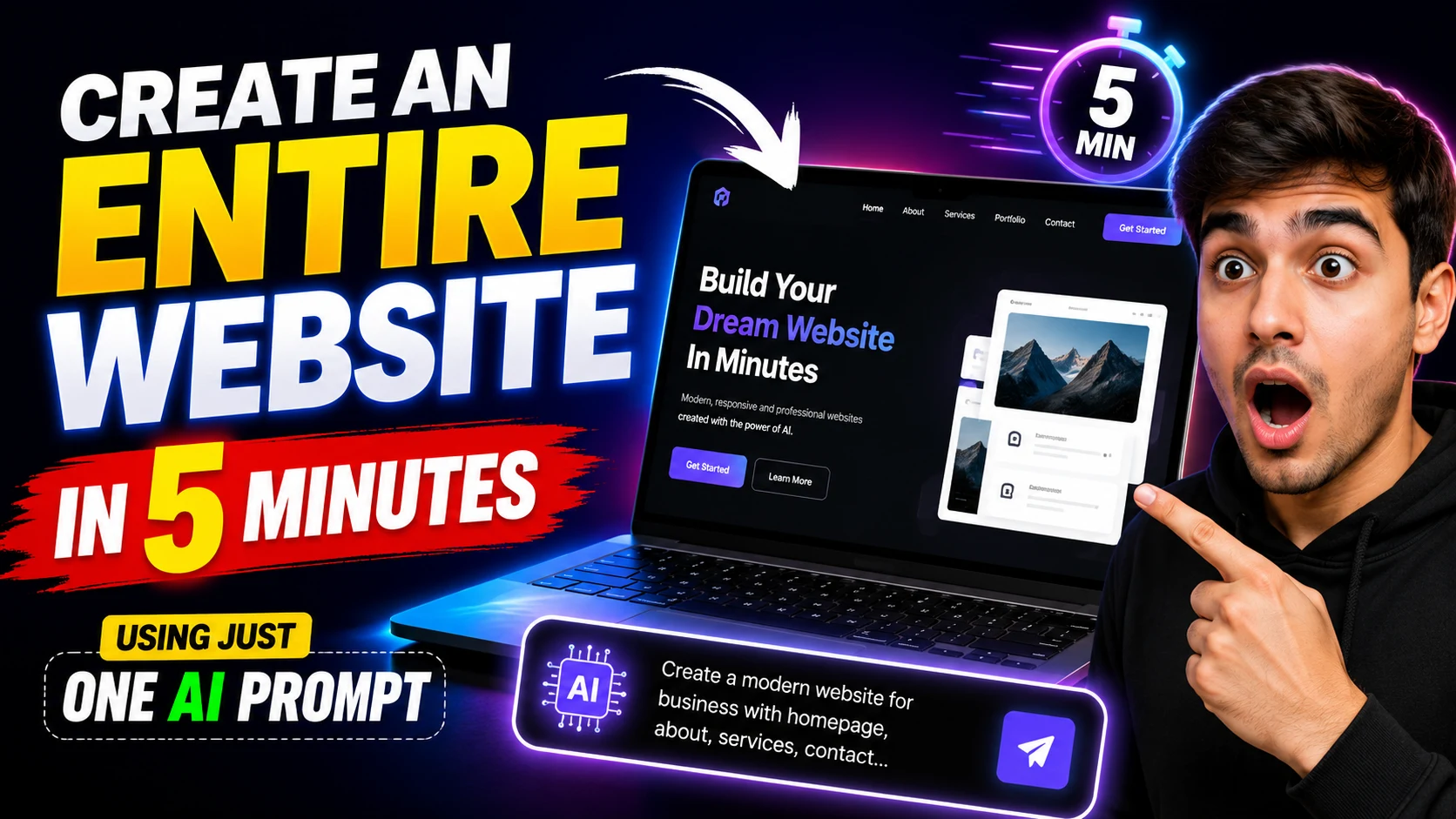
Remember when launching a website meant weeks of wireframing, debugging HTML, and spending thousands of dollars on agency fees? Those days are officially behind us. In 2026, the global AI in web development market is projected to reach an astounding $14.2 billion, growing at a massive 25.4% annual rate. The technology has evolved from suggesting basic layouts to functioning as a fully autonomous development team. Today, going from a blank screen to a live, responsive website takes just five minutes and a single, well-crafted AI prompt.
Welcome to the era of “vibe coding”—where natural language is the only programming language you need.
From Clunky Templates to “Text-to-Website”
For years, website builders relied on drag-and-drop templates. While they democratized web design, users still had to spend hours manually tweaking boxes and uploading assets. The current generation of AI website builders operates differently. Powered by large language models (LLMs) and agentic frameworks, these tools don’t just fill in templates; they generate custom frontend layouts, backend logic, and database connections entirely from scratch.
Whether you are a bakery owner needing a digital storefront or a startup founder testing a SaaS MVP, you can now describe your vision in plain English and watch the code write itself in real-time.
4 AI Tools That Build Websites in Minutes
The market is flooded with AI generators, but a few platforms are setting the gold standard for speed, code quality, and ease of use in 2026:
- Bolt.new: Engineered by StackBlitz, Bolt.new is a powerhouse for full-stack web applications. By typing a prompt, it generates both the frontend and backend, running everything directly in your browser using WebContainers without any local setup.
- Lovable.dev: Designed heavily for the 99% of people who don’t know how to code, Lovable translates simple text prompts into working web applications. It generates clean code, handles infrastructure, and even integrates with tools like Stripe and GitHub out of the box.
- v0 by Vercel: A favorite among developers, v0 generates modern, production-ready user interfaces using React, Next.js, and Tailwind CSS. You can prompt it with text, or even upload a screenshot or a rough Figma sketch, and v0 will recreate the layout flawlessly.
- Wix AI Builder: For traditional small business owners who prefer zero code, mainstream giants like Wix have perfected the conversational AI builder. You answer a few questions or provide a short prompt, and the platform delivers a complete site with built-in SEO, copy, and e-commerce tools ready to publish.
The Anatomy of a Perfect Website Prompt
The secret to generating a flawless website in five minutes isn’t just the tool you choose—it is how you instruct the AI. A vague prompt like, “Make me a website for my gym,” will yield generic results.
To get production-ready output, your prompt must act as a creative brief. According to prompt engineering best practices, a highly effective AI website prompt contains four key elements:
- Visual Style: Specify the exact aesthetic you want. (e.g., “Use a modern dark theme with neon green accents and a monospace font.”)
- Core Functionality: Outline what the site needs to do. (e.g., “Include a sticky navigation bar, a hero section with an email capture form, and a pricing table.”)
- Content: Provide structural direction for the copy. (e.g., “Add placeholder text for three customer testimonials and a ‘Book Now’ call to action.”)
- Technical Requirements: Dictate the behavior. (e.g., “Ensure the layout is fully mobile-responsive and uses smooth scrolling.”)
The Catch: Does AI Replace Human Developers?
While the speed of these tools is undeniable—platforms like Framer AI report that their builder reduces the average time to launch a functional landing page from 15-20 hours down to under 30 minutes—it is important to remain objective.
Can an AI prompt build a 100-page enterprise e-commerce site with complex legacy integrations in five minutes? Not yet. AI excels at getting you 90% of the way there. It eliminates the tedious boilerplate coding and wireframing, giving founders and designers a functional canvas immediately. However, for highly specialized security protocols, complex custom backend architectures, and fine-tuned brand storytelling, human oversight remains irreplaceable.
Your Next Move
The barrier to entry for digital real estate has been completely eradicated. You no longer need to learn JavaScript or hire a costly agency just to validate a business idea.
Takeaway Challenge: Don’t just read about this shift—experience it. Open a new tab, navigate to an AI builder like Bolt.new or Lovable.dev, set a timer for five minutes, and type out a detailed prompt for that business idea you’ve been sitting on. By the time the timer rings, your vision will be live on the internet.
Are you ready to prompt your first website into existence?