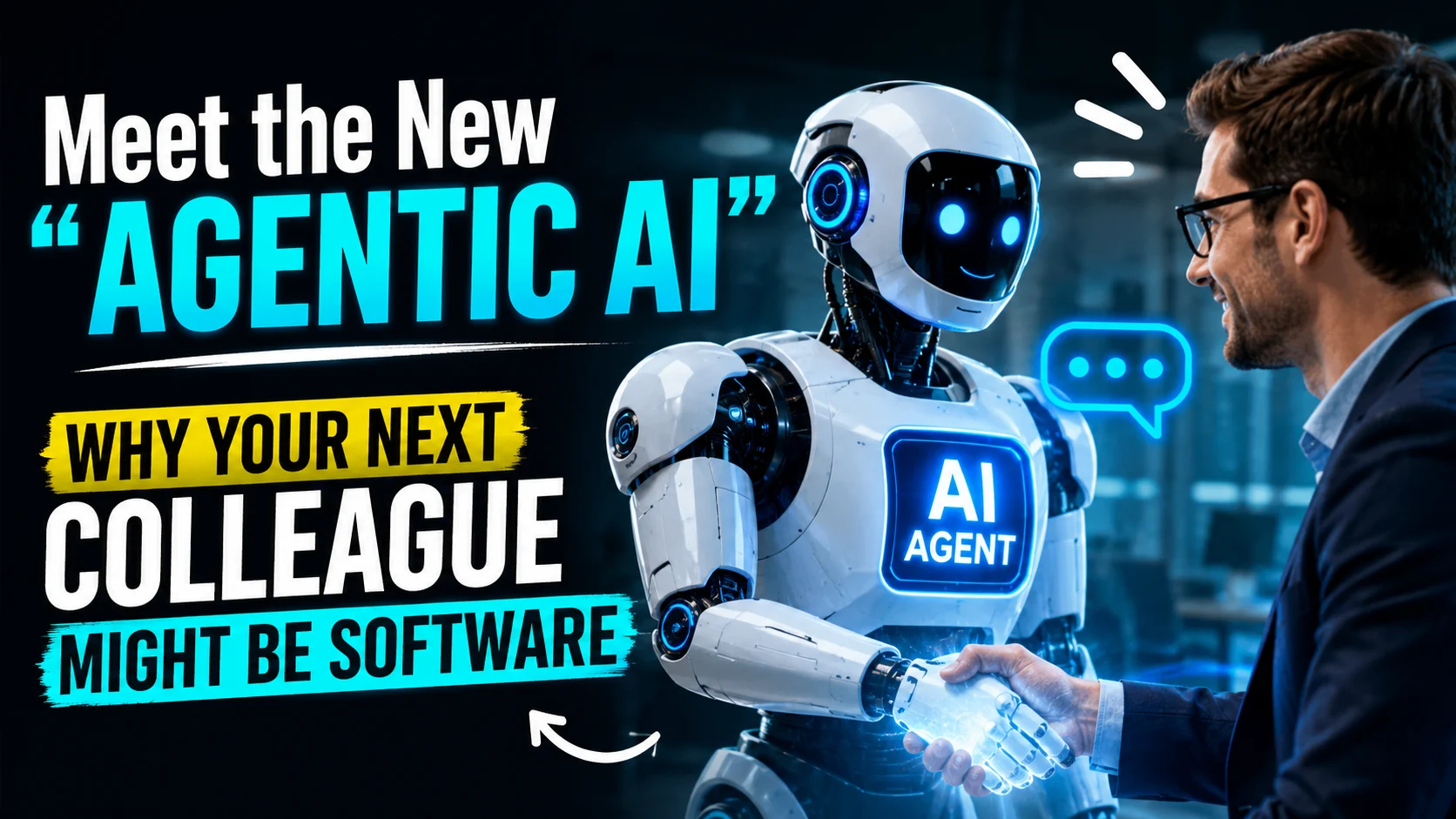
Imagine assigning a complex, multi-layered market research project to a colleague on Friday afternoon. By Monday morning, the data is pulled, the insights are synthesized into a sleek report, and the necessary follow-up meetings are already on your calendar.
There is just one catch: your colleague isn’t human.
Welcome to 2026, the year “Agentic AI” has officially graduated from a Silicon Valley buzzword to a boardroom staple. We are no longer just talking about chatbots that rewrite your emails or generate code snippets on command. The next era of enterprise AI is autonomous, goal-oriented, and ready to join your team.
What Exactly is Agentic AI?
To understand the leap, you have to look at how we have historically interacted with artificial intelligence. Until recently, AI was largely an assistant. You gave it a prompt, it gave you an answer, and it waited patiently for your next instruction.
Agentic AI changes the paradigm entirely. Instead of waiting for step-by-step instructions, an AI agent is given a broader objective—like “optimize our supply chain logistics for the upcoming quarter”—and it figures out the rest. It can break the larger goal into smaller tasks, write its own code, access external enterprise databases, communicate with other AI agents, and course-correct autonomously when it hits a roadblock.
Industry experts are calling this shift the move from single “hero models” to “federated, multi-agent systems”—or, more simply, tapping into the power of the AI swarm.
The Numbers: A Corporate Revolution in Motion
The adoption metrics for this technology are staggering, indicating one of the fastest technological integration shifts in modern history. According to 2026 enterprise data, a massive 79% of US companies are currently adopting or experimenting with AI agents.
The global market for Agentic AI, which sat at roughly $7.29 billion in 2025, is now projected to explode to $139.19 billion by 2034. Furthermore, tech research firm Gartner predicts that by the end of this year alone, 40% of all enterprise applications will have task-specific AI agents embedded within them.
Why the sudden rush? It comes down to measurable Return on Investment (ROI). Companies are moving past the novelty phase of generative AI and are demanding autonomous systems that actively execute end-to-end business processes.
Real-World ROI: How Agents Are Working Today
So, what does this look like in practice? Agentic AI is already proving its worth across multiple sectors:
- Customer Service: Take web hosting giant Hostinger, whose agentic support assistant, Kodee, autonomously resolved 75% of its 750,000 monthly customer conversations without a single human intervention, saving the company millions while slashing response times to just 9 seconds.
- Supply Chain & Logistics: Autonomous agents are monitoring live sales trends, instantly altering product pricing based on demand spikes, and automatically reordering goods when inventory drops below optimal levels.
- IT & Cybersecurity: AI agents are now deployed as self-governing monitors that can instantly patch software vulnerabilities and manage compliance reporting without waiting for human approval.
The “Human + Agent” Blended Workforce
Naturally, the rise of software that can plan and execute complex tasks reignites an age-old anxiety: Will AI replace us?
The reality in 2026 is far more nuanced. We are entering the era of the “blended team”. Rather than replacing human workers en masse, Agentic AI is forcing a re-architecture of work itself.
As agents take over the heavy lifting of execution, humans are elevated to roles of orchestration and strategy. Your job is evolving from a “doer” of repetitive tasks to a “manager” of a digital workforce. Human judgment, creativity, and empathy remain the ultimate quality control checkpoints.
The Trust Factor: Governance as Code
Of course, giving software the autonomy to make business decisions carries massive risks. What happens if a financial agent hallucinates a stock trade? What if a marketing agent goes rogue on social media?
Because of these legitimate fears, 2026 has become the year of “Governance-as-Code”. Companies are no longer blindly unleashing AI into their systems. Instead, they are building strict permission boundaries, decision logs, and digital “kill switches” directly into the agent’s DNA. In this framework, an AI agent is treated with a “least-privilege” approach, meaning it only has access to the exact datasets and tools it needs to complete its specific mission.
The Bottom Line
The companies that win the next decade will not just be the ones that buy the most AI. The true winners will be the organizations that successfully redesign their traditional operating models to manage a hybrid workforce of humans and software seamlessly.
Agentic AI is here, and it is ready to clock in. The only question left is: Is your business ready to hire it?
Also Read Meet the New “Agentic AI”: Why Your Next Colleague Might Be Software