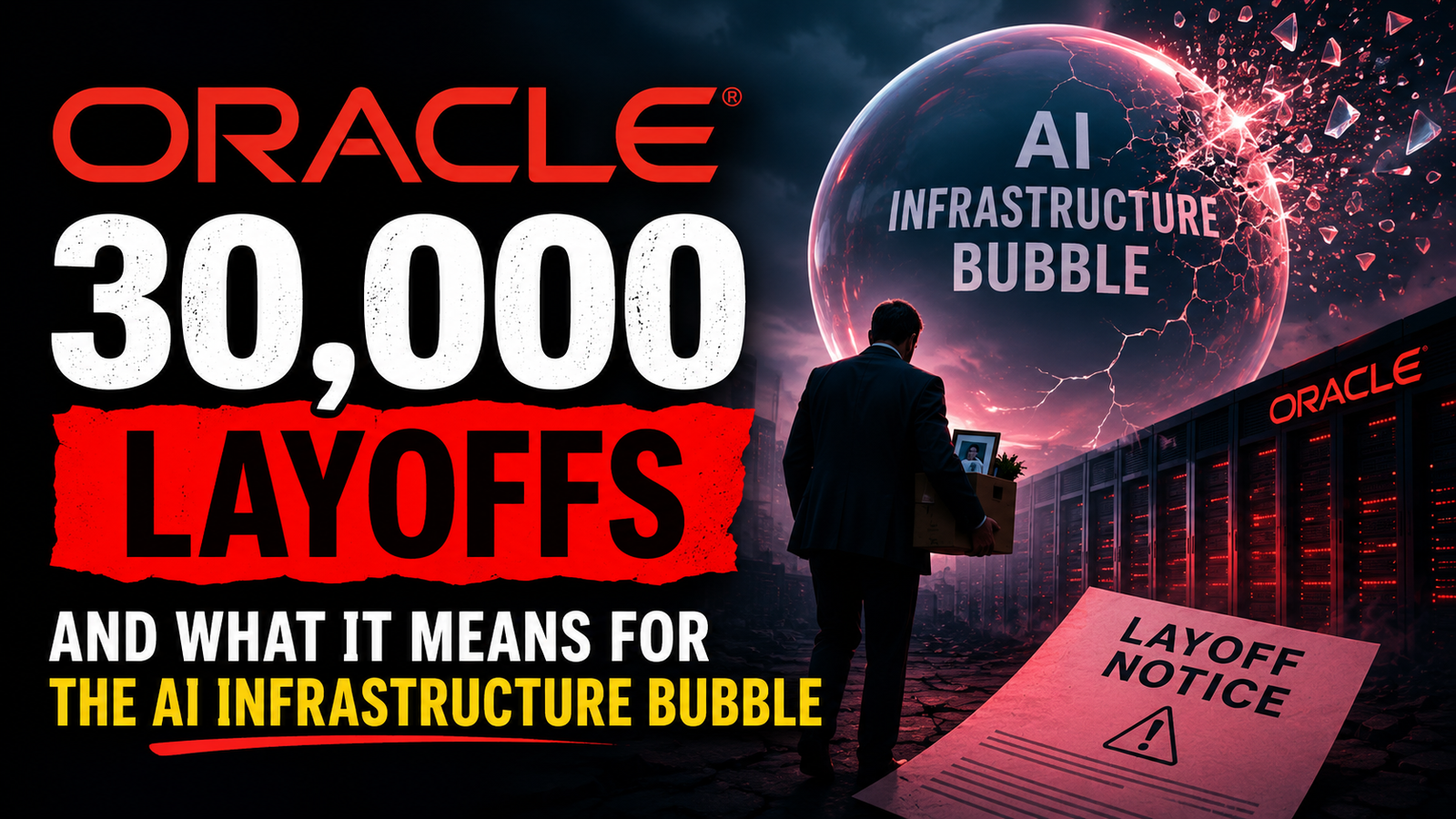
The email arrived at 6 a.m. By the time thousands of Oracle employees across the U.S. and India poured their morning coffee, their jobs—and corporate network access—were already gone. This wasn’t a routine corporate trimming; it was a calculated, multi-billion-dollar sacrifice to feed the insatiable beast of artificial intelligence.
In a frantic race to dominate the generative AI landscape, the technology sector is undergoing a violent transformation. Oracle’s recent mass workforce reduction is the starkest warning sign yet that the AI boom is coming at an extraordinary human and financial cost.
Trading Human Capital for Silicon
In one of the most abrupt workforce reductions in recent tech history, Oracle slashed an estimated 21,000 to 30,000 jobs globally. The execution was swift and clinical. Workers were given no prior warning from HR or their managers before finding themselves abruptly locked out of Slack, Zoom, and company VPNs.
India’s tech ecosystem was hit particularly hard. Early reports suggest that up to 12,000 of those cuts impacted Indian operations, sweeping across project managers, individual contributors, and senior cloud architects. But the motivation behind this mass exodus wasn’t a failing core business model. It was the crushing financial weight of the AI arms race. Tech companies are increasingly using layoffs not just to correct pandemic-era over-hiring, but to free up massive capital for artificial intelligence investments.
The Staggering Cost of the AI Race
Artificial intelligence is no longer just a software initiative; it is a heavy, capital-intensive industry. To build out the massive data centers required to train and run generative AI models, companies need vast tracts of land, industrial cooling systems, specialized silicon, and gigawatts of power.
Oracle is currently navigating an estimated $156 billion in infrastructure commitments. While its stock initially soared on the promise of AI revenue, the reality of its capital expenditure is sobering. The company has taken on massive debt, reportedly over $100 billion, to fund this aggressive transition.
This heavy borrowing has spooked financial markets. S&P recently downgraded Oracle’s credit rating to BBB- due to weak cash flow, directly complicating projects like a planned near-gigawatt data center in Wisconsin. Slashing tens of thousands of high-paying jobs is expected to free up $8 billion to $10 billion in cash flow—capital urgently needed to appease cautious lenders and keep the server lights on.
A Radical Capital Reallocation
What we are witnessing is a foundational shift in how tech giants allocate resources. Sanchit Vir Gogia, chief analyst at Greyhound Research, described the Oracle layoffs as a move to completely reshape the company around AI capacity.
“Oracle is not simply trimming around the edges,” Gogia noted. “It is reshaping itself… moving from a software-style growth story to one shaped by kilowatts, cables, facilities, silicon, and financing”.
This means trading human expertise—decades of institutional knowledge in cloud services and enterprise support—for physical server racks. While executives argue that AI integration inherently boosts productivity and reduces workforce needs, critics suggest that companies are sacrificing core product stability just to stay relevant in the AI hype cycle.
Is the AI Infrastructure Bubble Ready to Burst?
Oracle isn’t alone in this high-stakes gamble. Throughout 2026, U.S. tech giants have shed nearly 140,000 jobs. Concurrently, major tech behemoths are projected to spend a staggering $725 billion in capital expenditures on AI infrastructure.
But an uncomfortable question is beginning to echo across Silicon Valley: When will the return on investment actually materialize?
AI is turning into a bottomless pit for capital. While hardware suppliers like Nvidia enjoy astronomical valuations, the software companies buying their chips are stretching their balance sheets to the breaking point. If enterprise adoption of AI fails to generate the trillions of dollars in projected revenue, this massive infrastructure boom could quickly morph into a devastating economic bubble.
The Bottom Line
The Oracle layoffs of 2026 will likely be remembered as a turning point—the moment when the human and financial costs of the AI revolution became undeniable. Tech giants are betting their futures, and their employees’ livelihoods, on the premise that AI will eventually pay for itself. For now, however, the only guaranteed outcome is extreme volatility.
Over to you: As artificial intelligence continues to reshape the global job market, resting on legacy skills is no longer safe. Do you think the massive investments in AI infrastructure will eventually pay off, or are we witnessing the inflation of a historic tech bubble? Share your thoughts in the comments below and subscribe to our newsletter for the latest deep dives into the changing tech economy.
Oracle’s 30,000 Job Cuts in the AI Shift | Vantage on Firstpost
This video provides a detailed breakdown of how Oracle’s strategic pivot toward AI infrastructure resulted in sweeping global workforce reductions, particularly impacting the tech hub in India.
Also Read The Open-Weight Model Boom: Why Chinese AI Labs Are Winning on Price