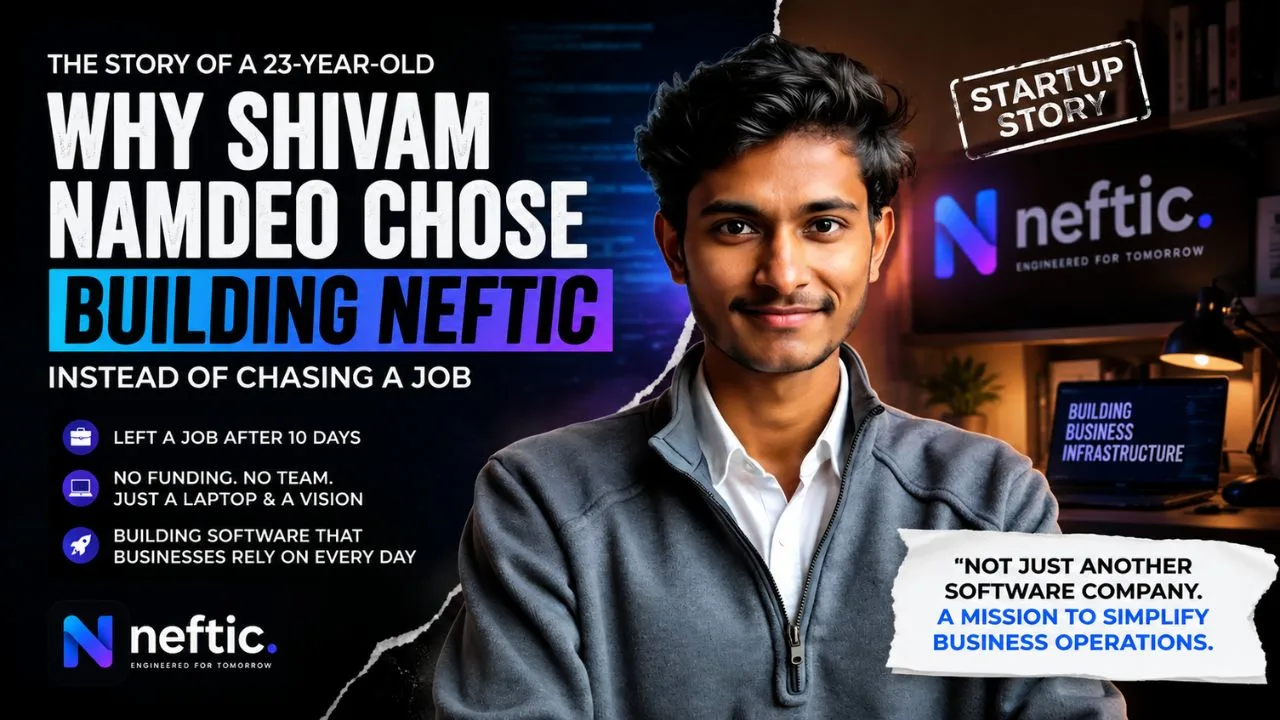
Instead of following the familiar path of campus placements and long-term employment, one engineering graduate chose a far more uncertain route—building a software company from scratch. With no investors, no established team, and no guarantee of success, Shivam Namdeo walked away from a job in Bengaluru after just ten days to pursue an idea that would eventually become Neftic.
At a time when stable jobs remain the preferred choice for most graduates, stories like this stand out not because they promise overnight success, but because they reflect a growing shift among young Indian entrepreneurs who are choosing to build rather than simply seek employment.
It Didn’t Start With a Company
Long before Neftic existed, there was curiosity.
While many engineering students spent their time preparing for semester examinations and campus placements, Shivam Namdeo became interested in something that wasn’t part of the curriculum—understanding how digital businesses are built.
Instead of waiting until graduation, he began experimenting during his first year of engineering.
His early projects included digital platforms such as Timely Bharat, RedPost, and several other web-based experiments. Some ideas never reached the public. Others launched but failed to gain traction.
None became commercial successes.
Yet each project offered practical lessons that classrooms rarely provide—how to validate an idea, launch a product, understand users, recover from failure, and improve through iteration.
Looking back, those experiments became the foundation of a much larger ambition.
Learning Beyond the Classroom
Over the next few years, the focus gradually shifted.
Rather than building websites simply for the sake of creating them, Shivam became increasingly interested in solving operational problems faced by businesses.
The more products he built, the clearer one goal became: creating software that businesses would use every day.
Like many students nearing graduation, he faced the same question—accept a stable job or pursue an uncertain entrepreneurial path.
For most graduates, the answer is straightforward.
For him, it wasn’t.
A Brief Job That Changed the Direction
After completing his engineering degree, Shivam moved to Bengaluru, India’s largest technology hub, and joined a software company.
The intention, however, was never to build a long-term corporate career.
He wanted to understand how software businesses worked from the inside.
His responsibilities involved software deployment, interacting with business clients, understanding operational challenges, and presenting software solutions.
Although his time there lasted only ten days, the experience proved influential.
Instead of being impressed by technology itself, he noticed something far more important.
Most businesses weren’t searching for complicated software packed with features.
They wanted practical tools that could save time, simplify operations, reduce manual work, and ultimately improve revenue.
That observation would shape what came next.
Choosing Uncertainty Over Security
On the tenth day, Shivam resigned.
From a financial perspective, it was a difficult decision.
There was no funding.
No venture capital.
No established customer base.
No office.
No team waiting to build alongside him.
Only a laptop, a rented room in Bengaluru, and a conviction that businesses needed software designed around real operational problems rather than unnecessary complexity.
That conviction became the foundation of Neftic.
Building Neftic Around Business Problems
Rather than positioning itself as another software development company, Neftic was envisioned as a business software company focused on helping organisations operate more efficiently.
Its objective was straightforward: build products that remove friction from everyday business operations.
The first opportunity emerged from observing the restaurant industry.
Many restaurants still relied heavily on manual order management, disconnected workflows, and limited customer engagement after a purchase.
Instead of building another digital menu, Neftic began developing DineOS, a restaurant operating platform designed to integrate QR ordering, kitchen workflows, customer engagement, repeat visit strategies, and WhatsApp automation into a single system.
The philosophy behind the product was simple.
Businesses rarely buy software because it has more features.
They invest in software because it produces better outcomes.
A Journey Still in Its Early Stages
Unlike many startup stories shared on social media, Neftic’s journey has not been marked by funding announcements, rapid scaling, or billion-dollar valuations.
The company remains in its early stage.
Its progress is measured not by headlines but by product development, customer conversations, and continuous iteration.
This reflects a broader reality of entrepreneurship.
According to the Government of India’s Startup India initiative, India is now home to more than 1.5 lakh recognised startups, making it one of the world’s largest startup ecosystems. However, industry studies consistently show that a significant percentage of startups struggle to achieve long-term sustainability, highlighting that building a successful company is often a gradual process rather than an overnight success. Success typically depends on consistent execution, market validation, and solving genuine customer problems.
In that context, Neftic represents one among thousands of early-stage startups attempting to build sustainable software businesses from India.
Whether it succeeds remains uncertain.
But the decision to build reflects a broader entrepreneurial mindset increasingly visible among young founders.
Looking Ahead
Shivam Namdeo does not describe Neftic as a startup built for a quick exit or short-term valuation.
His long-term vision is to create software infrastructure that businesses depend on every day.
The company’s current focus remains on developing practical software products that simplify operations for industries such as restaurants and other business sectors where digital transformation is still evolving.
The road ahead will likely include competition, financial challenges, product pivots, and continuous learning.
Like every early-stage startup, there are no guarantees.
But every established technology company once began with limited resources, uncertain outcomes, and founders willing to take calculated risks before anyone else believed in the idea.
The Takeaway
The story of Neftic is not one of instant success—it is one of deliberate risk, continuous learning, and long-term commitment. Shivam Namdeo’s decision to leave a conventional job after only ten days was not presented as a shortcut to entrepreneurship, but as a personal choice shaped by years of experimentation and firsthand exposure to business challenges.
Whether Neftic ultimately grows into a large software company remains to be seen. What is already clear, however, is that sustainable businesses are rarely built on viral moments or bold claims. They are built through consistent execution, close attention to customer problems, and the willingness to keep improving long after the initial excitement fades.
ALSO READ Best AI Video Generators Compared (Tested): Which Tool Is Worth Your Money in 2026?