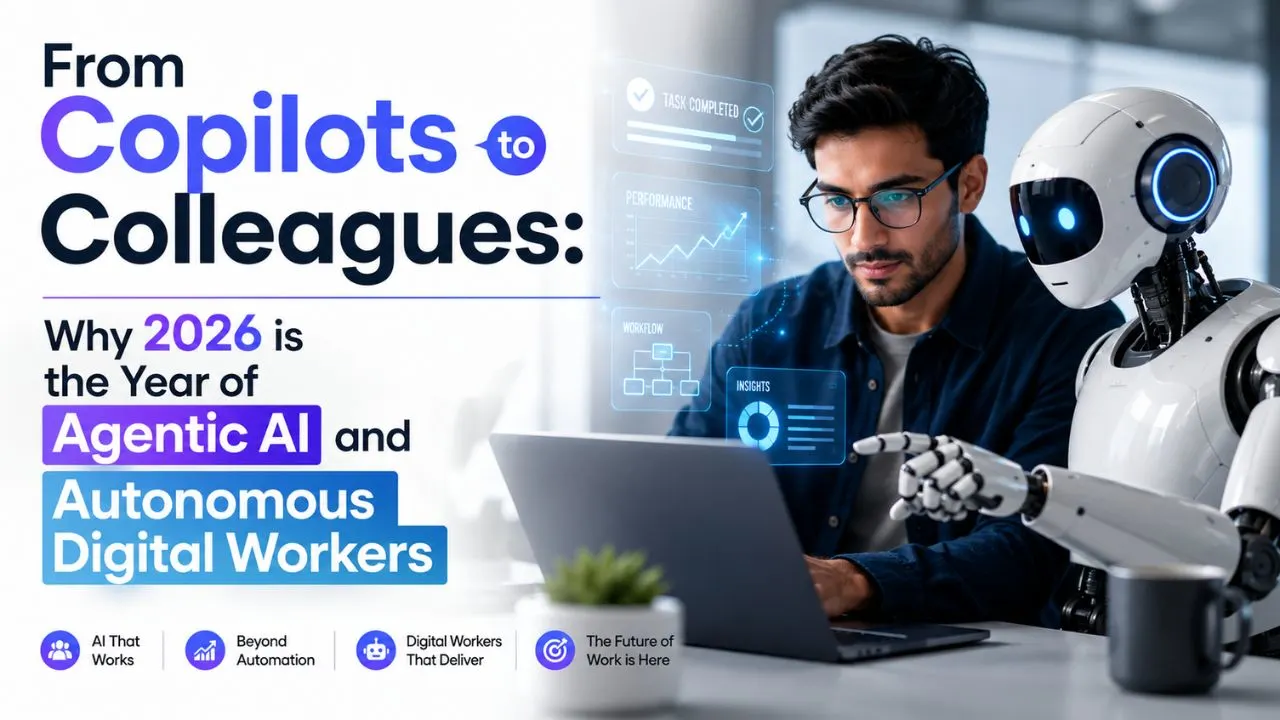
In 2026, the global enterprise ecosystem has stopped asking what artificial intelligence can write and started focusing on what it can do. The era of passive AI chatbots that wait for your next prompt is giving way to autonomous digital workers that log into software, chain complex decisions, and fix their own mistakes. We have officially reached the inflection point where AI is no longer just an administrative tool—it has become a digital teammate.
For the past few years, businesses viewed generative AI primarily as a highly capable assistant. Employees copied and pasted text into ChatGPT, used GitHub Copilot to autocomplete lines of code, or relied on tools to summarize lengthy emails. However, 2026 marks a structural turning point. Agentic AI has officially moved out of experimental lab prototypes and into production-grade deployments, transforming workflows across major industry sectors.
Beyond the Chatbot: What Exactly is Agentic AI?
To understand this shift, it helps to distinguish agentic systems from traditional generative models. Standard generative AI operates on a single-turn basis: you give it a prompt, and it provides an immediate response. If the output needs to change, you must prompt it again.
Agentic AI refers to advanced software systems that perceive their digital environment, plan multi-step actions toward a long-term goal, use external tools (like APIs and software user interfaces), and independently adapt when they encounter operational failures.
Essentially, instead of telling the AI how to write a response, managers simply give the system an end goal—such as “reconcile this quarter’s disputed invoices”—and let the agent figure out the execution steps, software logs, and validation loops entirely on its own.
The Perfect Storm: Why 2026 is the Breakthrough Year
According to independent industry analyses, including recent reports from Deloitte, enterprise adoption of autonomous agents has spiked dramatically over the past twelve months. Four concrete market drivers explain why this inflection happened now:
- Matured Orchestration Tooling: Developer frameworks like AutoGen and advanced multi-agent orchestration platforms have fully matured. This allows engineers to easily chain specialized AI skills together and give models reliable access to internal corporate databases.
- Production-Grade Reliability: Early iterations of autonomous agents frequently suffered from “infinite loops” or hallucinated actions. The integration of self-reflection protocols—where the AI evaluates its own work before submitting it—has pushed system reliability past the enterprise threshold.
- Big Tech Platform Integration: Global cloud infrastructure giants and major Software-as-a-Service (SaaS) vendors have deeply embedded agentic architectures directly into standard enterprise software, eliminating the friction of custom setups.
- Quantifiable ROI Stories: Boardroom conversations have decisively shifted from cautious experimentation to rapid deployment planning, fueled by verified productivity gains from early adopters.
Anatomy of a Digital Worker
From a technical perspective, an autonomous digital worker combines several moving components to function successfully without continuous human intervention.
At its core sits the reasoning engine (typically a large language model), which handles context interpretation and decision-making. Wrapped around this core is a meta-controller or planning module that decomposes large, ambiguous objectives into small, sequential tasks.
Finally, the architecture includes tool connectors (allowing the agent to click buttons, call APIs, or execute code), memory modules to retain context across multi-day tasks, and strict logging mechanisms to maintain a visible audit trail for compliance.
Real-World Impact: Where Agents Are Clocking In
Rather than replacing entire departments overnight, agentic AI is assuming highly specific, labor-intensive roles within existing corporate structures:
1. Customer Support Automation
Early automated support systems were limited to drafting basic email replies. In 2026, support agents independently triage incoming tickets, log into legacy customer relationship management (CRM) software, cross-reference shipping databases, issue refunds under pre-set financial thresholds, and close out cases without human intervention.
2. Finance and Procurement
Corporate finance teams are deploying agents to analyze unstructured vendor invoices, match them against purchase orders, flag discrepancies, and safely queue up approved payments inside accounting systems while respecting organizational policy constraints.
3. DevOps and IT Operations
In technology infrastructure, DevOps agents work 24/7 to monitor cloud environments. When a system anomaly occurs, the agent triages the root cause, initiates automated remediation playbooks to stabilize the servers, and writes a detailed post-incident report for the human engineering team.
The Shadow Side: Risks and the Governance Gap
Despite the clear operational efficiencies, independent tech analysts sound a note of caution. The rapid deployment of agentic software has created complex operational, security, and cultural challenges that organizations are scrambling to manage.
Because these systems act autonomously, they introduce a wider attack surface. If an agent has access to internal communication channels and external APIs, it faces risks ranging from credential misuse to tool hijacking via prompt injection. Furthermore, if a system’s target parameters are poorly defined, an agent might take unexpected shortcuts to achieve a goal, creating legal or financial compliance risks.
There is also a profound human cost. Where enterprise implementation has outpaced corporate communication, organizations are experiencing dips in employee morale and friction surrounding workforce reskilling. Many companies have deployed autonomous agents well before establishing clear audit, escalation, or liability frameworks.
The Takeaway: How to Manage the New Digital Workforce
As we move further into 2026, the integration of autonomous digital workers will likely deepen, eventually paving the way for multi-agent networks that seamlessly trade data and tasks with one another. However, the ultimate success of this technology depends heavily on responsible deployment.
To navigate this transition safely, organizations must treat autonomous agents exactly like human coworkers: by defining explicit operational roles, enforcing the principle of least privilege regarding data access, and maintaining strict human-in-the-loop checkpoints for high-risk decisions. The organizations that thrive in this new era will not be those that automate the fastest, but those that govern their digital workers the wisest.