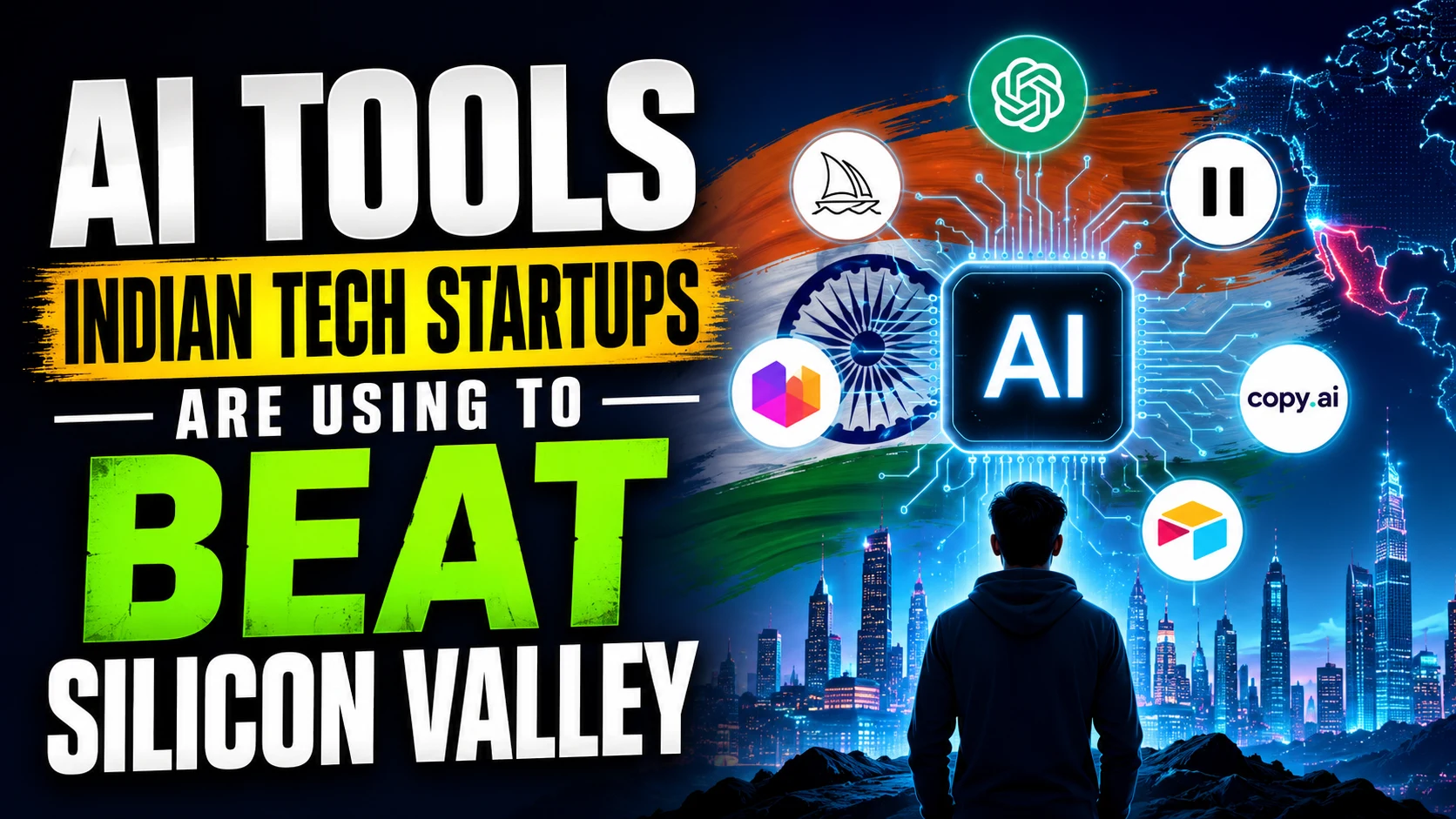
The global AI market has crossed the $300 billion mark, but a quiet revolution is shifting the center of gravity away from California. Indian tech startups are no longer just building software wrappers on top of OpenAI or Google’s foundation models. Backed by massive local compute infrastructure and strategic government initiatives, they are building sovereign, highly optimized AI tools that compete directly with Silicon Valley on cost, efficiency, and vertical expertise.
Here is an inside look at the homegrown AI tools, infrastructure, and strategies Indian startups are deploying to capture the global enterprise market.
The Rise of Sovereign Foundation Models
For years, Silicon Valley dominated the narrative with generalized, massive Large Language Models (LLMs). But Indian companies have recognized a distinct gap: global models often struggle with the nuances of multilingualism, code-switching, and voice-first usage patterns that dominate emerging markets.
Leading this charge is Sarvam AI, which recently secured a massive $234 million Series B funding round, catapulting it to a $1.5 billion unicorn valuation. Rather than trying to out-scale OpenAI, Sarvam is out-specializing it.
- Cost-Optimized MoE Architecture: Sarvam recently launched two foundational models (30B and 105B parameters) trained from scratch using a mixture-of-experts (MoE) architecture. Their 30B model uses only 1 billion parameters per output token, dramatically reducing inference costs compared to dense global models.
- Multilingual Superiority: Trained on 16 trillion tokens across 22 Indian languages, these models are purpose-built for India’s linguistic diversity.
- Targeted Tools: Tools like Sarvam Vision (an OCR system that reportedly outperforms Google’s Gemini on specific paper-record benchmarks) and Bulbul (a text-to-speech model supporting over 35 voices) demonstrate a hyper-localized approach to AI.
Alongside Sarvam, Krutrim became the country’s first AI unicorn, signaling that domestic capital is increasingly willing to back homegrown foundational model development rather than relying entirely on imported capabilities.
Vertical AI Over “AI for Everything”
While Silicon Valley continues to chase Artificial General Intelligence (AGI), Indian startups are capturing immediate commercial value through “Vertical AI”—specialized tools designed to solve specific industry problems ten times better than human-only workflows.
- Enterprise Conversational AI: Companies like Yellow.ai and Haptik are processing billions of conversations at telecom scale, taking over enterprise contact centers globally.
- Healthcare & Diagnostics: Qure.ai is deploying AI radiology tools in over 105 countries, while SigTuple has secured FDA clearance for AI-powered microscopy.
- Media & Localization: Startups like NeuralGarage are leveraging AI-powered lip-syncing and media localization to help content creators and studios break language barriers seamlessly.
These tools aren’t just conceptual; they are heavily deployed. Enterprise software customers are increasingly expanding their AI adoption budgets, turning to Indian developers for solutions that prioritize robust compliance standards like the NIST AI Risk Management Framework.
The Infrastructure Advantage
Building AI requires immense compute power, and India is rapidly laying down its own infrastructure backbone to support these startups.
The ₹10,372 crore IndiaAI Mission is fundamentally changing the landscape. By providing GPU subsidies, the initiative is democratizing access to the computing power necessary to train large models. For example, Sarvam AI secured 4,096 NVIDIA H100 SXM GPUs via Yotta Data Services, utilizing roughly ₹99 crore ($12 million) in government GPU subsidies.
Furthermore, startups like Neysa are building India’s AI compute backbone, backed by significant investments from firms like Blackstone, ensuring that Indian AI companies don’t have to rely exclusively on Western cloud providers for their infrastructure needs.
Cost-Efficiency as a Global Weapon
The most significant advantage Indian AI startups wield over their Silicon Valley counterparts is unit economics. Sustaining AI development requires navigating notoriously high infrastructure costs. Indian founders and engineering teams are focusing intensely on cost-optimized architectures and regional data efficiency techniques.
By optimizing models specifically for regional enterprise use cases, these startups lower raw compute costs significantly. For global enterprises looking to deploy AI at scale, an Indian AI platform that delivers the same accuracy as a Western model—but at a fraction of the inference cost—becomes an irresistible proposition.
The Takeaway
India is no longer just the world’s IT back office; it is rapidly becoming a primary architect of global AI infrastructure. By focusing on cost-efficiency, deep vertical integration, and sovereign foundation models tailored for complex, multilingual environments, Indian tech startups are proving that you don’t need a Silicon Valley zip code to build world-class AI.
What’s next for your business? As enterprise AI shifts from experimentation to production, now is the time to audit your software stack. Are you overpaying for generalized global LLMs when a specialized, cost-efficient regional model could do the job better?
Also Read The New On-Device AI: Why Apps Will Soon Work Perfectly Without Internet