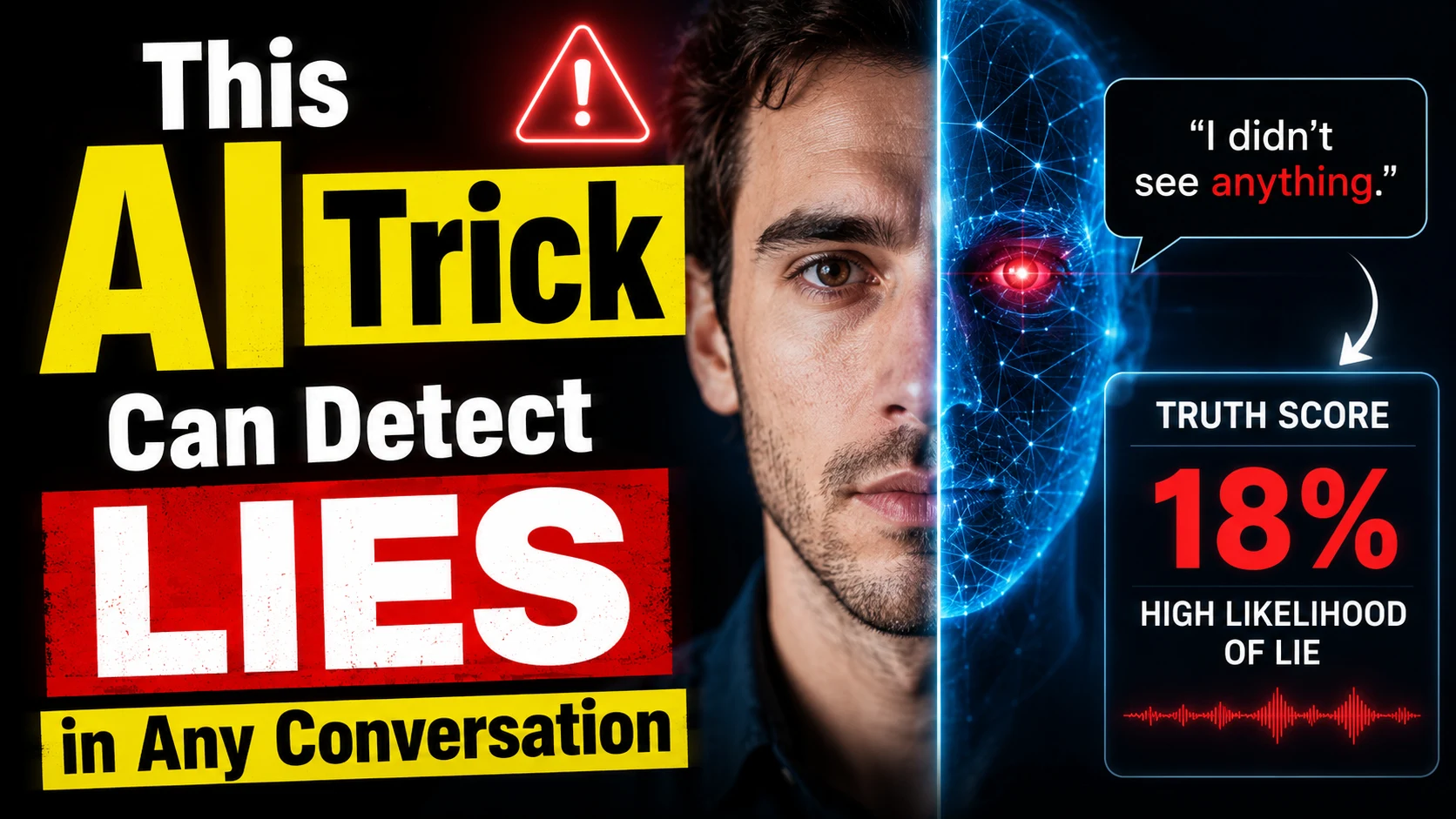
We have all been there—trying to read between the lines of a sketchy text message or staring at a colleague on a Zoom call, wondering if they are actually telling the truth. Science says human beings are terrible lie detectors, operating with the accuracy of a coin flip (about 50 to 54 percent). But what if artificial intelligence could spot deception before you even finish your sentence?
From corporate HR departments to law enforcement interrogations, a new wave of AI-powered deception detection tools is quietly entering the mainstream. By analyzing the subtle biological and linguistic markers that the human brain misses, these algorithms promise to decode truth from fiction. Yet, as the technology accelerates, a critical question remains: is this the ultimate truth machine, or just high-tech pseudoscience?
The “Linguistic Fingerprints” of a Lie
When people lie, the cognitive load on their brain increases, causing them to leave behind tiny, almost imperceptible clues. In text-based communication, AI algorithms act as super-powered language detectives, achieving a purported 75 to 85 percent accuracy rate by scanning for specific linguistic patterns.
When analyzing a conversation, AI looks for several core behavioral markers:
- Distancing Language: Liars often subconsciously distance themselves from their falsehoods. They will drop first-person pronouns like “I” or “my” and use generalized terms instead.
- Over-Complication:A deceptive story is often padded with excessive, unnecessary details to make it sound more convincing.
- Tense Inconsistencies:Liars frequently slip between past and present tense as they struggle to keep their fabricated narrative straight.
Because a machine can process thousands of these textual features simultaneously, it easily outperforms human intuition in controlled environments.
Decoding the Face and Voice
The real frontier of AI lie detection lies in multimodal systems—algorithms that analyze our faces and voices in real-time. Human deception often manifests through involuntary physiological responses that we cannot control.
- Vocal Stress Analysis: Voice has become a primary target for AI analysis. Systems look for frequency instability, micro-tremors, and shifts in harmonics-to-noise ratios.When a person fabricates information, their speech rate may inexplicably slow down as they manage the cognitive load, accompanied by an increase in filler words like “uh” or “um”.
- Facial Micro-Expressions: Deep learning models, particularly Convolutional Neural Networks (CNNs), are being trained to spot transient, involuntary facial muscle movements. These micro-expressions flash across a person’s face in a fraction of a second when they try to repress genuine emotion.
Companies in the fraud detection and customer service sectors are already testing these vocal and facial AI tools to flag potential fraudsters during interactions, giving institutions an automated layer of security.
The Reality Check: Is AI Actually Better?
Despite the futuristic appeal, the scientific community is raising major red flags regarding the accuracy of AI polygraphs.
A recent study led by Michigan State University, which conducted experiments with over 19,000 AI participants, revealed that AI is not yet the infallible lie detector it claims to be. In fact, the researchers found that generative AI often exhibits a “lie bias.” While humans possess a natural “truth bias” (we generally assume people are being honest), AI tends to be hyper-sensitive and overly suspicious, correctly identifying lies but severely failing to recognize truths.In non-interrogation settings, AI’s performance was ultimately no better than human judgment.
Furthermore, researchers at Stanford University have questioned the methodology behind studies claiming near 100 percent accuracy in AI deception detection.Their findings suggest that impressive AI performance is often the result of flawed data testing rather than genuine algorithmic brilliance, warning that current machine learning models may not generalize well in messy, real-world human interactions.
The Bottom Line
AI lie detection is a fascinating intersection of behavioral psychology and machine learning, and its ability to process micro-expressions, vocal pitch, and linguistic patterns is undeniably powerful. However, relying on an algorithm to determine a person’s honesty is currently a risky gamble. The technology is susceptible to biases, contextual misunderstandings, and methodological flaws.
The Takeaway: While AI can be a useful supplementary tool to flag potential inconsistencies in massive datasets or high-stakes interrogations, it should never be the final judge of human character. For now, the most reliable lie detector is still a combination of critical thinking, verifiable evidence, and basic human intuition. Trust the data, but always verify the context.
Also Read I Asked AI to Predict My Future – Here’s What Happened