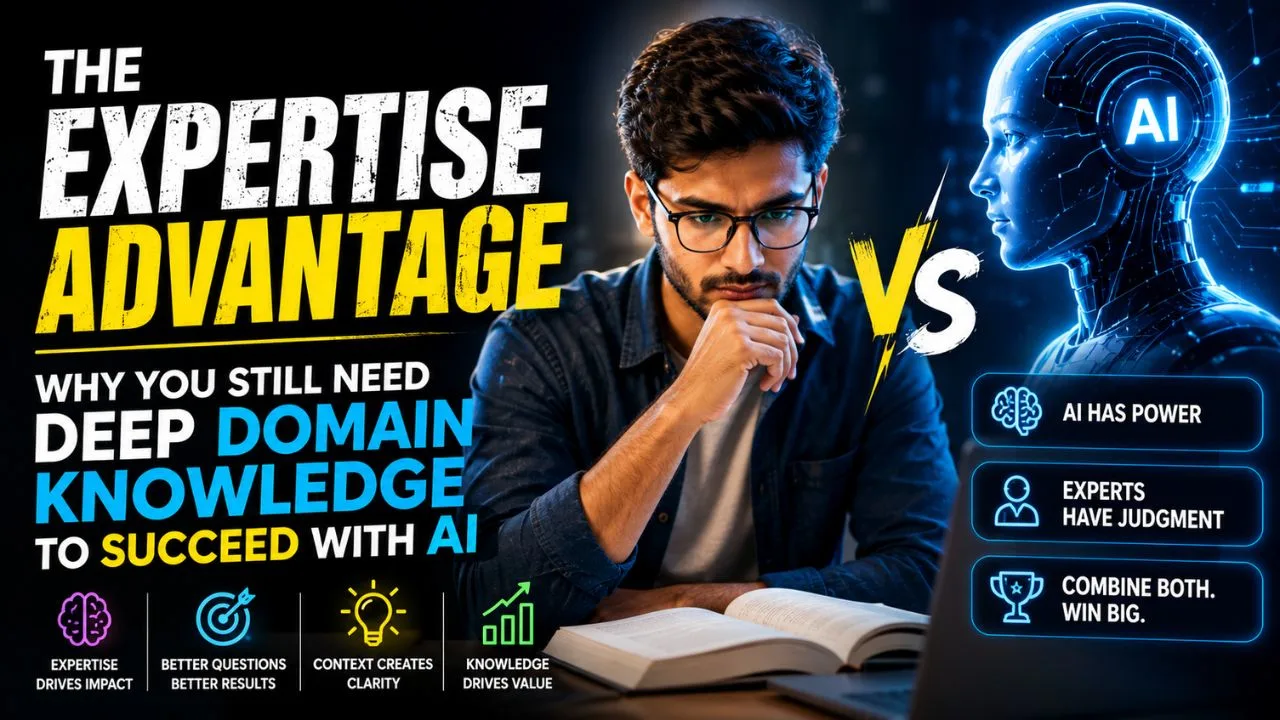
The democratization of artificial intelligence promised to turn every casual user into an instant expert. Yet, as enterprises push past the initial wave of digital adoption, a stark reality is setting in: the more advanced the software, the more vital the human mind guiding it becomes. In the era of algorithmic abundance, raw access to technology is no longer a differentiator—deep domain knowledge is.
Across digital newsrooms, financial institutions, and software firms, the initial euphoria surrounding automated tools is giving way to a more sophisticated conversation. The objective is no longer simply about generating text or lines of code at lightning speed. Instead, the focus has shifted toward systemic reliability, contextual accuracy, and the sharp human oversight required to prevent advanced systems from derailing critical operations.
The Fallacy of the ‘Universal Expert’
It is a seductive premise: feed an enterprise AI platform a single prompt, and out pours a flawless strategy. According to extensive global research from McKinsey, nearly nine in ten organizations have integrated generative AI or machine learning into at least one business function. However, this massive spike in deployment has exposed a profound “AI paradox”. While deploying Large Language Models (LLMs) boosts individual, entry-level productivity, it rarely creates a sustainable, long-term competitive advantage for the corporation on its own.
The limitation lies in the core architecture of general-purpose AI models. They function exceptionally well as broad reasoning engines, but they operate entirely on generalized data clusters. When an employee without specialized subject matter expertise interacts with these systems, the output inevitably defaults to the median. The result is a stream of generic, one-size-fits-all answers that fail to navigate localized constraints, cultural nuances, or industry-specific edge cases.
ALSO READ How Top YouTube Creators Use AI to Craft High-Retention Scripts and Viral Thumbnails
Polished Mistakes: The Risk of Execution Without Understanding
The primary danger of pairing powerful algorithms with an uninitiated workforce is the rapid generation of what computer scientists call “confident, polished mistakes”. AI systems are structurally engineered to deliver an answer under any circumstance, even when they lack sufficient data or context. This dynamic, known as the calibration paradox, results in high-confidence falsehoods or complex hallucinations that sound entirely convincing to the untrained eye.
The Verification Friction: Recent enterprise data indicates that up to 76% of technical professionals frequently encounter automated hallucinations in their workflows, leading to immense hesitancy to deploy scaled AI solutions without rigorous, manual peer review.
Without deep domain knowledge, a professional cannot effectively distinguish between an output that is merely fluent and one that is practically accurate. This vulnerability amplifies across three critical areas:
- The Context Gap: A general AI can summarize a legal document or a financial sheet, but it cannot decipher internal corporate history, legacy software logic, or highly specific regional compliance guidelines.
- Compounding Agentic Errors: In modern agentic AI systems—where multiple autonomous agents execute multi-step chains like calling database APIs and transforming data—a minor contextual error in step two compounds catastrophically by step ten.
- Aesthetic Anonymity: Automated content created without a unique, human-driven hypothesis ultimately reads like digital white noise, running the risk of being penalized by modern search engine quality updates.
How Human Expertise Anchors the Machine
As AI tools spread globally, raw processing capability is rapidly becoming a standard table stake. The corporate moat shifts entirely toward proprietary data foundations and the human capability to govern them. Domain experts are no longer just passive consumers of software; they are the essential architects of the AI content workflow.
True AI success relies on a tight, iterative collaboration between data systems and subject matter experts across the lifecycle of the technology:
- Context Engineering: Constraints make AI reliable. True experts know how to limit the AI’s search space, ground the tool in specific regulatory boundaries, and build semantic layers that anchor the machine’s logic.
- Feature and Data Refinement: Identifying the hidden variables, anomalies, and pertinent connections within highly specialized datasets that a generic algorithm would naturally smooth over or ignore.
- Traceability and Exception Management: Interpreting complex model outcomes, tracking why a particular automated decision was made, and knowing exactly when to intervene and override the machine.
The Takeaway
We are entering the era of the “symbiotic enterprise”—a modern operating model where competitive advantage is unlocked through direct human-AI collaboration. The most valuable professionals in this landscape are not those who focus solely on learning the latest external software wrapper, but those who deeply master the core mechanics, history, and vulnerabilities of their specific industry.
Technology drastically compresses the time it takes to execute a task, but domain knowledge draws the map. To future-proof your career or business, double down on your specialty. Master the nuances, interrogate the anomalies, and build the critical judgment that math alone cannot replicate. The future belongs not to the algorithm, but to the domain expert who commands it.