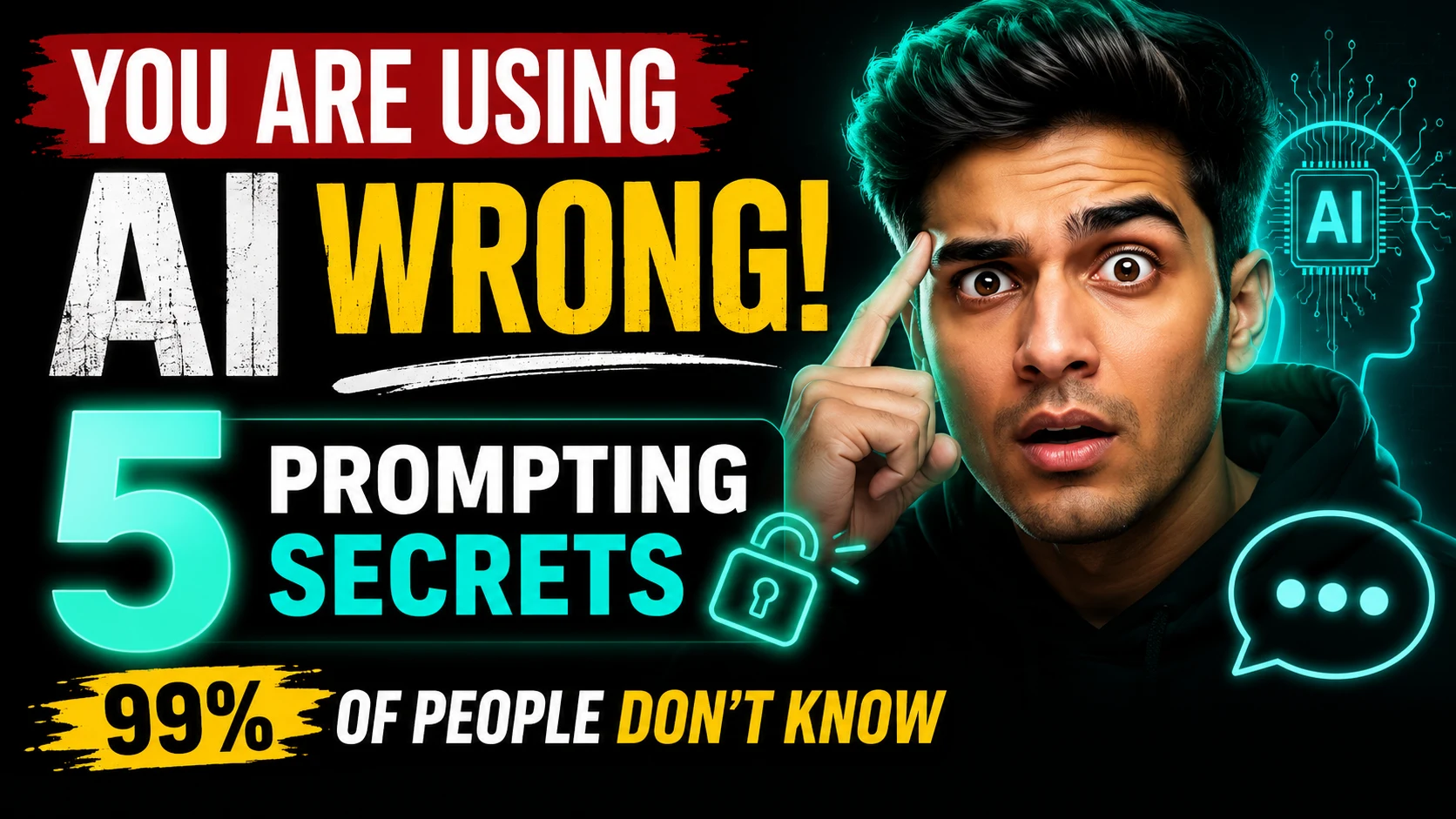
Imagine having the world’s smartest intern at your desk, but only asking them to fetch coffee. That is exactly how most professionals are treating Artificial Intelligence today. We type in a lazy, one-sentence question, get a generic, robotic answer, and mistakenly conclude that the technology is overhyped.
But the problem isn’t the AI—it’s how you are talking to it.
Former head of AI at Tesla, Andrej Karpathy, accurately predicted this shift when he declared, “English is the hottest new programming language”. Today, your ability to communicate effectively with large language models (LLMs) dictates your workplace productivity. A landmark study by Harvard Business School and Boston Consulting Group (BCG) revealed that consultants who used AI effectively completed tasks 25.1% faster and produced work of 40% higher quality than those who didn’t.
If you want those results, you need to stop treating ChatGPT like a Google search bar. Here are five expert prompt engineering secrets that will instantly upgrade your AI outputs from average to exceptional.
1. The ‘Role-Task-Context’ Framework

Most users start with a naked command: “Write an email to my boss about a project delay.” The result is usually a stiff, overly formal apology that sounds like a corporate robot wrote it.
Instead, give the AI an identity and a backdrop. Use the Role-Task-Context structure:
- Role: Who is the AI? (e.g., “Act as a seasoned senior project manager.”)
- Task: What exactly do you need? (e.g., “Write a 150-word email to the department head.”)
- Context: What is the background? (e.g., “We are delayed by two weeks because the vendor shipped the wrong parts. The tone should be professional, solution-oriented, and confident, not defensive.”)
By assigning a persona, you immediately filter out generic responses and force the AI to adopt the specific vocabulary and perspective of an expert.
2. Chain-of-Thought Prompting (Don’t Rush the Machine)
When you ask generative AI to solve a complex problem in one go, it often hallucinates or skips critical logical steps. The secret fix? Force it to think out loud.
This technique, known in AI research as Chain-of-Thought prompting, dramatically improves reasoning. You simply add a phrase like:
“Think about this step-by-step before providing the final answer.”
If you are asking for a marketing strategy or a coding solution, having the AI break down its logic phase-by-phase ensures it doesn’t just spit out a trendy buzzword salad. It mimics human reasoning, allowing you to catch errors and understand how it arrived at its conclusion.
3. The Power of Negative Constraints
We are used to telling computers what we want them to do. But with AI, telling it what not to do is just as crucial. LLMs are eager to please and tend to overwrite, over-explain, or rely on tiresome clichés.
You can instantly clean up your output by adding negative constraints at the end of your prompt. For example:
- “Do not use words like synergy, delve, paradigm, or revolutionize.“
- “Do not include an introductory or concluding summary.”
- “Do not use bullet points; write in continuous prose.”
Setting strict boundaries narrows the AI’s creative runway, forcing it to deliver a more focused, natural-sounding, and human response.
4. Few-Shot Prompting (Show, Don’t Just Tell)
If you want the AI to format a report exactly how your company likes it, or write a social media caption in your specific brand voice, instructions aren’t enough. You need to provide concrete examples.
Few-shot prompting means giving the AI two to three examples of the desired output before asking it to execute the task.
- Example 1: [Insert a good headline and its corresponding tweet]
- Example 2: [Insert another good headline and tweet]
- Prompt: “Now, using the exact same style, tone, and formatting as the examples above, write a tweet for this new headline: [Insert Text].”
This drastically reduces the back-and-forth editing process because the AI has a definitive template to mimic.
5. The ‘Iterative Pushback’ Technique
The biggest mistake beginners make is accepting the first answer the AI generates. The magic of AI lies in iteration. Treat the first output as a rough draft, not a final product.
If the AI gives you a mediocre response, push back critically:
- “This is too wordy. Cut it down by 30% and make the tone punchier.”
- “You missed the point about the budget constraints. Rewrite this focusing strictly on cost-saving measures.”
- “Play devil’s advocate. What are the three biggest flaws in the argument you just presented?”
Top-tier prompt engineers treat AI like a collaborative brainstorming partner. They challenge the machine, ask for revisions, and relentlessly refine the output until it is perfect.
The Bottom Line
The era of typing a few words and hoping for a miracle is over. Generative AI is incredibly powerful, but it remains a mirror of your instructions. Vague prompts yield vague results. Precise, structured, and context-rich prompts unlock a level of productivity that can genuinely transform your career.
Your Next Step: Pick one task you do every week—whether it is writing a weekly report, drafting client emails, or brainstorming content. Apply the Role-Task-Context framework to it today. You will never look at an AI chatbox the same way again.
Also Read 5 AI Resume Builders Guaranteed to Get You Past Tech Interview Filters