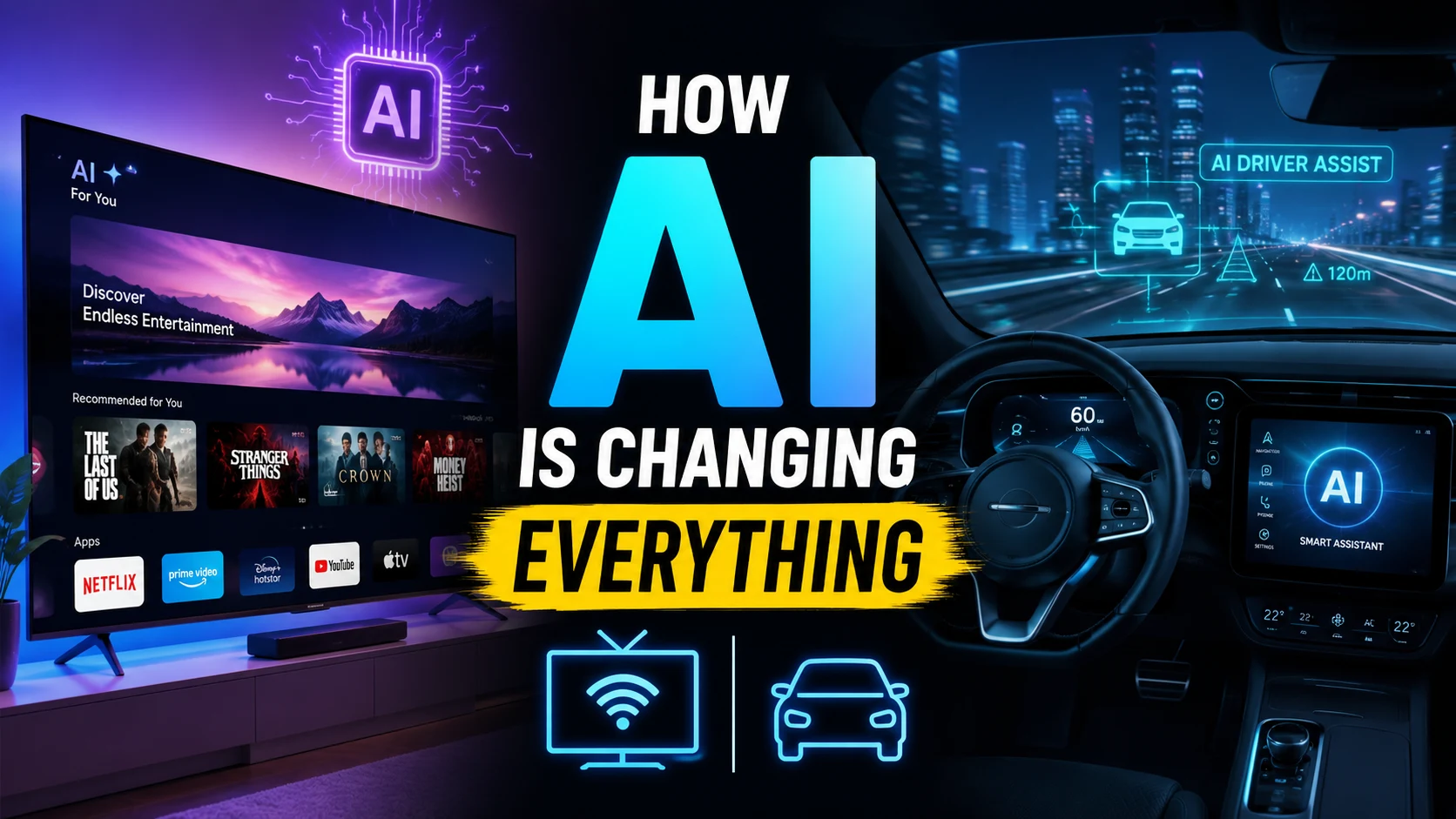
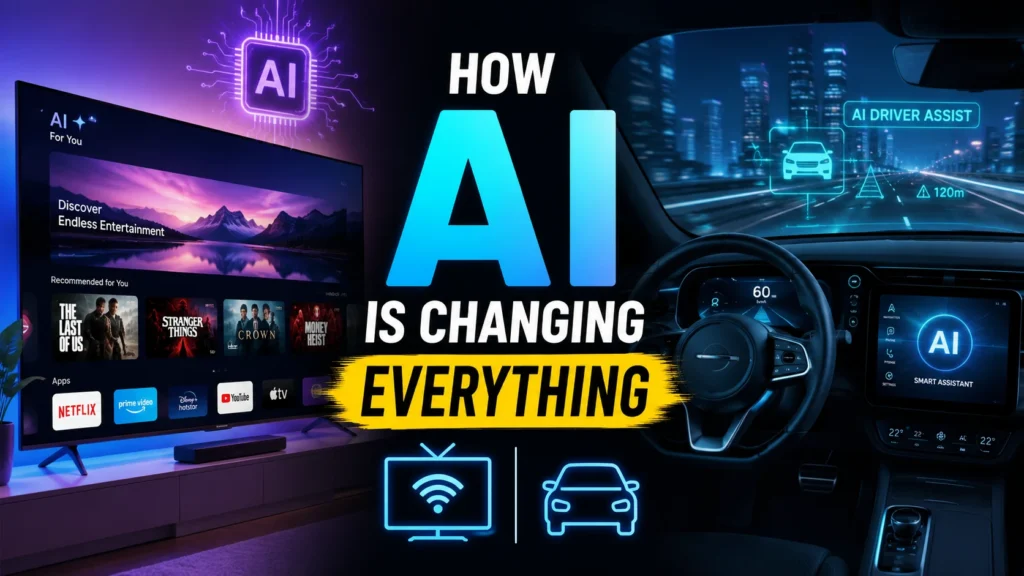
The screens in our living rooms and the cars in our driveways are no longer just hardware—they are rapidly evolving into intelligent, proactive companions. Driven by massive leaps in generative AI, the tech industry in 2026 has shifted its focus from raw specs to hyper-personalized, context-aware experiences. Whether you are navigating a busy highway or settling in for a movie marathon, artificial intelligence is fundamentally rewriting how we interact with our most prized machines.
For years, “AI” in consumer tech was little more than a marketing buzzword used to describe basic voice commands or simple algorithms. Today, the integration of Large Language Models (LLMs) and advanced neural networks is turning smart TVs into digital concierges and automobiles into software-defined vehicles (SDVs).
Here is a closer look at how AI in Smart TVs and generative AI in automobiles are transforming the consumer landscape this year.
The Living Room Revolution: Smart TVs Get a ‘Brain’
If you think the latest smart TV tech is just about cramming more pixels onto a screen, think again. The battleground for top-tier electronics giants like Samsung, LG, and Sony has officially moved to AI processing.
Rather than simply displaying an image, modern TVs now analyze, upscale, and completely reconstruct content in real-time. For instance, Samsung’s 2026 Vision AI TV lineup utilizes a processor packed with 128 AI neural networks. This allows the television to understand exactly what you are watching and dynamically adapt the environment.
Here is how smart TV tech in 2026 is elevating the viewing experience:
- Context-Aware Picture & Audio: Features like “AI Football Mode Pro” instantly recognize live sports, automatically sharpening fast-moving players and boosting the volume of the stadium crowd while isolating the commentator’s voice.
- Generative AI Companions: TVs are becoming central hubs for daily life. Premium 2026 screens are integrating advanced AI agents—including Microsoft Copilot and Perplexity—directly into their operating systems. You can pause a movie and ask your TV to identify an actor, summarize a plot, or even order food, all via natural conversational prompts.
- Real-Time Upscaling: AI engines can take standard HD broadcasts and digitally restore lost textures, making decades-old movies look like they were natively shot in 4K or 8K.
Cars That Think, Talk, and Anticipate
While TVs are mastering entertainment, the automotive industry is using automotive AI to overhaul driver safety, comfort, and digital interaction. The traditional dashboard is dead; the “agentic cockpit” has arrived.
Automakers have realized that clicking through clunky touchscreen menus while driving at 70 mph is dangerous. The solution? Highly advanced, conversational AI that understands natural language and driver intent.
- Conversational Co-Pilots: Volkswagen, which integrated ChatGPT into its fleets as early as 2024, is heavily leaning into its “agentic AI roadmap” for 2026, utilizing systems like Cerence Chat Pro. Drivers can ask complex questions, request route optimization, or troubleshoot vehicle issues without looking away from the road.
- Predictive Maintenance: Through digital twins and connected-car analytics, your vehicle now knows when a part is going to fail before it actually breaks. AI analyzes driving habits and component wear, proactively scheduling service appointments to save you from sudden breakdowns.
- Hyper-Personalization: BMW and Mercedes-Benz are utilizing AI to learn your daily routines. In 2026, a connected car will automatically adjust the ambient lighting, prep the cabin temperature, and map out your preferred commute before you even buckle your seatbelt.
The Shift to “Edge AI”: Faster, Safer, and Private
One of the most critical trends bridging both AI in connected cars and smart TVs this year is the shift from cloud processing to “Edge AI.”
Historically, asking a voice assistant a question required beaming data to a cloud server, waiting for it to process, and bouncing it back. This caused frustrating lag and raised valid privacy concerns. In 2026, tech leaders are moving the AI directly onto the device’s hardware.
In April 2026, Mercedes-Benz announced a groundbreaking partnership with Liquid AI to deploy embedded “Liquid Foundation Models” into their vehicles. This allows the car’s AI to process speech, reasoning, and context entirely offline. The result is zero latency, continuous operation in internet dead zones, and total data privacy for the driver.
What This Means for Consumers
The line between hardware and software is officially blurring. When you buy a smart TV or a car today, you aren’t just buying a static product—you are buying a digital ecosystem that will learn, adapt, and improve itself over time. Generative AI has made our devices more intuitive and significantly less frustrating to use.
As we move deeper into the AI era, the ultimate luxury will no longer be how fast a car can drive or how bright a screen can get, but how seamlessly these machines can understand us.
Over to you: Are you ready to let a generative AI assistant take control of your dashboard, or do you prefer the old-school tactile feel of buttons and dials? Drop your thoughts in the comments below, and subscribe to our tech newsletter for the latest updates on the AI revolution.
Also Read Don’t Buy a Laptop Without This AI Chip in 2026 (Here’s Why)