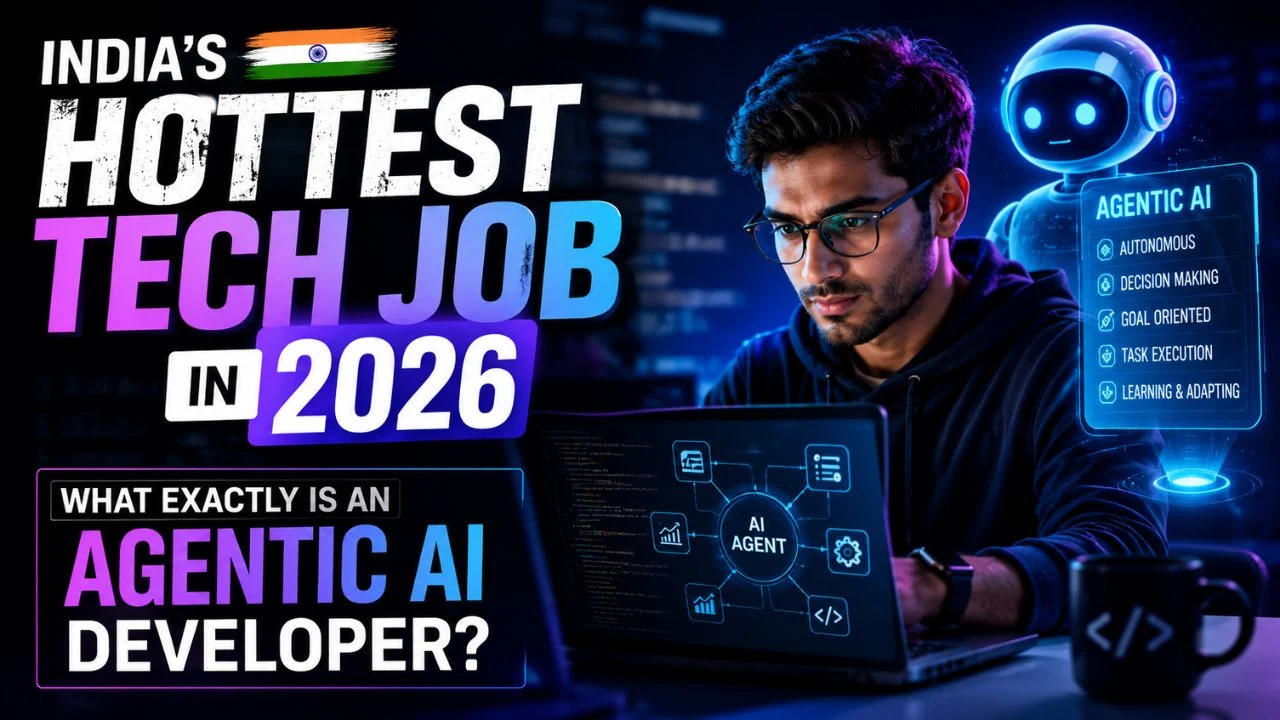
The Indian tech landscape is undergoing a massive structural shift. Forget traditional prompt engineering or the resource-heavy race to build massive Large Language Models (LLMs) from scratch; the engineering market has moved to a new, highly practical frontier. “Agentic AI Developer” has emerged as India’s fastest-growing tech job title in 2026, driven by intense enterprise demand for autonomous systems that can think, plan, and execute multi-step workflows independently.
As businesses pivot from static chatbots to autonomous workflows, the demand for developers who can orchestrate these intelligent agents has spiked dramatically. But what exactly does this role entail, what are companies paying, and is it sustainable or just another layer of tech hype?
What is an Agentic AI Developer?
Unlike traditional Machine Learning (ML) engineers who spend months training or fine-tuning foundation models, an Agentic AI Developer focuses on building production-grade autonomous pipelines and systems. They design AI “agents” that don’t just generate text, but actively interact with the digital world—calling APIs, managing short- and long-term memory, and collaborating with other AI agents to solve complex business problems.
A representative job description for a Senior Agentic AI Engineer from recent corporate postings illustrates the scope perfectly. Responsibilities typically include designing multi-agent orchestration frameworks, building hybrid retrieval-augmented generation (RAG) and knowledge-graph architectures, and implementing rigorous evaluation and monitoring systems to ensure the agents do not hallucinate or malfunction.
Why the Role is Exploding in India
The hiring numbers tell a compelling story. Data from prominent job platforms including Indeed, Glassdoor, and Internshala reveal thousands of active agentic AI openings across India.
Hiring Growth for Agentic AI Roles (Mid-2026 YoY Analysis):
[██████████████████████████████] +260%
A mid-2026 talent market analysis by Quess found that hiring growth for agentic AI developers surged by roughly 260% year-on-year among all specialized AI roles.
This hiring boom is primarily driven by industrial adoption. According to the EY Agentic AI in India: The AIdea of India 2026 report, large-scale deployment is accelerating across Banking, Financial Services, and Insurance (BFSI), SaaS, education tech, and customer service automation.
ALSO READ From Copilots to Colleagues: Why 2026 is the Year of Agentic AI and Autonomous Digital Workers
The Compensation Landscape
Salaries for these roles reflect the supply-demand mismatch. While entry-level pay varies widely depending on the candidate’s core software engineering foundations, market listings show typical starting packages ranging between ₹8–12 LPA. For senior engineers and AI architects capable of deploying resilient multi-agent infrastructure, compensation scales substantially higher, frequently crossing premium tiers depending on the organization.
The Toolkit: What Employers Actually Want
Job postings from technology firms and automation consulting agencies like Sutherland highlight a very specific, integration-first tech stack. Employers prioritize practical engineering over theoretical research.
- Languages & Orchestration: Deep proficiency in Python, alongside hands-on experience with agentic frameworks like LangChain, LangGraph, and CrewAI.
- Data & Memory Architecture: Mastery of vector databases (such as Pinecone, Milvus, or Qdrant) and advanced RAG pipelines to give agents a reliable semantic memory.
- Infrastructure & MLOps: Experience with cloud environments, API tool-calling orchestration, and container deployments using Kubernetes.
- Evaluation Frameworks: Setting up guardrails and testing environments (like TruLens or Ragas) to evaluate agent safety and reliability before production.
The Reality Check: Hype vs. Production Risks
Despite the corporate enthusiasm, industry analysts urge caution. The transition from a neat tech demo to a stable, revenue-generating product is notoriously difficult for agentic systems.
Enterprise Core Traction  <=============>  Consumer-Facing Scale
(High adoption in BFSI/SaaS)               (Friction: Monetization & Cost)
Market analysts note that while enterprise adoption remains robust due to predictable internal data environments, consumer-facing agentic products in India face severe scale and monetization friction. Running continuous multi-agent loops incurs heavy API token costs, and consumer willingness to pay a premium remains low.
Furthermore, legal and regulatory experts warn that data privacy, compliance frameworks, and safety liability for autonomous actions taken by AI agents remain deeply unsettled under current Indian digital regulations.
A Balanced View of the Agentic AI Surge
The Pros:
- Immediate Employability: The focus on practical integration means software engineers can transition into these roles faster than traditional ML research tracks.
- High Business Value: Deployed agents drastically reduce operational costs in industries heavily reliant on multi-step workflows, ensuring sustained corporate budgets.
The Cons:
- Market Volatility: Many early-stage AI startups are still actively searching for repeatable product-market fit, making some roles vulnerable to shifts in venture capital funding.
- High Interdisciplinary Demand: The position requires a scarce mix of traditional software architecture, infrastructure engineering, and cognitive psychology-style prompt engineering.
The Career Roadmap: How to Transition
For Indian software developers looking to pivot, industry learning guides and university tech blogs (such as recent curriculum analyses from IIT Kharagpur and Edzor) suggest a systematic transition path:
- Solidify System Design: Learn how to design asynchronous systems; agentic AI functions similarly to microservices that communicate via APIs.
- Master Context & Search: Move beyond basic keyword searches. Understand how a vector database indexes information and how hybrid search pairs with RAG.
- Build Safe-Fail Systems: Focus heavily on error-handling. An autonomous agent needs to know what to do when an external API fails or returns a corrupted response.
Final Takeaway for the Indian Tech Professional
The rise of the Agentic AI Developer in 2026 confirms that the AI revolution has moved out of experimental research labs and directly into the corporate engine room. While the hype surrounding fully autonomous digital entities requires a healthy dose of skepticism, the demand for engineers who can construct reliable, tool-using automation pipelines is undeniably real.
If you are a developer or an engineering student, now is the time to build. Stop focusing solely on how to prompt an LLM; instead, start building the infrastructure that allows multiple LLMs to work safely, talk to databases, and solve real-world problems.
Methodology Note: The insights in this article are synthesized from open job listings and corporate JDs across Indeed, Glassdoor, and Internshala, economic hiring reports from Quess (mid-2026), enterprise automation analyses from EY India, and educational tech roadmaps published between late 2025 and mid-2026.
Take the Next Step
Are you planning to transition into an AI role this year? Explore open-source multi-agent frameworks like LangGraph or CrewAI today, and build your first local tool-calling agent to stay ahead of the hiring curve.