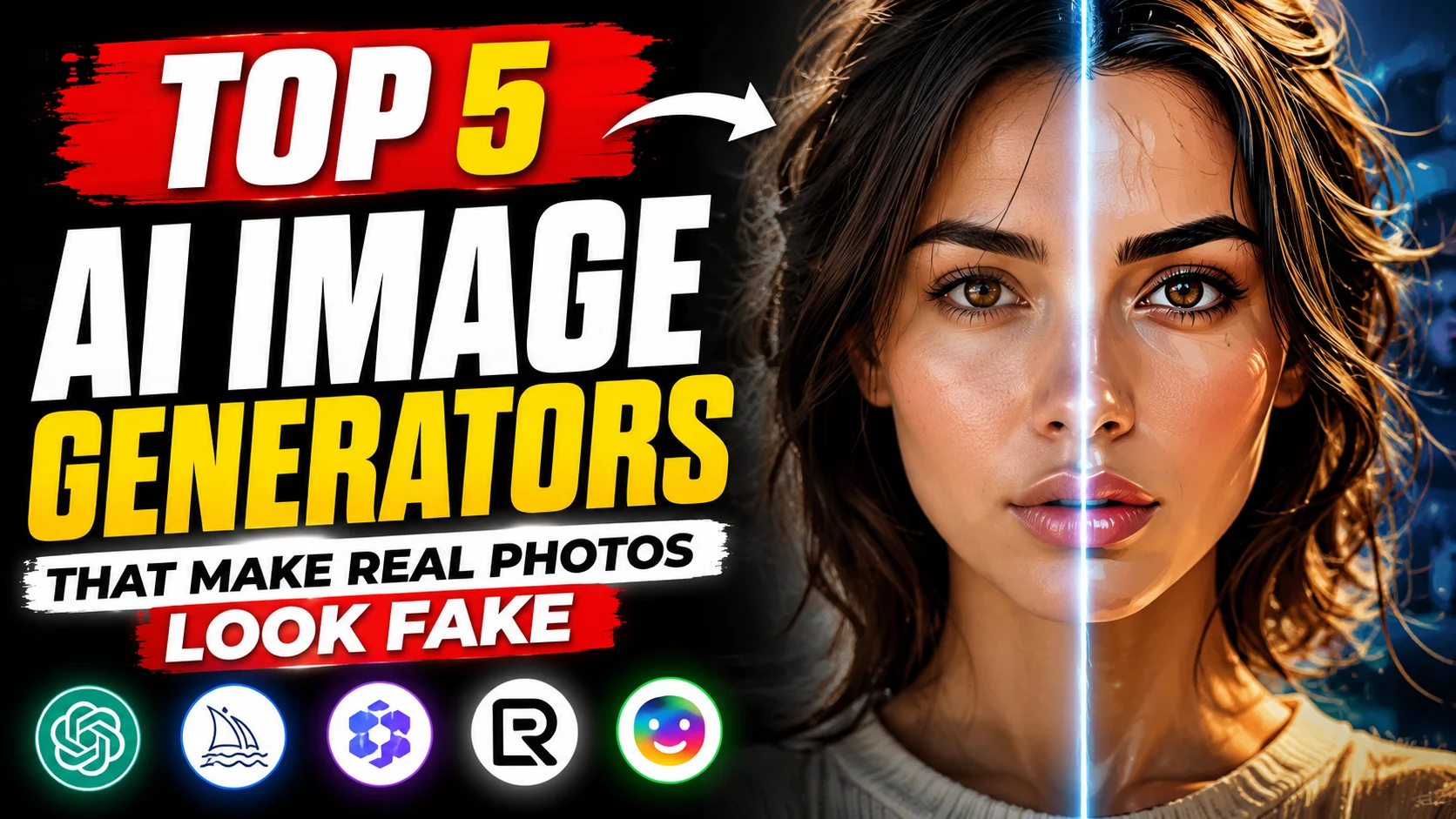
The era of “spot the extra finger” is officially over. Today’s artificial intelligence doesn’t just mimic photography; it surpasses it, rendering scenes with such hyper-realistic perfection that actual camera shots are starting to look flawed by comparison. If you’re still blindly trusting your eyes online, these five powerhouse AI image generators are about to permanently alter your perception of reality.
In the fast-paced world of digital media and content creation, generative AI has evolved from a quirky novelty into an enterprise-grade necessity. We are no longer dealing with the surreal, warped, and easily identifiable outputs of 2023. The latest foundational models are trained on unprecedented datasets, employing advanced physics-awareness and highly nuanced text rendering. They can flawlessly replicate cinematic film stock, mimic the exact focal length of a 50mm DSLR lens, and generate micro-expressions that completely bypass our innate human radar for the “uncanny valley.”
As the boundary between physical photography and synthetic rendering dissolves, a new tier of AI tools has emerged to dominate the market. Here is a definitive look at the top five AI image generators of 2026 that are making reality look like a rough draft.
1. Midjourney v7: The Cinematic Aesthete
Midjourney has long been the darling of digital artists, but the release of version 7 has pushed its capabilities into terrifyingly realistic territory. Moving past its clunky Discord-only origins, Midjourney now boasts a highly polished web interface and remains the undisputed king of aesthetic quality.
- The Reality Hack: Midjourney doesn’t just generate faces; it crafts soulful lighting, micro-textures in human skin, and a cinematic depth of field that rivals high-end studio photography.
- Why it Fools Us: It perfectly mimics the subtle imperfections of physical camera lenses, such as authentic film grain and chromatic aberration.
- Pricing: Starts at $10 per month, with a new Draft Mode that iterates ideas 10x faster at half the computational cost.
2. Google Imagen 4 (Gemini): The Physics-Aware Powerhouse
Google’s Imagen 4 model—which powers the consumer-facing Gemini ecosystem—has quietly become a titan of photorealism. Unlike earlier AI systems that struggled with spatial logic, Imagen 4 is engineered to be “physics-aware”.
- The Reality Hack: It natively understands how gravity affects different fabrics, how light refracts through a glass of water, and how shadows accurately fall across complex, multi-subject scenes.
- Why it Fools Us: It renders flawless 4K resolution natively in under 10 seconds and can seamlessly embed multilingual text—like Arabic street signs or Chinese menus—into realistic environments without garbling the characters.
- Best For: Enterprise users in the Google ecosystem and marketers needing dynamic, physically accurate product photography.
3. FLUX.1 Pro: The Uncensored Documentarian
Developed by Black Forest Labs (the original architects behind Stable Diffusion), FLUX.1 Pro is the dark horse of the 2026 AI race. It offers unparalleled open-weight customization and operates without the heavy-handed, hyper-polished aesthetic filters that make some AI images look a bit “too perfect”.
- The Reality Hack: FLUX excels at the mundane. It generates cluttered desks, asymmetrical faces, and casual smartphone-style lighting so accurately that the outputs look like they were pulled straight from an everyday iPhone camera roll.
- Why it Fools Us: Its lack of strict stylistic guardrails allows for gritty, documentary-style street photography that feels inherently raw and authentic.
- Accessibility: Available via cloud API (pay-per-image) or can be run entirely locally on consumer hardware for ultimate privacy.
4. GPT Image 2 (OpenAI): The Detail Obsessive
OpenAI’s latest integration into ChatGPT, GPT Image 2, has transformed complex prompt engineering into a fluid, natural conversation. You no longer need to be a coding wizard to achieve photorealism; you simply collaborate with the artificial intelligence.
- The Reality Hack: Users can refine realistic renders conversationally. Simply asking the AI to “make the afternoon sunlight warmer,” “move the subject slightly to the left,” or “add a subtle reflection in the window” works flawlessly.
- Why it Fools Us: The sheer volume of photorealistic detail, proper lighting geometry, and nuanced understanding of artistic styles makes these renders practically indistinguishable from premium commercial stock photography.
- Cost: API costs hover around $0.04 to $0.08 per image, making it highly scalable for professional mockups and brand assets.
5. Ideogram v3: The Typography Illusionist
Historically, accurately rendering text was the Achilles’ heel of artificial intelligence. Ideogram v3 has completely eliminated this hurdle, outperforming every other general model on typography.
- The Reality Hack: While older models still occasionally produce alien hieroglyphics, Ideogram perfectly integrates sharp, legible text into real-world, tactile textures.
- Why it Fools Us: When the human eye sees a photorealistic neon sign, a weathered billboard, or a perfectly printed vintage t-shirt, our brains automatically assume the underlying photo is real. Ideogram leverages this cognitive bias perfectly.
- Best For: Marketers, social media managers, and graphic designers who require flawless text integrated directly into highly realistic visuals.
The Takeaway: Navigating a Post-Truth Visual World
The rapid evolution of these top AI image generators proves that photography is no longer just a medium of capturing light—it is now a medium of programmable code. As tools like Midjourney v7 and Google Imagen 4 make synthetic media cheaper, faster, and more beautiful than traditional photography, the burden of visual truth shifts entirely to the viewer.
Call to Action: As professionals and digital consumers, we must adapt to this new normal. Don’t just consume visual media passively; scrutinize the context, trace the source, and start experimenting with these generative AI platforms yourself. Understanding how the digital illusion is crafted is the only real way to avoid being fooled by it in the wild.
Also Read 3 Banned AI Tools You Weren’t Supposed to Know About