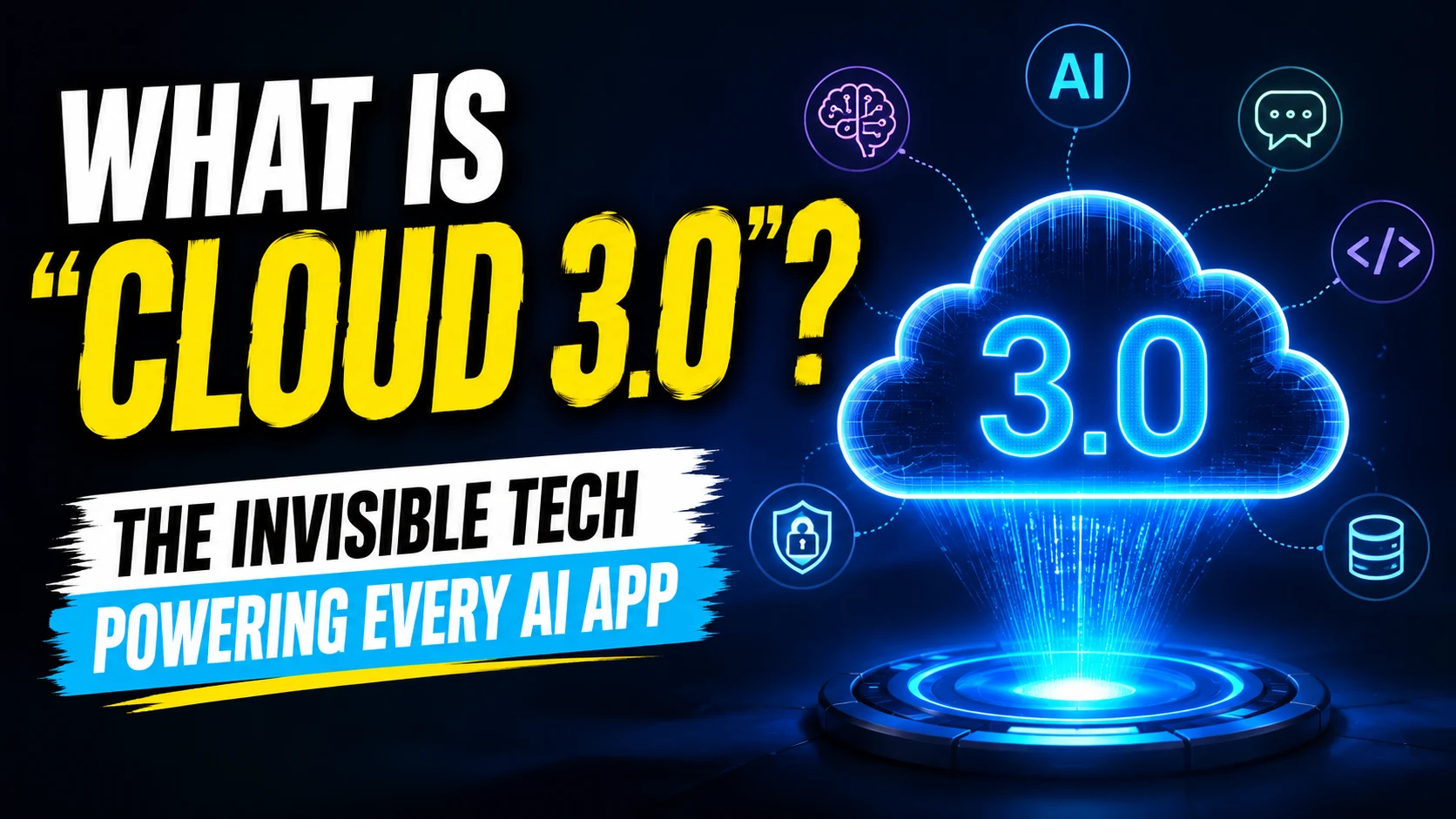
Every time you generate a hyper-realistic image, ask a chatbot to write complex code, or rely on a smart system for real-time analytics, you are tapping into a digital nervous system most people don’t even know exists. The artificial intelligence revolution didn’t just change software—it fundamentally broke the internet’s underlying infrastructure, forcing a massive, invisible upgrade. Welcome to Cloud 3.0: the intelligent, self-optimizing engine quietly powering the global AI boom.
If you think the cloud is just a giant hard drive in the sky where you back up your photos, it is time to update your mental model. Here is an inside look at how Cloud 3.0 is reshaping the internet, enterprise architecture, and the future of technology.
From Storage to Brainpower: The Cloud Computing Evolution
To understand the magnitude of Cloud 3.0, we have to look at how we got here. Technology conceptualizes cloud evolution in three distinct phases:
- Cloud 1.0 (The Infrastructure Era): Born in the mid-2000s, this era was simply about “renting servers.” Companies moved their data from physical basement server rooms to virtual machines hosted by giants like Amazon Web Services (AWS).
- Cloud 2.0 (The Platform Era): This phase was obsessed with speed and scalability. Developers embraced containers, microservices, and platforms like Kubernetes to build and deploy applications faster than ever before.
- Cloud 3.0 (The Intelligence Era): If 2.0 was about deploying apps faster, 3.0 is about letting the cloud manage its own complexity. Cloud 3.0 is an AI-native ecosystem where infrastructure isn’t just a passive host; it is an active, self-aware participant that thinks, learns, and adapts in real time.
Why AI Broke the Old Cloud
Why was a new cloud architecture necessary? The short answer: Artificial Intelligence is a resource-hungry beast.
Standard web applications run perfectly fine on traditional Central Processing Units (CPUs) and predictable network environments. AI workloads, however, are fundamentally different. Training large language models (LLMs) requires massive clusters of Graphics Processing Units (GPUs) and generates petabytes of data.
Under the Cloud 2.0 model, transferring such colossal amounts of data across regions to central servers became too slow, too expensive, and often violated strict data sovereignty laws.
Cloud 3.0 solves this “data gravity” problem. Instead of forcing petabytes of data to travel to a centralized compute hub, Cloud 3.0 pushes the compute power directly to where the data lives—whether that is in a localized data center, a multi-cloud environment, or at the “edge” (devices operating in the real world).
The Core Pillars of Cloud 3.0
This next-generation infrastructure isn’t just a buzzword. It is built on tangible, cutting-edge technologies.
- AI-Driven Automation (AIOps): Cloud 3.0 systems use machine learning to manage themselves. They can predict server failures before they happen, automatically heal broken nodes, and optimize costs in real time without human intervention.
- Distributed and Edge Intelligence: Data is processed closer to its source. For example, sensors in an autonomous vehicle or a smart factory can analyze data and react in milliseconds, bypassing the latency of sending information to a distant server.
- Data Fabric Over Data Lakes: Rather than dumping all data into a single, massive repository, Cloud 3.0 uses a “data fabric”. This allows AI applications to seamlessly query and unify data spread across AWS, Azure, and private servers as if it were all in one room.
- Zero-Trust Security Built-In: In a highly distributed network, security cannot be an afterthought. Cloud 3.0 embeds AI-powered threat detection and policy-as-code natively into the infrastructure.
Real-World Impact: Who is Winning the Race?
The race to dominate the Cloud 3.0 landscape has sparked a massive capital expenditure war among tech titans. Hyperscalers like Microsoft Azure, Google Cloud, and AWS are rapidly rebuilding their data centers to accommodate AI-ready infrastructure.
At the hardware level, the shift is staggering. We are witnessing the rise of purpose-built AI storage and memory systems—such as WEKA’s ultra-dense AI infrastructure, which slashes energy consumption while delivering exabytes of capacity in a single rack. Traditional data centers are being retrofitted with liquid cooling systems just to keep advanced AI microchips from melting under the extreme computational load.
The enterprise adoption rate is equally aggressive. Analysts predict that by 2030, the vast majority of businesses will rely on AI agents for primary tasks, a reality that is mathematically impossible without Cloud 3.0 architecture.
What This Means for You (and Your Business)
For consumers, Cloud 3.0 means faster, smarter, and more personalized digital experiences with near-zero lag. For IT leaders, it means the end of manual server management and the beginning of “intent-driven” computing—where developers simply tell the cloud what outcome they want, and the AI handles the deployment, scaling, and security automatically.
However, this transition requires a massive skills shift. IT professionals must evolve from system administrators to cloud architects who understand machine learning orchestration and multi-cloud environments.
The Takeaway: We have officially moved past the era of the cloud as a digital storage unit. Cloud 3.0 is a living, breathing digital nervous system. If your company is still treating its cloud strategy as a simple IT hosting decision rather than an AI-driven business imperative, you aren’t just falling behind—you are already operating in the past.
Are you ready to audit your organization’s cloud maturity? Start today by evaluating how much manual intervention your infrastructure currently requires, and ask your engineering team if they are building for the intelligence era.
Also Read 3 Banned AI Tools You Weren’t Supposed to Know About